


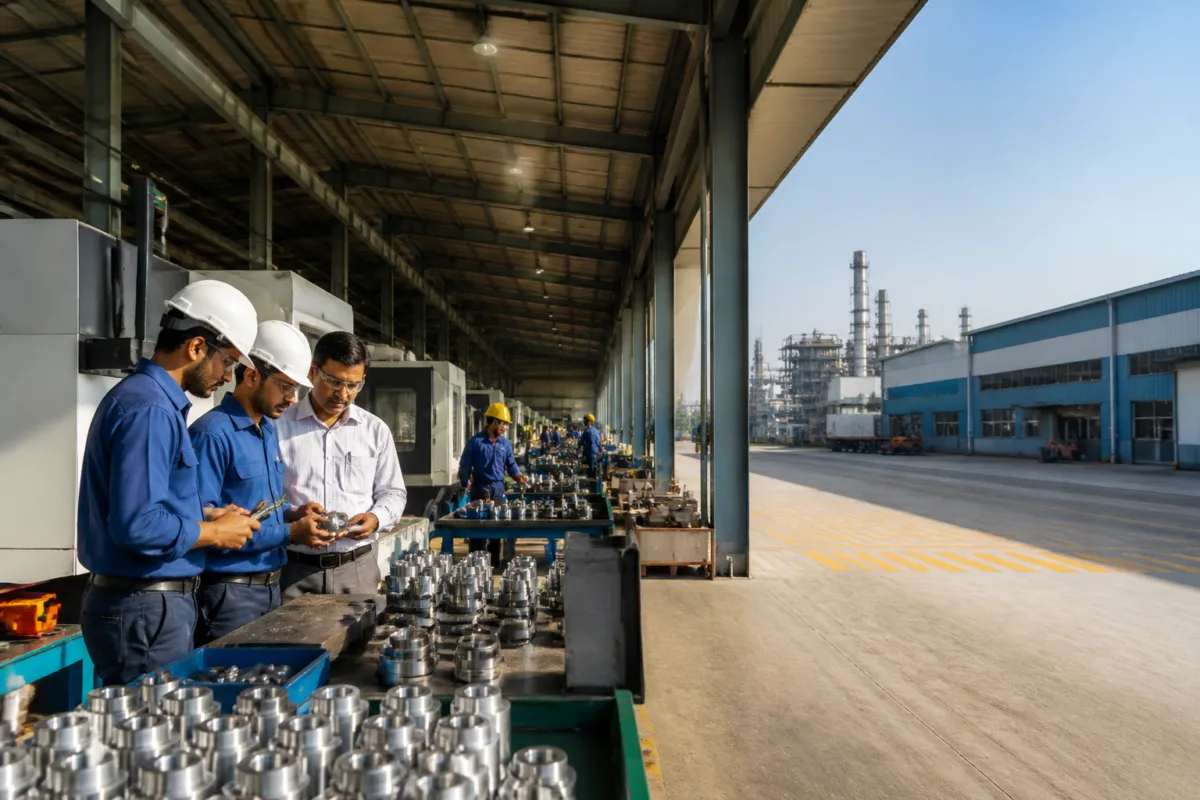
Norwest’s decision to direct a major part of its India strategy towards value-added manufacturing is more than a private-equity investment signal. It reflects a wider change in how India is positioning its industrial economy: not simply as a lower-cost alternative for routine production, but as a location for quality-sensitive products, precision components and long-term global supply relationships. That shift will place new demands on industrial land, factory infrastructure, logistics, skills and the cities that support manufacturing businesses.
The US-based multi-stage investment firm announced the closure of a $4 billion fund covering India, the United States and Israel. Speaking about its India strategy, Niren Shah, managing director and head of Norwest India, said the firm invests between $30 million and $150 million in growth capital, with a preferred investment size of around $75 million. The firm has identified value-added manufacturing and the manufacturing services supporting it as an area that could outperform.
The significance lies in the type of companies Norwest is targeting. According to Shah, India’s manufacturing opportunity is moving away from the earlier model in which companies were primarily chosen for cost advantages and routine production. He said Indian companies are now making products that meet global quality standards, while supply chains are seeking alternatives to dependence on China. The report said Indian companies are entering into five- to eight-year agreements with global companies that commit to procuring from India because of product quality.
Long-term procurement agreements can change the development path of a manufacturing company. A business with predictable demand can invest in machinery, expand production space, hire specialised employees and build the compliance and quality systems required by large original equipment manufacturers. It can also plan capacity over several years rather than operate around short-term orders.
That matters for cities because manufacturing growth is not limited to the factory gate. Industrial expansion requires serviced land, reliable power, transport links, warehousing, worker housing and access to technical talent. The source report does not identify particular cities, industrial corridors or facility locations linked to Norwest’s strategy. It does, however, describe a group of established family-run companies that have spent a decade moving from one component to another and learning to serve multiple original equipment manufacturers.
These businesses represent a different industrial development challenge from attracting a new greenfield plant. They already possess production knowledge and customer relationships, but may need capital and institutional support to expand faster. Shah said such companies want to bring in new talent, build new manufacturing facilities and receive help in approaching potential original equipment manufacturers in the United States. The implication is that the next stage of industrial growth may depend as much on scaling existing businesses as on announcing entirely new projects.
The economics described by Norwest also point to a maturing segment. Shah referred to precision-component and engineering companies offering high returns on capital employed and strong earnings before interest, taxes, depreciation and amortisation margins after being built over time. These are not necessarily businesses created around a single large investment announcement. They are companies that have gradually accumulated capabilities and are now reaching a scale at which institutional capital can accelerate expansion.
Government policy is another part of the investment case. Shah cited policy support, including goods and services tax cuts, as a factor that has helped manufacturing. The report does not specify which GST reductions he was referring to or quantify their effect on individual companies. It does establish, however, that investors are assessing manufacturing performance through a combination of company-level capability and the policy environment in which supply chains operate.
For urban administrators, this distinction is important. Industrial policy often focuses on incentives, approvals and capital investment, while the physical requirements of manufacturing are handled across multiple agencies. A company expanding production may need land-use permissions, utility connections, road access, logistics capacity, worker transport and faster coordination with local authorities. If those systems do not expand at the same pace as factory capacity, investment can produce bottlenecks rather than productivity gains.
Norwest’s investment model is also relevant to how industrial clusters evolve. Shah said around half of the companies in which the firm has invested are family-run, with multiple family members involved, and that Norwest typically invests when a business is already profitable. These companies seek between $40 million and $100 million and may want support in preparing for a public listing within four years. Norwest begins considering an exit after five to seven years in growth-capital investments.
This approach places the firm in the middle of a transition from entrepreneurial ownership to professionally managed scale. For manufacturing companies, that transition can involve formalising management, recruiting specialist talent, improving financial reporting and making the business capable of serving more customers. It can also change the spatial footprint of the company, particularly when growth requires new facilities rather than only additional equipment inside an existing plant.
The larger question is whether India’s cities and industrial regions are prepared for this form of expansion. The source material provides no figures on the number of jobs, factories, land parcels or infrastructure projects expected to result from Norwest’s new fund. It also does not identify the sectors within value-added manufacturing that will receive the largest allocations. Those limits make it impossible to treat the fund as a forecast of a specific industrial boom.
What can be established is the direction of the investment thesis. Norwest is looking for companies with proven production capabilities, established profitability and the potential to serve global customers. The focus is not limited to venture-stage experimentation. Growth capital, in the firm’s stated range, is intended to help companies that have already demonstrated a business model expand facilities, talent and market access.
That is different from the firm’s approach to artificial intelligence and deep technology. Shah said Norwest is not avoiding large language model companies, but does not currently see an appropriate opportunity in that segment. Its AI and deep-tech investments will instead be pursued through venture capital, with cheques ranging from $1 million to $25 million. The report cited Resolve.ai, an AI-based debt-collection platform, as one company in which Norwest has invested.
The contrast between the two strategies is revealing. Manufacturing is being assessed as a growth-capital opportunity built around existing companies, physical assets and customer contracts. AI and deep technology are being approached through smaller venture investments, where the commercial outcome is less established. The distinction underscores how different forms of economic growth place different demands on cities: factories need land, utilities and logistics, while technology companies depend more heavily on talent, networks and specialised knowledge infrastructure.
Healthcare is Norwest’s other major India focus. Shah said hospitals currently being built meet only 20 to 30 per cent of overall requirements as India ages. The report presents this as a separate investment opportunity and does not provide a detailed estimate of the shortfall or specify how the fund will allocate capital between healthcare and manufacturing. It does show that Norwest is combining a physical-economy thesis around industrial production with a demand-driven thesis around healthcare capacity.
For the built environment, the manufacturing signal deserves attention because value-added production typically depends on more than an inexpensive site. It requires dependable utilities, quality industrial buildings, efficient movement of components and finished products, and access to employees who can operate increasingly sophisticated processes. The report does not establish that these conditions are currently available everywhere. Its account of companies seeking new facilities and talent indicates where the pressure could emerge as businesses attempt to scale.
The evidence therefore supports a measured conclusion. Norwest’s $4 billion fund does not guarantee a wave of new factories, nor does the announcement identify the cities that may benefit. It does indicate that a major investment firm sees India’s higher-quality manufacturing companies as capable of competing for long-term global demand. Whether that opportunity becomes durable urban and industrial growth will depend on how effectively companies, infrastructure providers and public authorities convert existing capability into expanded production.
The developments to watch are specific: which Indian manufacturing companies receive growth capital, where new facilities are built, whether five- to eight-year procurement relationships translate into capacity expansion, and how successfully family-run businesses recruit talent and professionalise operations. Those indicators will show whether value-added manufacturing remains an investment thesis or becomes a broader transformation of India’s industrial cities.

