


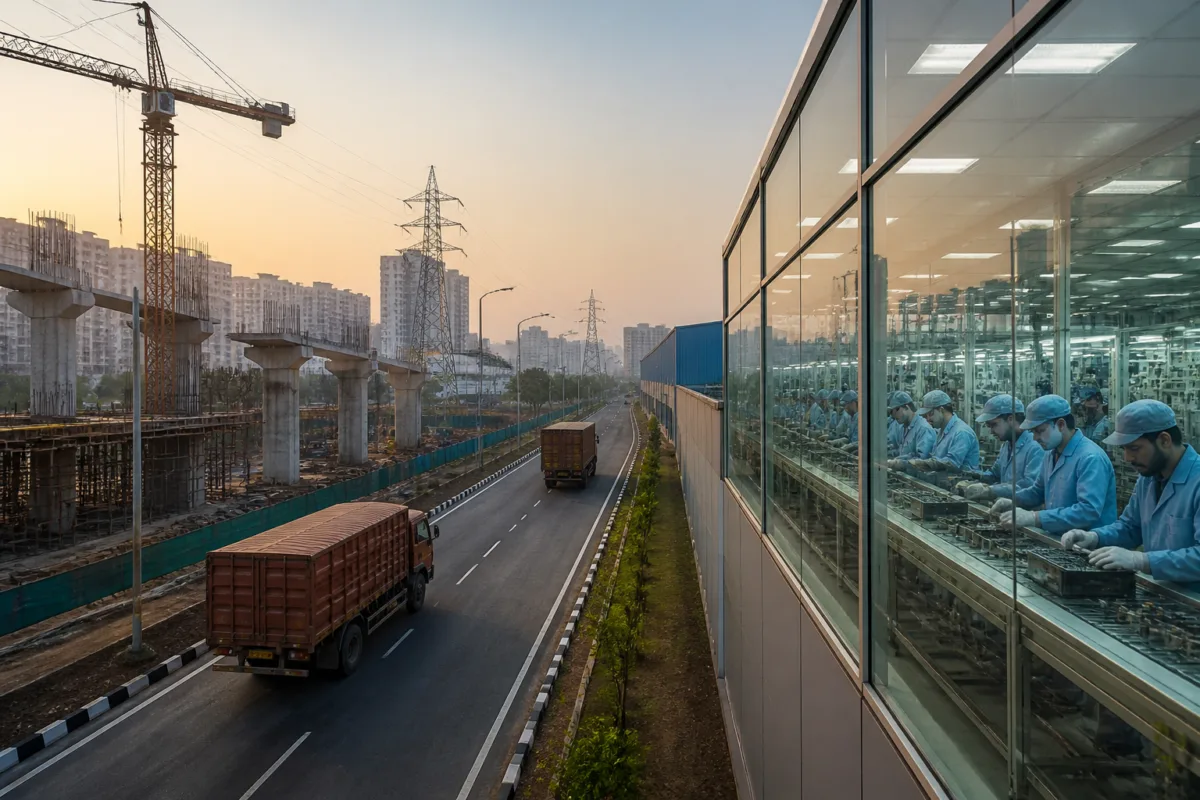
India manufacturing growth is entering a more demanding phase. The country has expanded its electronics assembly capacity, increased the number of active companies and lowered inflation, but the next stage will depend on whether cities can generate enough demand through construction, infrastructure, real estate and power projects, according to Neelkanth Mishra, executive director at the World Bank.
Mishra, who oversees India, Sri Lanka, Bangladesh and Bhutan at the World Bank, argued in an interview ahead of the Hindustan Times Leadership Summit that fiscal discipline has helped reduce the cost of capital available to businesses. His broader argument was that cheaper capital, digital infrastructure and access to technology are creating conditions in which private companies can invest, scale and create jobs.
That argument places urban development at the centre of a question usually framed as an industrial policy challenge. Manufacturing does not expand only through factories or production-linked incentives. It also requires construction activity, industrial real estate, transport connections, electricity generation and a domestic market capable of absorbing materials and services. Mishra said the cycle linking these sectors is now underway, and expects manufacturing and industry to increase as a share of India’s gross domestic product.
The evidence cited in the interview begins with the macroeconomic environment. Mishra said India had made progress in controlling inflation through fiscal discipline, which in turn reduced the cost of capital. Consumer inflation, recorded at 10.5% in financial year 2012-13, fell to 3.41% in 2018-19 before rising again and reaching 2.06% in the last financial year, described in the report as a decadal low.
Lower inflation does not automatically produce new factories or jobs. It changes the conditions under which those investments are assessed. Mishra’s interpretation is that the government is increasingly signalling to private companies and entrepreneurs that capital may be more productively deployed by them than by the state. The intended result is greater private investment and employment creation.
One indicator he cited was the increase in active companies in India. Their number rose by roughly one-third in three years, from 1.6 million to 2.2 million. The interview did not establish how much of this increase came from manufacturing, construction, services or other sectors. It does, however, point to a wider expansion of formal business activity that could support demand for offices, industrial premises, logistics facilities and urban services.
The technology argument is equally important for cities. Mishra said artificial intelligence and Aadhaar-based digital public infrastructure could change the prospects of small and medium-sized businesses. His comparison was between the five to six million software engineers who currently instruct computers and a possible future in which 100 million people use technology to increase their productive capacity.
The statement is a projection rather than a measured outcome, and the interview does not provide a timeline or estimate for achieving it. Its significance lies in the scale of the proposed change. If digital systems allow smaller businesses to access markets, payments, credit or administrative services more efficiently, the effects would not be confined to technology companies. They could influence the location, size and operating model of businesses across urban India.
That transition would also expose differences in digital access and business capability. The supplied evidence does not establish how many small firms currently use artificial intelligence or Aadhaar-linked services, nor does it quantify the productivity gains. The central point remains that digital public infrastructure is being presented as an enabler for a much broader entrepreneurial base, rather than as a specialised technology intervention.
Manufacturing policy, however, faces a scale problem. Mishra was positive about the performance of electronics under India’s production-linked incentive schemes, but less certain that the current design would work equally well in other sectors. He attributed the success of mobile manufacturing incentives partly to their focus on scale.
His example was footwear. A global buyer ordering 500 million pairs would have limited interest in contracts for half a million or one million pairs, he said. Suppliers would need the capacity to offer orders of 20 million or 50 million pairs. The example highlights an institutional issue within industrial policy: incentives can support production, but they cannot by themselves create the scale, supplier networks, land, utilities, labour systems and logistics required by large global buyers.
This is where the urban system becomes inseparable from manufacturing strategy. Large-scale production requires serviced land, reliable power, roads, freight movement, worker housing and access to supporting businesses. The World Bank executive’s comments do not provide a location-by-location assessment of these requirements, but they identify construction, infrastructure, real estate and power plants as sectors whose domestic demand could strengthen the manufacturing cycle.
The electronics sector shows both the progress and the limitation of India’s current position. Government data cited in the interview showed that India accounted for about 20% of annual global phone production in December 2025. Mishra acknowledged that assembly does not add as much value as higher stages of the electronics chain, but said it is a starting point in building an industry.
The next question is whether production can move beyond assembly into design and other higher-value activities. Mishra pointed to India’s engineering base, saying that 300,000 of the world’s 1.5 million chip design engineers are in India. He said Indian engineers have moved from lower-end assignments to work on two-nanometre chips and advanced graphics processing units for leading global companies.
These figures, as presented in the interview, describe a potential advantage rather than a guarantee of domestic manufacturing depth. Design capability and factory capacity are related but distinct. A stronger industrial ecosystem would require connections between engineering talent, component suppliers, manufacturing plants, research, power infrastructure and markets. The interview does not establish how much of that integration has already occurred.
The labour dimension adds another layer to the manufacturing question. Mishra said India could increasingly match its demographic dividend with demand from ageing countries including Japan, the United Kingdom, the United States and Australia. He argued that controlled migration, based on specific skills and bilateral coordination, could eventually absorb a fourth of India’s incremental workforce.
He also said such an outcome could take 10 to 15 years to reach scale. India already has migration and mobility partnership agreements with more than two dozen countries, according to the report. Dammu Ravi, a former secretary of economic relations at the external affairs ministry, cautioned that some countries view India as dumping labour and that political resistance to immigration remains strong in parts of the world. He argued that countries should focus on agreed standards and labour quality rather than only on the number of people permitted to enter.
This is relevant to urban policy because both domestic industrial growth and overseas labour mobility depend on skills, housing, transport and public services. The evidence supplied does not show whether Indian cities currently have the institutional capacity to support the workforce expansion implied by either pathway. It does show that employment cannot be separated from the physical and administrative systems that allow workers and businesses to function.
The policy landscape described by Mishra therefore has several connected parts. Fiscal discipline is intended to support macroeconomic stability and reduce the cost of capital. Digital public infrastructure is expected to widen access to technology and business services. Production-linked incentives are being used to attract and expand manufacturing, although their effectiveness may vary by sector. Migration agreements offer a possible route for matching Indian workers with overseas demand.
None of these measures operates independently. Manufacturing incentives need infrastructure and scale. Technology adoption needs businesses and workers who can use it. Labour mobility needs standards, bilateral coordination and acceptance in destination countries. Lower capital costs can improve investment conditions, but they do not determine where projects are built or whether cities can provide adequate land, housing, transport and utilities.
The data points in the interview show a country moving from stabilisation towards expansion, but they do not establish that the transition is complete. Inflation has fallen from earlier highs, active companies have increased from 1.6 million to 2.2 million, India has reached about one-fifth of global phone production, and its engineers occupy a significant position in global chip design. At the same time, the evidence does not quantify manufacturing’s current share of GDP, the number of jobs created by the expansion, or the domestic value added in electronics.
That gap matters. A rise in production volumes can coexist with limited local sourcing, while a rise in registered companies does not necessarily translate into large-scale employment. The interview itself recognises the distinction by acknowledging the lower value added of assembly and emphasising the need for scale in other sectors.
The larger urban question is whether Indian cities can become productive platforms rather than merely locations where factories are placed. The answer will depend on how effectively construction, infrastructure, real estate, power and digital systems support firms at different scales. It will also depend on whether workers can access jobs without the urban costs of inadequate housing, unreliable transport and weak services being transferred to households.
The evidence currently confirms an ambition and an emerging set of enabling conditions, not a completed transformation. The developments that require monitoring are the sector-by-sector performance of incentive schemes, the movement of electronics beyond assembly, the relationship between industrial investment and urban infrastructure, and whether migration partnerships produce recognised, quality-controlled employment at scale.

