


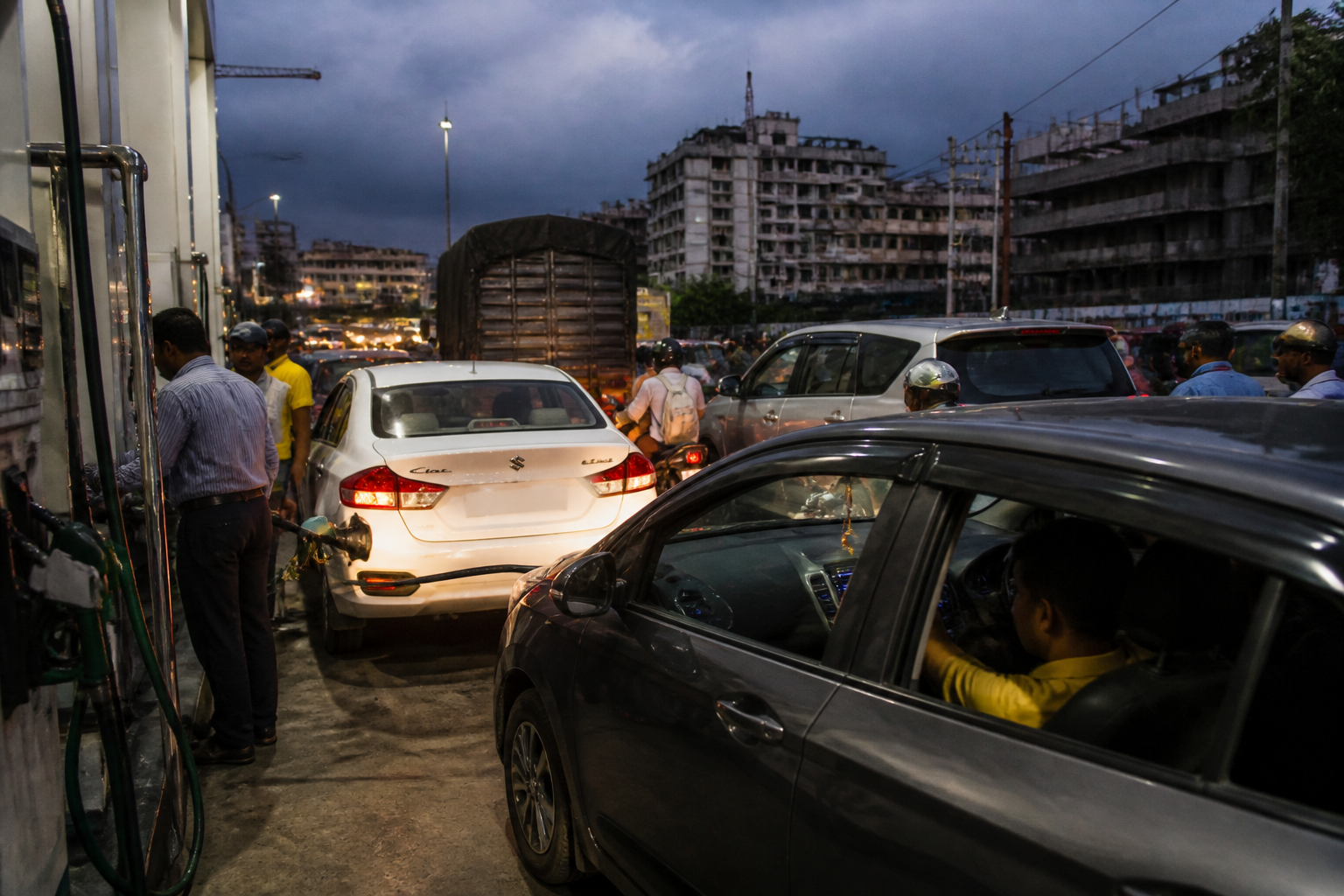
India’s petrol price benchmark has climbed to a 50-month high, placing state-run oil marketing companies under renewed financial pressure just as geopolitical disruptions threaten global energy supplies. The immediate event is a rise in international pricing benchmarks, but the larger urban question is how much stress India’s transport-dependent economy can absorb when fuel retailers delay passing higher costs to consumers.
The average daily benchmark price for petrol between September 1 and 18 was $133.05 a barrel, according to official data cited in the report, 20% above the August average of $110.87. The benchmark has also moved above the recent peak of $129.63 recorded in May, when state-run oil marketing companies raised petrol and diesel prices four times in one month.
The numbers do not represent the retail price paid by motorists at Indian fuel stations. They indicate the international pricing pressure facing companies that buy, refine, distribute and sell fuel in the domestic market. That distinction is important because the effect of a higher benchmark is not transmitted automatically or immediately to consumers. It first appears in the financial position of fuel retailers, particularly when pump prices remain below the level required to recover costs.
According to industry experts cited by Hindustan Times, oil marketing companies are currently losing about ₹5 a litre on petrol and ₹20 a litre on diesel. Some private oil companies have also begun restricting bulk diesel sales, the report said. Such restrictions point to a market under pressure from the gap between procurement costs and selling prices, although the supplied report does not establish the extent or duration of those restrictions.
The pressure is greater for diesel because it remains closely tied to commercial activity. Heavy vehicles, construction equipment, logistics fleets and a range of urban services depend on diesel-powered transport or machinery. The report does not quantify the impact on freight rates, construction costs, municipal services or public transport operations. It does, however, show how a fuel shock can begin with international supply concerns and reach institutions and businesses that keep cities moving.
The diesel benchmark has risen to a four-month high of $167.08 a barrel, according to the experts cited. It remains below the April 2026 peak of $187.92 during the recent energy crisis. The comparison suggests that the current pressure is serious but not yet at the highest level recorded in the recent period. It also shows why the financial position of fuel retailers cannot be assessed only by looking at one day’s price movement: the duration and direction of the increase matter as much as the latest benchmark.
State-run oil marketing companies raised petrol and diesel rates by ₹7.35 and ₹7.53 a litre respectively in May 2026 after their daily losses mounted to ₹1,000 crore, the report said. That episode provides the clearest recent indication of the scale at which fuel pricing can become a public and fiscal concern. When retail rates are adjusted, households and businesses face higher direct costs. When they are not adjusted, the losses accumulate on the books of the companies selling the fuel.
This creates a difficult institutional balance. The oil marketing companies must maintain supplies and retail operations while managing a widening difference between international costs and domestic prices. The report says public-sector OMCs may absorb under-recoveries during the July-September quarter, but that a price increase would become imminent if India and China face greater pressure to reduce purchases of Russian crude. The statement was made by an unnamed industry expert cited in the report and is therefore a warning about a possible pricing response, not an announced decision.
The importance of Russian crude in the discussion comes from the position of India and China in the global market. The two countries are described in the report as the world’s second- and third-largest consumers of crude oil after the United States. If their purchases of Russian crude were to fall significantly, they would compete for supplies from other producers. The experts cited argue that this could place additional upward pressure on international prices.
That mechanism links foreign-policy pressure to domestic mobility costs. A change in the source of crude imports would not remain confined to commodity markets if it tightened the supply available to major consuming countries. It could affect the costs faced by fuel retailers, transport operators and businesses that use fuel in their daily operations. The supplied material does not establish whether such a shift will occur, nor does it quantify the effect on Indian consumers. What it establishes is the exposure created by India’s dependence on a volatile international oil market.
The report identifies several geopolitical risks behind the current volatility. Energy flows through the Strait of Hormuz have been disrupted, Saudi Arabian supplies have become less predictable following attacks on oil infrastructure and export supply lines, and shipping through the Bab al-Mandeb Strait faces a further risk of disruption. It also refers to drone attacks on Saudi Arabia’s East-West pipeline and new United States measures aimed at countries buying Russian crude.
These are not isolated price signals. They concern the routes, infrastructure and political conditions through which crude oil reaches refineries and markets. A disruption to a shipping corridor can raise concerns about supply availability even when physical shortages have not yet been established. Similarly, an attack on a pipeline can increase uncertainty about the reliability of alternative export channels. The report says Saudi Arabia’s efforts to create alternative channels for moving crude subsequently eased some of the pressure, illustrating how logistics can influence prices alongside production levels.
Brent crude rose to $108.75 a barrel on September 15 after the Saudi East-West pipeline was hit by a Houthi drone, according to the report. It then fell to $105.83 on September 16 and $103.87 by the close of the week after alternative Saudi channels helped ease concerns. The movement demonstrates the speed with which international prices can respond to both an infrastructure incident and the restoration of confidence in supply routes.
For Indian cities, fuel pricing matters because urban mobility is not limited to private car ownership. Diesel and petrol support goods movement, personal travel, commercial fleets, construction activity and the movement of workers and supplies across metropolitan regions. The supplied report does not provide city-level data or separate the effect on different income groups. It does show that the same benchmark shock reaches different parts of the urban system through different channels: retail fuel prices for motorists, operating costs for commercial users and financial losses for fuel companies.
The distinction between petrol and diesel is also relevant. Petrol is more directly associated with private vehicles, while diesel has a stronger presence in commercial and heavy-use applications. The reported loss of ₹20 a litre on diesel, compared with ₹5 a litre on petrol, indicates a wider gap for diesel retailers at the time covered. If sustained, such a gap could make bulk sales commercially difficult, which helps explain the report’s reference to restrictions by some private oil companies. The material does not establish whether retail availability has been affected.
India’s fuel-pricing system therefore faces a choice between competing pressures rather than a single technical calculation. Raising pump prices can reduce the losses of OMCs but increases the immediate burden on fuel users. Holding prices steady can protect consumers in the short term but transfers the pressure to retailers through under-recoveries. The May experience, when daily losses reached ₹1,000 crore before price increases, shows that the second approach also has limits.
The available evidence does not establish what the government or OMCs will do next. It records expert warnings that fuel retailers could begin losing heavily again if international prices move higher, and that a price increase could become imminent under additional pressure on Russian crude purchases. It also records a recent fall in Brent prices after supply concerns eased. Those facts point to a system whose next move will depend on the interaction between international prices, geopolitical developments, import flows and domestic retail decisions.
The central issue is not only whether petrol or diesel becomes more expensive at the pump. It is whether India’s urban economy can remain insulated from global fuel volatility without imposing unsustainable losses on the companies that supply it. The current figures confirm that the buffer is already under strain: petrol has reached a 50-month benchmark high, diesel has risen sharply, and the reported losses are significant. What remains uncertain is how long the disruption will last and whether the pressure will be absorbed by OMCs, passed to consumers or distributed across the wider transport and commercial economy.
