


India’s economy grew 7.8% in the first quarter of financial year 2026-27, according to the report discussed by Aaj Tak Business. The figure has been presented as evidence of resilience despite global economic pressures. But the debate that followed is less about whether one quarter was strong than about what kind of growth India needs to sustain its ambition of becoming a developed economy by 2047.
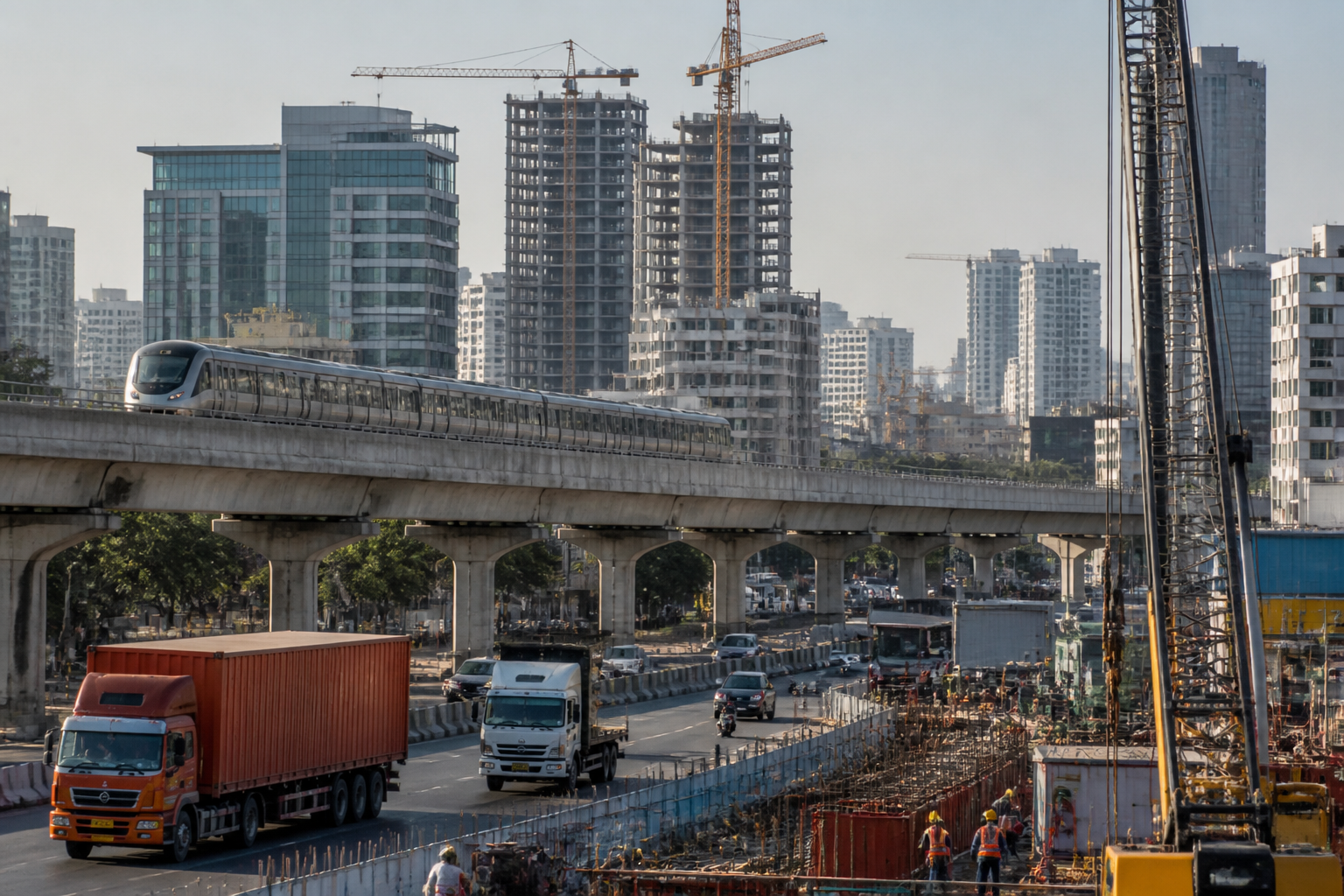
That distinction matters for cities. Urban India absorbs workers, attracts investment, provides services and concentrates much of the country’s productive capacity. A high national growth rate can support better infrastructure and rising incomes, but only if the expansion generates productive employment and reaches households beyond the sectors and regions already positioned to benefit. The GDP debate therefore also raises a question about the economic model that Indian cities are expected to support.
The immediate controversy concerns the measurement of growth. Former finance secretary Subhash Chandra Garg questioned revisions to the previous year’s first-quarter GDP figures under the new series. The report says the current-price GDP estimate for the comparable period was earlier presented at about ₹86 lakh crore and later reduced to roughly ₹80 lakh crore. Garg argued that the difference affected the interpretation of the latest growth rate, though he later revised his own estimate of the economy’s actual growth from 2.6% to about 5% in an interview.
The Congress also questioned the new GDP series, the GDP deflator and revisions to earlier numbers. It claimed that the revised series showed a reduction of about ₹43 lakh crore in India’s GDP over four years. The government rejected those allegations, saying that the new series uses 2022-23 as its base year, along with improved data sources and a revised methodology. The Ministry of Statistics and Programme Implementation said that growth rates cannot be calculated by combining figures from separate statistical series.
This methodological point is central. A statistical series is not simply a list of interchangeable numbers. Changes in the base year, data sources and calculation methods can alter the way earlier economic activity is represented. Comparing figures drawn from different series without accounting for those changes can produce a result that appears precise but does not measure growth consistently. The material supplied for this analysis does not independently establish which interpretation is correct, but it does show why GDP revisions can become politically consequential and difficult for the public to evaluate.
Economists Surjit Bhalla and Montek Singh Ahluwalia rejected the allegation that the 7.8% figure had been manipulated. Bhalla argued that there was no concrete evidence of interference and noted that consumption estimates had been revised downward rather than simply being increased to make the economy appear stronger. Neelkanth Mishra, identified in the report as an economist representing India at the World Bank, also rejected the practice of combining separate GDP series to derive an alternative growth rate.
Their position does not end the debate over data quality. It separates two questions that are often merged. The first is whether the reported growth rate has been calculated according to the stated methodology. The second is whether the methodology captures the economy’s real conditions, including employment, household purchasing power and the distribution of gains. A credible answer to the first question does not automatically settle the second.
That is why the 2047 discussion is more important than the dispute over a single quarterly number. Bhalla and Ahluwalia both said that 7.8% growth, while strong, would not by itself be sufficient to make India a developed economy by 2047. Bhalla argued that India would need to sustain double-digit growth for a prolonged period. He regarded an investment-to-GDP ratio of about 34% as a positive development, but said that much faster growth would still be needed to raise per-capita income in dollar terms.
Ahluwalia similarly described the economy as stronger than earlier pessimistic estimates suggested, while cautioning that the current pace would not be enough for the 2047 objective. His argument shifts the focus from acceleration in one or two quarters to the durability of growth over decades. That requires more than favourable headline numbers. It requires productive investment, rising labour productivity, expanding markets and institutions capable of implementing reforms consistently.
The income comparison cited in the report illustrates the scale of the challenge. World Bank figures mentioned by Aaj Tak Business put India’s per-capita GDP at about $2,695 in 2024. The corresponding figures cited for China, the United Kingdom and the United States were approximately $13,303, $53,246 and $84,534. These comparisons do not provide a complete definition of development, but they show why the size of the national economy cannot be treated as a substitute for the living standards of individuals.
For cities, per-capita income is connected to the quality and stability of employment. Urban economies depend on construction, manufacturing, logistics, retail, transport, housing, public services and a wide range of formal and informal activities. If growth is concentrated in high-productivity services without generating enough broad-based employment, cities may expand economically while large sections of their populations remain vulnerable to insecure work and volatile incomes.
The report describes this as a potential K-shaped pattern, in which different social groups or industries move in opposite directions. It also cites economist Rohit Lamba’s argument that India moved from an agriculture-based economy towards high-skill services without building a manufacturing base strong enough to generate employment at the required scale. That pattern has direct urban consequences. Manufacturing can create demand for industrial land, worker housing, freight infrastructure and local services, while high-skill services often concentrate opportunity in particular locations and among workers with specific educational credentials.
This does not mean services are unimportant or that manufacturing alone can resolve India’s development challenge. It means that the composition of growth matters. A city’s economic performance cannot be assessed only through aggregate output. The relevant questions include how many jobs are created, what skills they require, how stable they are, whether wages keep pace with living costs and whether new economic activity is matched by housing, transport and utilities.
The policy prescriptions discussed in the report point towards a more outward-facing growth strategy. Bhalla and Ahluwalia called for stronger integration with global trade, lower tariffs and cheaper imported inputs for industry. Ahluwalia also referred to the need to use trade agreements with the United Kingdom and the European Union to make Indian companies more competitive in global markets. He argued that identifying the need for reform is not enough; the government must specify which reforms are required and how they will be implemented.
That implementation question is particularly important in urban India. Trade and industrial reforms are national decisions, but their effects are spatial. They require land, ports, roads, rail connections, warehouses, reliable power, water supply, worker accommodation and municipal services. If these systems are not coordinated, investment may face higher costs and cities may struggle to absorb new employment. Conversely, where infrastructure and governance work together, urban areas can become platforms for productivity rather than bottlenecks to growth.
The supplied material does not provide city-level employment figures, regional growth comparisons or evidence on how the 7.8% expansion has affected household incomes. Those gaps limit what can be concluded. The GDP figure indicates momentum, but it does not reveal whether that momentum is broad-based. The debate over revisions also shows that public confidence depends on transparent statistical methods and clear explanations, especially when revised numbers materially change the historical record.
The evidence therefore supports a measured conclusion. India’s reported growth is strong, and the economists cited in the report found no established evidence of manipulation. At the same time, a high quarterly rate cannot prove that India is on a guaranteed path to developed-country status. The larger test lies in whether growth can remain fast, generate productive employment, raise per-capita incomes and distribute gains across workers, sectors and regions.
For cities, the developments worth monitoring are not only the next GDP release. They include the investment rate, the strength of manufacturing and tradable services, the quality of employment, the capacity of urban infrastructure and the clarity of future statistical revisions. The 2047 goal will ultimately be judged not by one quarter’s headline number, but by whether economic growth changes the everyday productive opportunities available to urban households.
