


Bengaluru’s 32nd-place finish among India’s million-plus cities in the 2026 Swachh Vayu Sarvekshan is more than a poor ranking. It is a measure of how difficult it remains for a rapidly expanding city to convert clean-air programmes into lower emissions on the ground. The result places Bengaluru among the bottom 10 cities in its category, despite efforts under the National Clean Air Programme and the presence of clean-fuel schemes across most households in the city’s informal settlements.
The Union Ministry of Environment, Forest and Climate Change announced the rankings at the Swachh Vayu Sarvekshan awards on Monday. Bengaluru scored 152.6 points, well behind Lucknow, which topped the million-plus category with 198 points, followed by Indore at 197 and Jabalpur at 195. Only seven cities in the category ranked below Bengaluru.
The ranking is based not on a single measure of ambient air quality but on actions taken across several pollution sources. The assessment considers road-dust control, solid-waste management, vehicular and industrial emissions, construction and demolition waste, diesel generator sets and emissions from commercial establishments. It also evaluates information, education and communication activities. Cities conduct self-assessments, which are approved by state-level monitoring committees before evaluation by the Central Pollution Control Board and field verification by independent committees.
That framework matters because Bengaluru’s result reflects an implementation problem spread across several urban systems rather than one isolated source of pollution. The city’s air-quality challenge is closely connected to the way people and goods move, how roads are managed, how small industries are monitored, how waste is handled and whether lower-income households can consistently afford cleaner fuels.
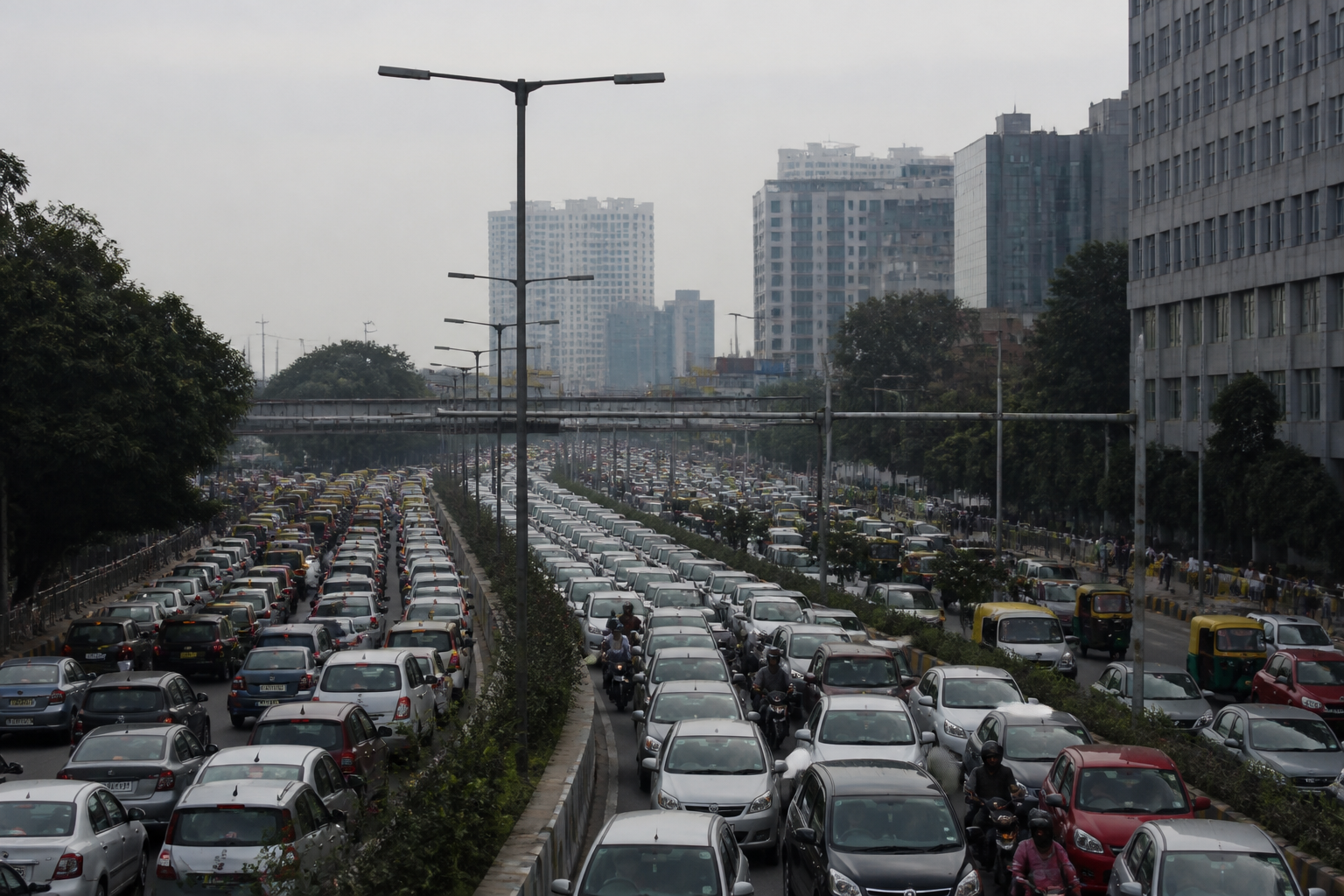
Traffic is the most visible of these pressures. Professor Gufran Beig, chair at the National Institute of Advanced Studies, identified inadequate and improper traffic management as one of the main reasons for rising pollution in Bengaluru. He said the city’s slow-moving traffic and congestion increase emissions, with a mix of slow-, low-speed and high-speed vehicles creating a particularly difficult pollution profile.
The issue is not simply the number of vehicles on the road. A traffic stream in which vehicles repeatedly slow down, idle and accelerate can produce a different emissions burden from one that moves more consistently. Bengaluru’s congestion therefore becomes an air-quality issue as well as a mobility issue. The same road network is being asked to carry growing traffic volumes while limiting the time vehicles spend in polluted, built-up corridors.
The city’s geography offers some advantage, according to the expert cited in the report, but that advantage has not been enough to offset emissions generated by congestion. The distinction is important. Natural or geographical conditions may help disperse pollution, but they do not eliminate the emissions being produced. A city can benefit from atmospheric conditions and still perform poorly when the sources of pollution remain persistent and difficult to control.
Road infrastructure is another part of the problem identified by air-quality experts. The supplied assessment does not quantify the contribution of traffic, road dust, industrial activity or household fuel use separately, but it indicates that these sources interact. Poor road infrastructure can worsen congestion, while weak traffic management can increase the duration for which vehicles emit pollutants. At the same time, the report notes that road-dust pollution is relatively lower in Bengaluru than some other sources, suggesting that the city’s clean-air response cannot be reduced to sweeping roads or dust suppression alone.
The industrial picture is less visible but increasingly significant. Professor Beig said emissions from small-scale industries are increasing and remain largely unaccounted for. That observation points to an administrative challenge: pollution-control systems may be more capable of identifying and regulating large facilities than dispersed, smaller establishments operating across an urban region. When emissions are distributed among numerous units, the city’s overall pollution burden can rise without a single source becoming prominent enough to dominate public attention.
The report also highlights emissions from waste mismanagement and the burning of wood and charcoal in informal settlements. These sources bring the question of affordability into the clean-air debate. Government data cited by the expert indicates that clean-fuel schemes cover most households in these localities, creating an assumption that emissions from cooking fuels should have fallen. But coverage on paper does not necessarily mean regular use in practice.
According to Professor Beig, some residents do not use clean cooking fuel because refilling cylinders is expensive. As a result, households may return to wood or charcoal, producing emissions that are not captured by a simple count of scheme coverage. This is a gap between access and sustained adoption. A programme can reach a household administratively while failing to make the cleaner option affordable enough for everyday use.
The point has wider significance for urban governance. Pollution is often managed through separate departments and schemes: transport authorities address traffic, municipal bodies handle waste and roads, pollution-control institutions monitor industrial emissions, and welfare programmes support access to cleaner household fuels. Bengaluru’s ranking suggests that the combined outcome depends on whether these systems work together, not merely on whether each has an initiative or target.
The Swachh Vayu Sarvekshan’s design recognises this institutional complexity by assessing several categories at once. Its inclusion of construction and demolition waste, diesel generators, commercial establishments and public communication indicates that clean air is treated as a city-management responsibility rather than only an environmental one. However, the ranking also shows the difference between having a broad assessment framework and producing strong results within it.
Bengaluru’s 152.6 points were 45.4 points below Lucknow’s score of 198. The available material does not explain how each city performed in individual assessment categories, so the ranking alone cannot identify which specific interventions account for the gap. It does establish, however, that Bengaluru’s combined performance across the evaluated areas remains substantially weaker than that of the leading million-plus cities.
The assessment also includes field verification, which is intended to test the claims made through city self-assessments. That process gives the ranking a broader basis than a purely self-reported exercise. At the same time, the supplied report does not provide the verification findings or disclose the category-level scores for Bengaluru. Those details would be necessary to determine whether the city’s weakness is concentrated in a few areas or spread across multiple departments and pollution sources.
The result therefore raises two different questions. The first is operational: which actions can reduce emissions from congestion, small industries, waste practices and household fuel use? The second is institutional: which authority is responsible for ensuring that these actions add up to measurable improvement across the city? The ranking provides evidence of an outcome, but not enough information to assign the full gap to any one agency.
The city’s experience also shows why clean-air programmes cannot rely only on formal coverage or announced measures. Clean-fuel schemes may reach most households, but high refill costs can limit their use. Traffic-management measures may exist, but congestion can continue to generate emissions if the road system remains slow-moving. Industrial regulations may cover registered facilities, while smaller sources remain difficult to track. In each case, the effectiveness of the intervention depends on conditions beyond the existence of the policy.
For residents, the significance of the ranking lies in this connection between air quality and everyday urban systems. Time spent in congestion, the affordability of cooking fuel, the management of waste and the operation of small industries are not separate from the city’s pollution profile. They are among the conditions through which that profile is produced.
The evidence currently confirms that Bengaluru remains a weak performer in the 2026 clean-air assessment despite the presence of national programmes and city-level actions. It also identifies several pressure points: traffic congestion, inadequate road infrastructure, rising and poorly accounted-for industrial emissions, waste mismanagement and household use of wood and charcoal. What remains unclear is the weight of each source and the performance of individual interventions. The next useful information will be the city’s category-wise scores, the field-verification findings and the specific measures authorities plan to take before the next assessment.
