


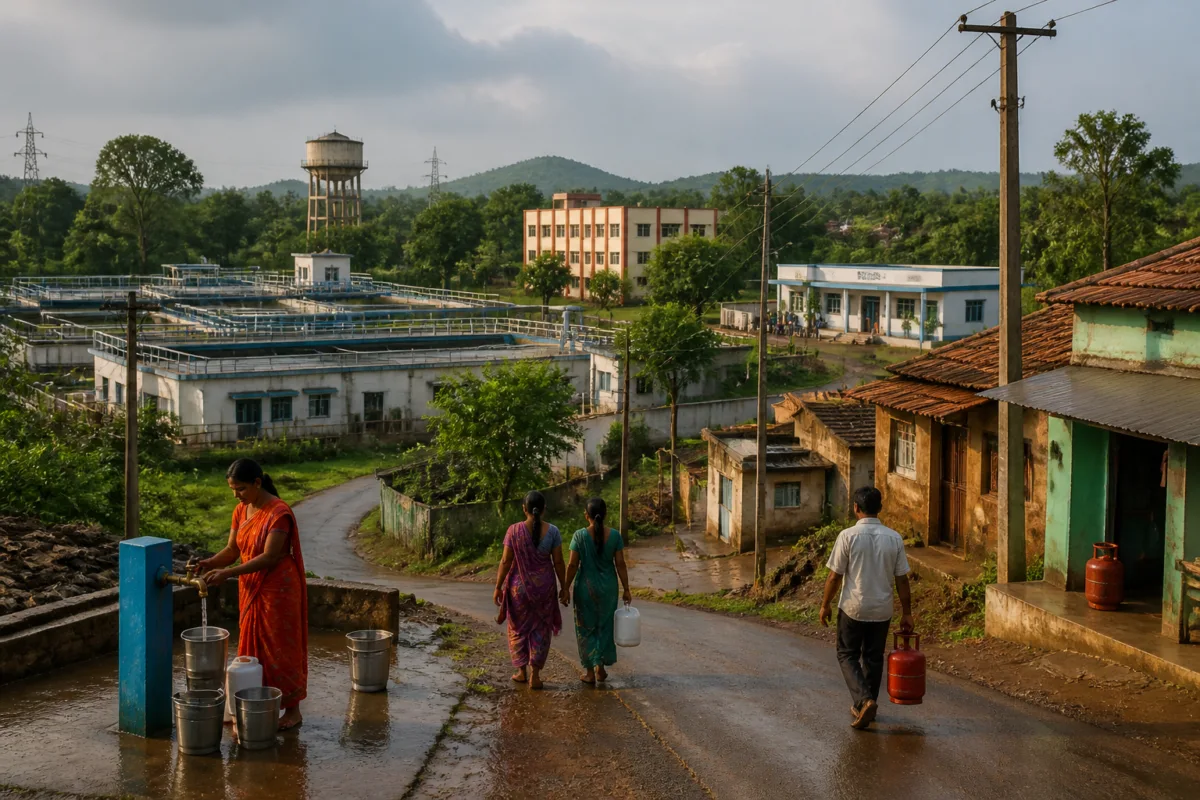
India’s ability to withstand floods, droughts, heatwaves and other climate stresses may depend less on the number of infrastructure assets built than on whether households can reliably use essential services, according to a study covering 733 districts.
The paper, titled “Infrastructure access and availability as determinants of community vulnerability: A spatial analysis of 733 districts in India”, was authored by Srijith Balakrishnan, Shivam Srivastava and Chirag Kothari and published in Sustainable Cities and Society. As reported by India Water Portal, the researchers examined how infrastructure and access to essential services are associated with community vulnerability using open-source geospatial and socioeconomic datasets.
The study distinguishes between infrastructure availability and household access. Availability refers to the presence of systems such as roads, electricity networks and other critical infrastructure. Household access covers whether people can obtain essential utilities, including drinking water, electricity, sanitation and clean cooking fuel. The analysis also considered social infrastructure such as schools, hospitals and police stations.
That distinction is important during climate emergencies. An electricity connection may exist but remain unreliable because of frequent outages. A water connection may be installed but provide an erratic supply. In either case, the formal presence of infrastructure does not necessarily mean that households receive a dependable service when it is most needed.
The researchers developed composite indicators for community vulnerability, critical infrastructure availability, household access to essential utilities and social infrastructure density. They used principal component analysis to build the indicators, hierarchical clustering to identify district profiles and spatial regression to examine associations between infrastructure and vulnerability.
Although the study covered 733 districts, its spatial model included 729. Four isolated island districts were excluded because of the requirements of the spatial weighting method.
Household access to essential utilities showed the strongest association with lower community vulnerability among the dimensions examined. The indicators included access to electricity, improved sanitation, improved drinking-water sources and clean cooking fuel. The study reported a Kendall’s rank correlation of 0.47 between essential-utility access and community vulnerability.
The association was stronger than those found for critical infrastructure availability or social infrastructure density. The spatial regression analysis found that a one-standard-deviation improvement in household utility access was associated with a 0.39-standard-deviation direct reduction in community vulnerability. After estimated regional spillover effects on neighbouring districts were included, the reduction reached 0.89 standard deviations.
These findings indicate why climate resilience cannot be assessed only by counting roads, power lines, water systems, schools or hospitals. The study’s results are associations rather than proof that utility access alone determines vulnerability. However, they point to the importance of affordability, last-mile connections and service reliability in determining whether infrastructure improves households’ capacity to cope with disruption.
The analysis also challenges the assumption that the same investment priorities will work across all districts. It identified geographical patterns in vulnerability and infrastructure availability, with lower overall vulnerability in southern districts, parts of the Himalayan region and the Northeast. Higher vulnerability was concentrated in states including Rajasthan, Gujarat, Uttar Pradesh, Madhya Pradesh and Chhattisgarh, as well as several eastern regions.
Six infrastructure profiles were identified. One group of 48 districts had severe deficits in household access to essential utilities even though critical and social infrastructure were close to the national average. Another, much larger group of 229 districts was slightly below the national average across all the dimensions examined.
This variation has direct implications for public investment. A district with extensive roads and power networks but poor drinking-water access may gain more from improving household water services than from expanding major transport infrastructure. In a district where household utility access is already stronger, regional transport or energy networks may be a more significant gap.
The findings therefore support district-specific planning rather than a broad classification of areas as simply infrastructure deficient. Planners need to identify which services are missing, whether households can afford and access them, and how those gaps contribute to local vulnerability. Climate-adaptation finance can similarly be directed towards the connections and distribution systems that bring water and energy services to households, rather than focusing only on large assets.
The study also highlights the interdependence of infrastructure systems. Water supply can depend on electricity for pumping and treatment. Schools and health centres require reliable power, roads and communications networks to function. A flooded road can prevent access to healthcare, while a power outage can disrupt water distribution.
This interconnectedness means that improvements in one district can have effects beyond its boundaries. The researchers found that stronger household utility access and critical infrastructure were associated with lower vulnerability in neighbouring districts as well. That finding adds a regional dimension to infrastructure planning, particularly where water systems, transport routes and power networks cross administrative boundaries.
National programmes such as the Jal Jeevan Mission and the Pradhan Mantri Gram Sadak Yojana illustrate the relationship between household services and regional connectivity. The study points towards making this integration more systematic, so that investments in roads, electricity, water and social infrastructure are planned around how they operate together rather than as separate asset categories.
For urban and regional authorities, the practical lesson is to measure what residents actually receive. The kilometres of road built, number of connections provided or facilities completed do not by themselves reveal whether services are available during an emergency. Monitoring should also consider continuity, quality, affordability and the ability of households to access services when transport or power systems are disrupted.
Infrastructure cannot eliminate vulnerability, which is also shaped by education, employment and governance. But the study indicates that reliable access to essential household services is closely associated with lower vulnerability across India’s districts. For climate adaptation to deliver public value, infrastructure must not only be built. It must reach households, function consistently and remain connected to the wider systems that communities depend on.

