


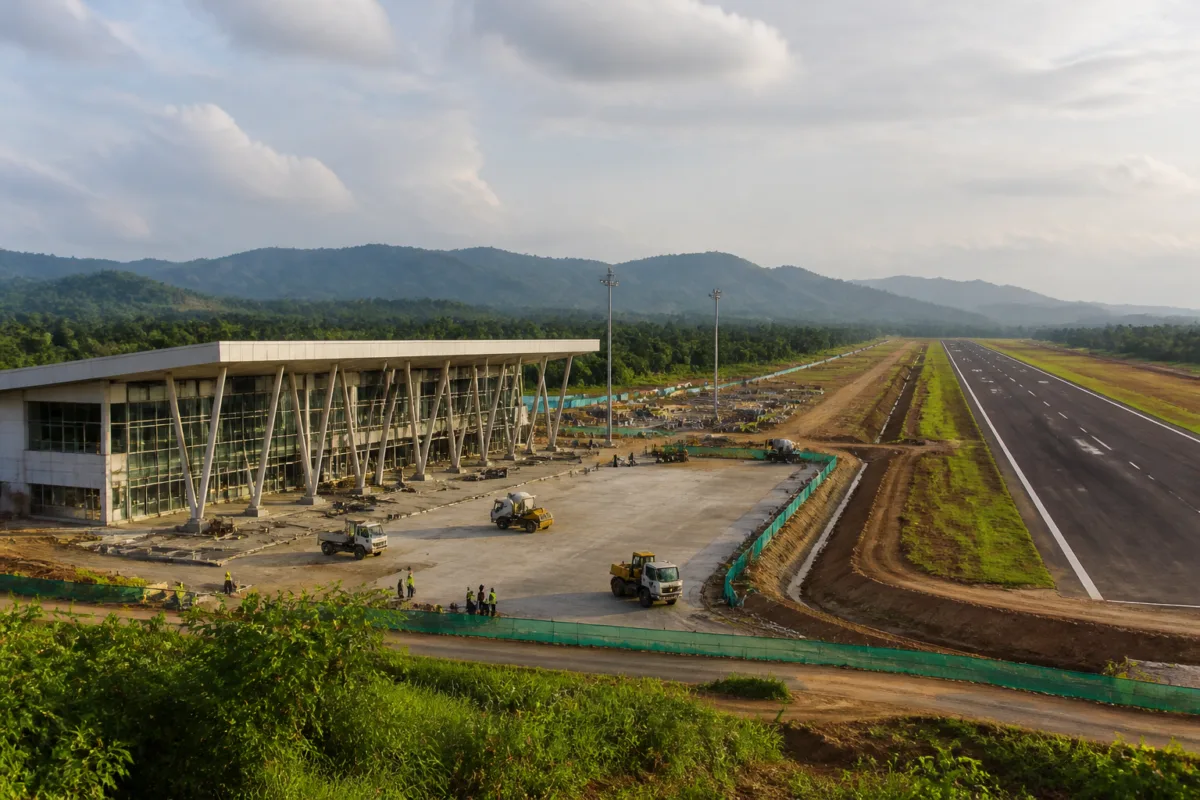
The Union Cabinet has approved a ₹2,014-crore greenfield airport at Doloo in Assam’s Cachar district and a ₹4,288.26-crore second container terminal at Kamarajar Port Limited in Tamil Nadu, according to a government release reported by Livemint.
The Doloo airport is intended to replace the capacity-constrained civil enclave at the existing Silchar airport, which is jointly owned by the Indian Air Force and the Airports Authority of India (AAI). The existing civil facility operates across 70 acres of defence land, according to the government.
The new airport will be developed by the AAI. Its proposed terminal building will cover 12,351 square metres and handle up to 800 passengers during peak hour, with an annual capacity of one million passengers. The design includes modern passenger amenities, sustainable green-building principles and provision for modular expansion.
The airport project also includes a 2,705-metre by 45-metre Code 4C runway designed for A-320 operations, an apron for six A-320 aircraft and a dedicated isolation bay. The government said the facility is expected to address growing air-traffic demand in southern Assam and nearby areas of neighbouring states.
Doloo is located in Cachar district in the Barak Valley, which the government identifies as a region with tea gardens, agro-based industries and tourism potential. Assam Chief Minister Himanta Biswa Sarma described the approval as a landmark decision for connectivity and economic opportunities in the valley. Prime Minister Narendra Modi also said the airport would improve connectivity to southern Assam and neighbouring states.
Separately, the Cabinet approved the development of a second container terminal at Kamarajar Port under a public-private partnership. The project will be implemented on a Design, Build, Finance, Operate and Transfer basis, with the selected concessionaire arranging investment for the ₹4,288.26-crore PPP component, including GST.
The proposed terminal will have a 900-metre quay, a design draft of 18 metres and annual capacity of two million twenty-foot equivalent units (TEUs). The project will be executed in two phases. Phase I is estimated to cost ₹2,429.32 crore and Phase II ₹1,858.94 crore. Kamarajar Port will separately bear an estimated ₹450 crore dredging cost, according to the project proposal.
The concession period will be 40 years, including a 48-month construction period. Phase I is scheduled for completion within 24 months of the award of concession, with commercial operations expected to begin in the 25th month. Phase II construction is planned from the 25th to the 48th month, with full commercial operations scheduled to begin in the 49th month.
The government said the additional capacity would strengthen Kamarajar Port’s role as a container gateway on India’s east coast and support export-import cargo from industrial clusters in Tamil Nadu and adjoining states. It identified automobiles, auto components, engineering goods, electronics and chemicals among the sectors expected to benefit.
The terminal is also intended to enable handling of larger container vessels, support direct calls by mainline shipping services and reduce dependence on foreign deep-water hub ports and related feedering costs. The government estimates that the project could support about 750 direct and indirect jobs during construction and around 800 operational-phase jobs.
Kamarajar Port handled 49.08 million tonnes of cargo and 1,008 vessels in 2025–26, including more than 700,000 TEUs of container traffic, the government said. Its existing container terminal has installed capacity of 0.8 million TEUs a year and handled about 0.7 million TEUs during the same period, representing utilisation of approximately 88%.
The two approvals expand planned aviation and maritime capacity in regions where the government says existing facilities face operational or capacity constraints. Their implementation will now depend on project execution, concession arrangements and the construction schedules outlined in the approvals.

