


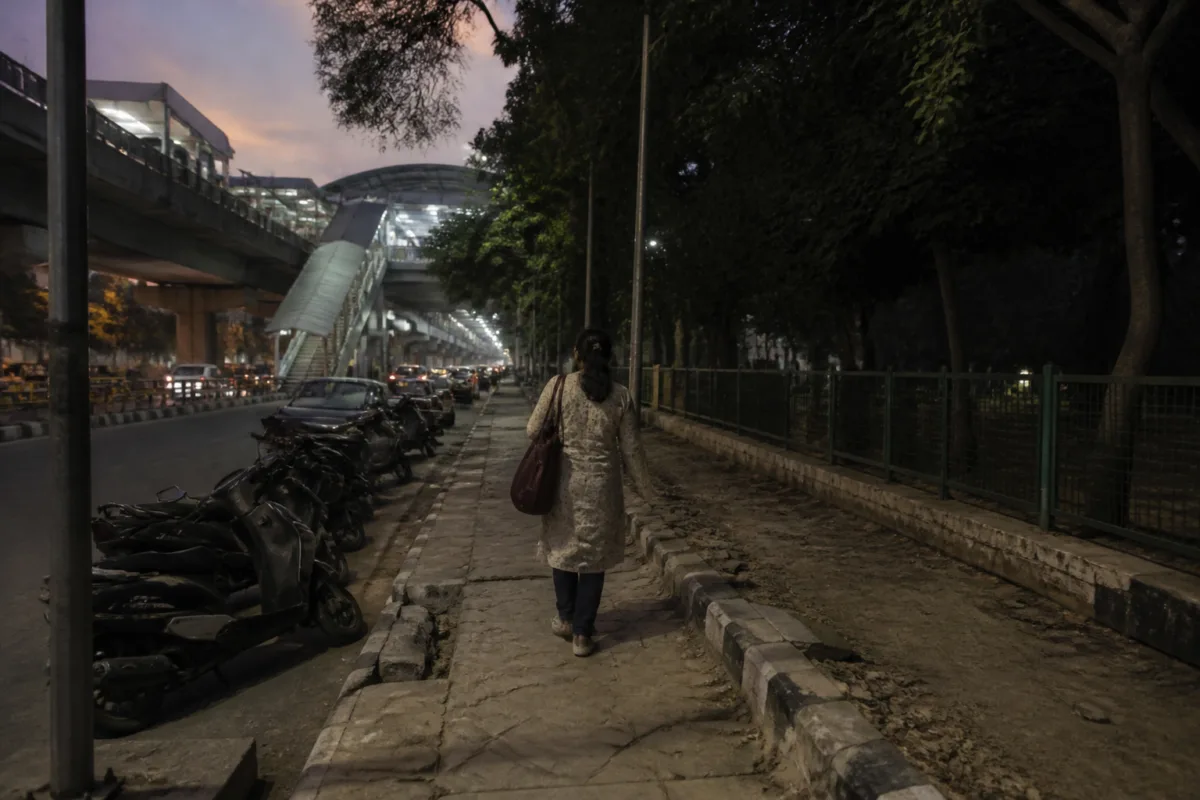
Delhi’s public transport safety challenge begins before passengers reach a bus stop or Metro station, with 87.5 per cent of women and girls reporting that they feel unsafe walking to their nearest public transport stop, according to a study cited by Jagran.
The study by the Centre for Equity and Inclusion (CEQUIN) is based on responses from 1,588 women, girls and members of the LGBTQ+ community. It examines the condition of public spaces, basic infrastructure and institutional accountability in the city.
The findings indicate that poor access infrastructure is affecting the first and last parts of a public transport journey. About 60 per cent of respondents said footpaths were broken or absent in several places. More than three-fourths described footpath lighting as very poor, making walking difficult not only at night but also during the day in areas where pedestrian conditions are inadequate.
Public parks were another area of concern. The study reported that 88.9 per cent of respondents felt unsafe in a nearby public park after dark. This points to a wider public-space issue beyond the immediate surroundings of bus stops and Metro stations.
Respondents also identified behaviour in public spaces as a major safety concern. Around 80 per cent said staring, passing inappropriate remarks and following by men made their daily journeys feel unsafe. The findings therefore connect women’s access to public transport with both the design and maintenance of streets and with the conduct experienced along the route.
The study also highlighted a gap in civic accountability. As many as 80.5 per cent of respondents said they did not know which government department was responsible for addressing complaints related to footpaths, parks or other public spaces. Even where infrastructure problems are visible, uncertainty about the responsible agency can make it harder for residents to seek repairs or report unsafe conditions.
The findings suggest that improving public transport access requires more than services inside buses and Metro systems. Continuous, well-lit and usable pedestrian routes, safer public parks and clearer complaint channels are also part of the journey to public transport. The study, as reported, does not identify specific locations or assign responsibility for individual infrastructure deficiencies. Those details would be needed to connect the reported concerns to targeted repairs and agency-level action.

