


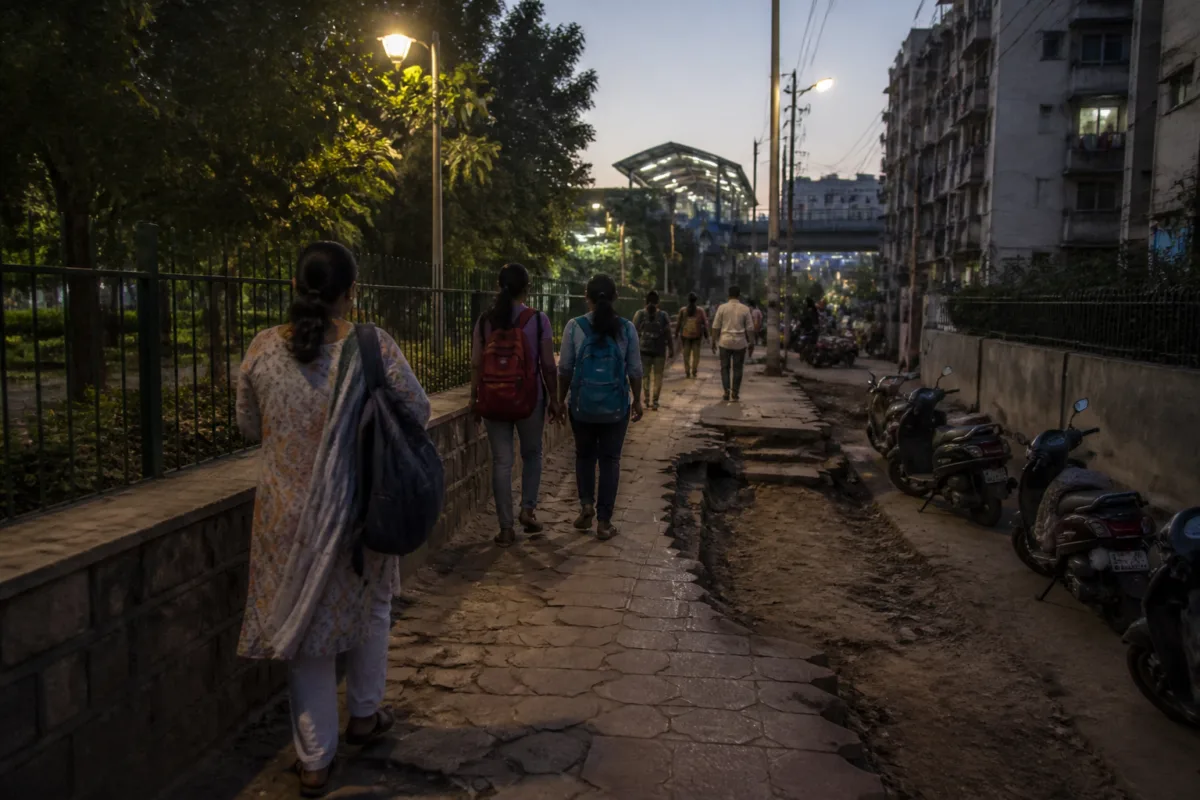
Nearly nine in 10 respondents in a CEQUIN study said they felt unsafe walking to their nearest metro station or bus stop, highlighting how conditions beyond the transport network can shape access to public mobility in Delhi.
The study by the Centre for Equity and Inclusion found that 87.5 per cent of respondents felt unsafe on the walk to the nearest public transport stop. It also found that 88.9 per cent felt unsafe in their nearest public park after dark.
The findings were based on responses from 1,588 women, girls and LGBTQ+ people, according to a statement issued by CEQUIN. The study, titled ‘Everyday Journeys: Women’s and Girls’ Access to Footpaths and Public Parks in Delhi’, was released at the organisation’s annual event, ‘Hain Haq Hamara Hissedari’, at Vasant Udyaan in Vasant Vihar. The event marked the start of the 16 Days of Activism against gender-based violence.
The survey points to the last-mile environment as a significant part of the public transport experience. More than three-fourths of respondents reported poorly lit footpaths, while 60 per cent said footpaths were broken or missing. These conditions affect the route between homes, public transport stops and other public spaces, rather than the metro or bus systems alone.
CEQUIN said the safety concern extended beyond the threat of sexual violence to the everyday conditions in which people navigate the city. Nearly 80 per cent of respondents said men’s behaviour, including staring, passing comments and following them, made daily journeys unsafe.
The study also identified gaps in civic accountability and complaint awareness. Some 80.5 per cent of respondents said they could not identify the civic authority responsible for addressing their concerns. A further 52.3 per cent did not know where to complain about problems related to footpaths and public parks.
The gap was particularly pronounced among respondents aged 60 and above, with 80.6 per cent saying they did not know where to complain. Even among people living in planned colonies, Delhi Development Authority flats and housing societies, 62.9 per cent did not know where to report civic problems.
Among those who knew where to complain, only 29 per cent were aware of the Municipal Corporation of Delhi’s 311 grievance-redressal platform, according to the study. The figures indicate that the existence of a complaint mechanism does not necessarily ensure that residents know about it or can connect a reported problem with the responsible agency.
For public transport users, this creates a governance issue at the point where transport, streets, lighting, parks and municipal services meet. A metro station or bus stop may be physically available, but the journey to reach it can remain difficult when walking routes are poorly lit, incomplete or perceived as unsafe.
CEQUIN said its study examines how public-space design and institutional gaps affect women’s safety. The organisation has submitted its recommendations to the Supreme Court, its statement said. The study also cited 13,396 crimes against women in Delhi in 2024 and low female workforce participation while making its case for attention to the design and management of public spaces.
The findings place responsibility for safer access across several parts of the urban system, including footpath maintenance, lighting, public-park management and public information about grievance channels. They also show that improving mobility is not limited to expanding transport infrastructure: the surrounding streets and the ability to report failures are part of whether residents can use that infrastructure with confidence.

