


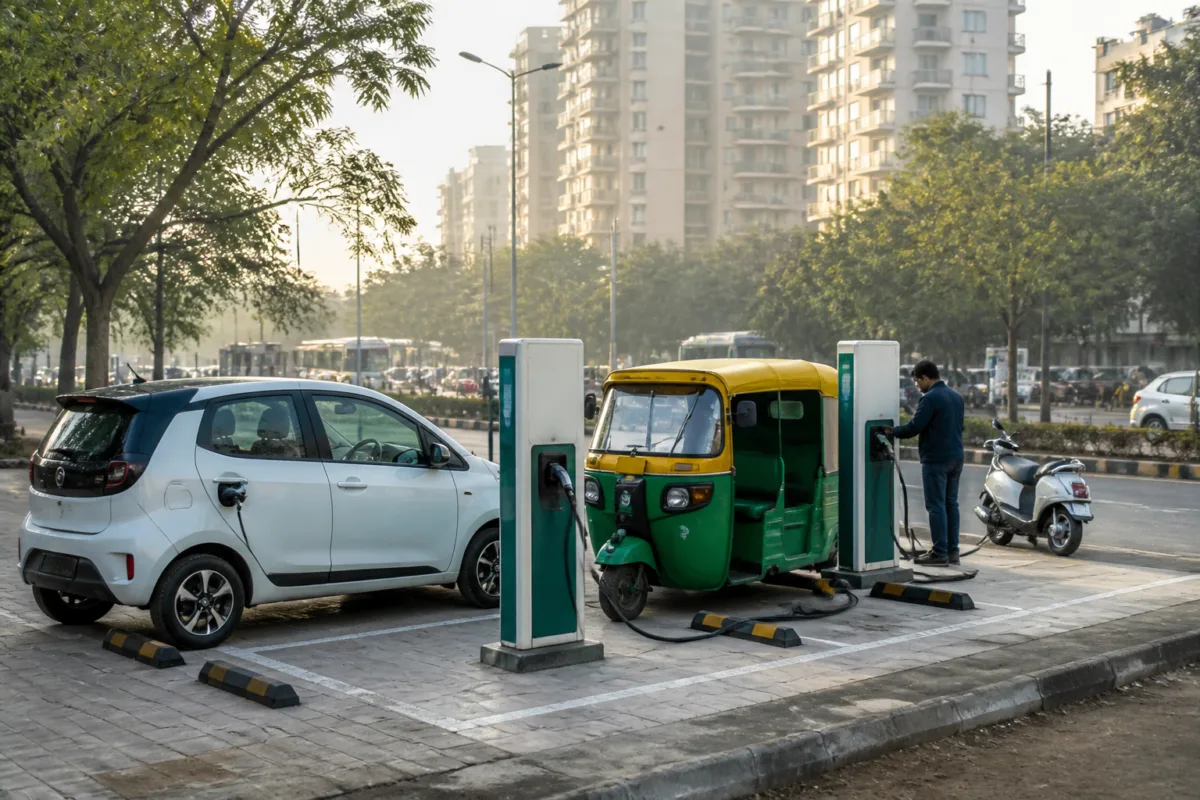
Delhi’s plan to install 540 public EV chargers at 180 locations could expand charging access across the capital as the city moves towards tighter registration requirements for new electric three-wheelers, cargo vehicles and two-wheelers.
The project is being taken up under the Centre’s PM E-DRIVE scheme, with an estimated cost of around Rs 62 crore, according to a report by Jagran. Delhi Transco Limited (DTL), identified as the nodal agency, has started the process of appointing an operator for the charging network.
The proposed stations are intended to serve two-wheelers, three-wheelers, cars and commercial vehicles. Each selected location is expected to have three categories of chargers: a 12-kilowatt unit for two- and three-wheelers, a 60-kilowatt charger for N1-category cargo vehicles and cars, and a 120-kilowatt fast charger.
The reported distribution would divide the 180 locations equally between two broad clusters. Ninety sites are planned for western and northern Delhi, while another 90 are proposed for southern, New Delhi and eastern parts of the capital.
The charging expansion is linked to anticipated growth in demand under the Delhi EV Policy 2026. According to the report, only electric three-wheelers and electric N1 cargo vehicles will be eligible for new registrations from 1 January 2027. From 1 April 2028, new two-wheeler registrations are also expected to be limited to electric vehicles under the policy.
The stated implementation challenge is therefore not limited to adding chargers. Their usefulness will also depend on whether the locations are distributed close to residential areas, commercial hubs, freight activity and major travel routes, and whether the network provides reliable access across vehicle categories. The report does not provide the individual site list, installation schedule, tariff structure or details of the proposed operator.
The Air Quality Management Commission has set a target of 32,062 charging points in Delhi by December 2029, the report said. Delhi government officials cited vehicle emissions as a significant contributor to air pollution and said improved charging access would help address a key barrier to EV adoption.
For residents and fleet operators, the proposed network could reduce dependence on private charging arrangements. Its wider public value will depend on timely commissioning, dependable power supply, transparent pricing and continued operation after the initial rollout. These implementation details remain unresolved in the reported plan.

