


India’s electronics exports to China rose nearly 40% in the first five months of FY27, but the more important development may be the emergence of a two-way manufacturing relationship. India is still heavily dependent on Chinese components, machinery and production inputs. At the same time, Indian factories are beginning to supply selected assemblies and intermediate goods into production networks centred on China.
That is a more complicated story than a simple reduction in India’s trade deficit. It suggests that India may be entering China’s industrial ecosystem at a specific point in the value chain: not by immediately replacing Chinese manufacturing, but by producing selected intermediate components that Chinese companies can use in more sophisticated products.
The shift is visible in the numbers, although the data requires careful interpretation. India’s exports to China rose 39% in the five months through August, according to government data cited by The Economic Times. Electronics and engineering goods accounted for a substantial part of the increase. The rise has come from a low base and has been linked by industry representatives to demand generated by artificial intelligence infrastructure and data-centre expansion.
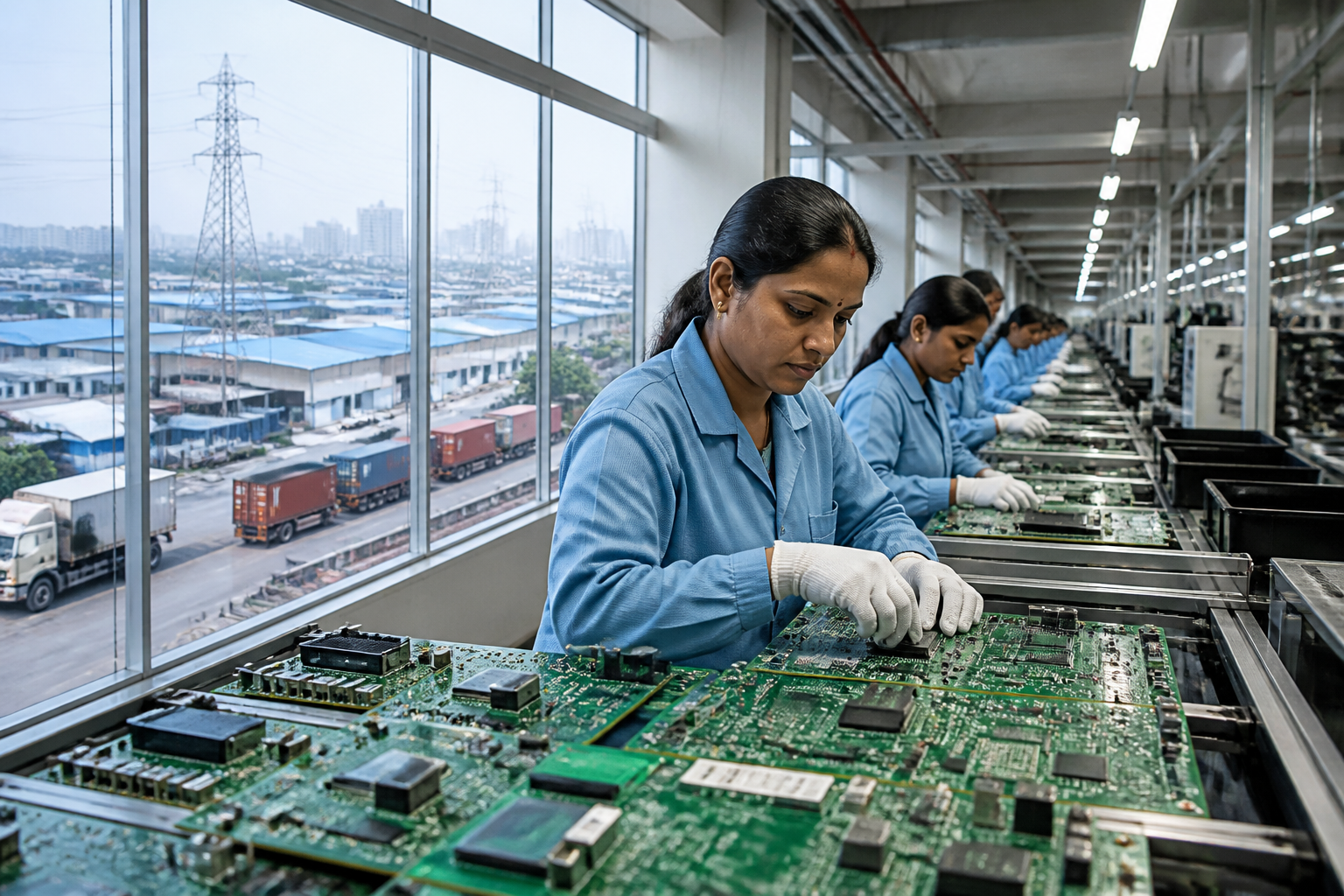
A more striking indicator came earlier in the electronics supply chain. India’s printed circuit board assembly, or PCBA, exports to China rose more than 40-fold in FY26, reaching $1.5 billion from $36 million a year earlier. Nearly 80% of India’s total PCBA exports went to China, while overall Indian PCBA exports increased more than 20-fold to $1.9 billion.
The figures do not establish that China is systematically relocating low-end manufacturing to India. Chinese customs data does not show a matching rise in PCB imports from India, and some of the reported trade appears to have been classified under smartphones and telecom equipment. Differences in trade classification make it difficult to identify precisely which products are driving the increase. Even so, the direction of the movement is notable because it reverses the familiar pattern in which India imports components from China, assembles products domestically and sells them in India or to other markets.
The larger explanation lies in how China’s manufacturing system has evolved. China’s strength is no longer limited to producing inexpensive goods. It has developed a dense supplier network that allows factories to divide production into increasingly specialised stages. As Chinese companies move into semiconductors, advanced electronics, artificial intelligence servers and telecom equipment, they may have less reason to retain every relatively simple subassembly in-house if it can be sourced competitively elsewhere.
This creates a narrower opportunity for India. The country does not need to reproduce China’s entire electronics ecosystem to participate in it. It needs to become competitive in specific intermediate activities where production scale, labour, engineering capability and costs are sufficient to attract orders. PCBA and basic box-build manufacturing are among the areas where India has already developed capacity, although more advanced design-led manufacturing and sophisticated electronics remain at an earlier stage.
India’s own industrial policy is moving in the same direction. The country’s first phase of electronics expansion focused heavily on assembling finished smartphones. Policy is now targeting components, subassemblies, materials and manufacturing equipment. The Electronics Components Manufacturing Scheme is central to that transition. Its allocation has been increased from Rs 22,919 crore to Rs 40,000 crore.
By August, 106 projects involving Rs 69,548 crore of investment had been approved under the scheme, with 38 plants either operational or in advanced stages of construction, according to the material cited by The Economic Times. The stated policy objective is to create domestic capacity in components and raw materials rather than simply assemble products using imported parts. That is also the type of capacity that could eventually generate exports to China.
The growth in India’s electronics industry shows how quickly the manufacturing base has expanded. Government data cited in the report puts electronics production at Rs 13.11 lakh crore in 2025-26, compared with Rs 1.9 lakh crore in 2014-15. Electronics exports rose from about Rs 38,000 crore to Rs 4.24 lakh crore over the same period.
However, the increase in production and exports does not mean that India has become self-sufficient. Domestic value addition remains around 18-20%. A study by the Koan Advisory Group and the Institute of Chinese Studies found that China supplied at least 80% of India’s imports across 71 electronics product lines in FY26. The number of such product lines had risen from 44 in 2018-19.
This dependence changes the meaning of the new export figures. India is not replacing China in electronics. Indian factories are increasingly making components and assemblies while importing a large share of their upstream inputs from China. That is a common feature of economies entering global value chains, where different countries specialise in different stages of production. It also means that a rise in Indian exports to China can occur alongside a large and persistent Indian trade deficit with China.
The bilateral imbalance remains substantial. India imported $131.6 billion worth of Chinese goods in FY26 and exported about $19.5 billion, leaving a deficit of roughly $112 billion. China remains deeply embedded in India’s electronics supply chain, supplying components, machinery and production inputs. The emerging trade pattern therefore represents deeper integration, not economic separation.
The same industrial ecosystem that contributes to India’s import dependence could also create a market for Indian manufacturing. The Economic Times previously reported that India’s exports of Apple-related components to China had reached $2.5 billion. That movement indicated that Indian suppliers were beginning to send components into production networks centred on China, rather than receiving all components from Chinese vendors for assembly in India.
Artificial intelligence and data centres may have accelerated this process. Demand for servers, networking equipment and associated electronics has created a new market for manufacturers able to meet scale and certification requirements. But AI demand alone cannot explain the change. The capacity to supply these markets has accumulated through smartphone production, production-linked incentives, contract manufacturing and the newer focus on components.
This distinction matters for industrial infrastructure. A temporary surge in AI-related demand may fade if investment in data centres or AI hardware slows. But factories, supplier relationships, production know-how and certification processes can remain in place. Once a manufacturer becomes an approved supplier to a major electronics company, it may gain access to additional product categories and markets. The durability of the trend will depend on whether that capability expands beyond a narrow set of orders.
The next test is therefore not simply whether India’s electronics exports to China continue rising. It is whether the export basket broadens from finished or assembled electronics into a wider range of components and industrial inputs. The areas identified in the source material include more sophisticated circuit boards, connectors, camera modules, displays, passive components and manufacturing materials.
That would align with the government’s stated objective of building a deeper domestic ecosystem. It would also require more than assembly plants. Component manufacturing depends on reliable power, logistics, industrial land, testing facilities, skilled labour, supplier networks and predictable policy. The scale of investment approved under the Electronics Components Manufacturing Scheme indicates that capacity creation is under way, but the supplied evidence does not yet establish how many projects will reach sustained commercial production or how much domestic value addition they will generate.
For cities and industrial regions, the consequences are likely to be expressed through manufacturing clusters rather than a single national trade statistic. Electronics production requires concentrated networks of suppliers, warehouses, testing facilities, transport links and worker housing. As component manufacturing expands, the urban systems around these facilities will influence whether India can move beyond assembly. The quality of industrial infrastructure will be as important as the incentive package.
The central urban-economic question is whether India can convert large approved investments into durable production ecosystems. A factory can raise output, but a cluster creates the supplier depth and specialised workforce needed for repeated innovation and export growth. The evidence currently confirms rapid expansion in electronics production and exports, rising policy support for components, and a notable increase in selected shipments to China. It does not yet confirm a broad transfer of manufacturing from China or a fundamental reversal of the bilateral trade deficit.
India’s opportunity may therefore be less dramatic but more practical: becoming a reliable supplier for selected stages of China-linked and global electronics value chains. Whether that opportunity becomes a lasting industrial shift will be measured by the breadth of components India can produce, the level of domestic value addition and the ability of manufacturing clusters to sustain competitive output beyond the current AI-led demand cycle.
