


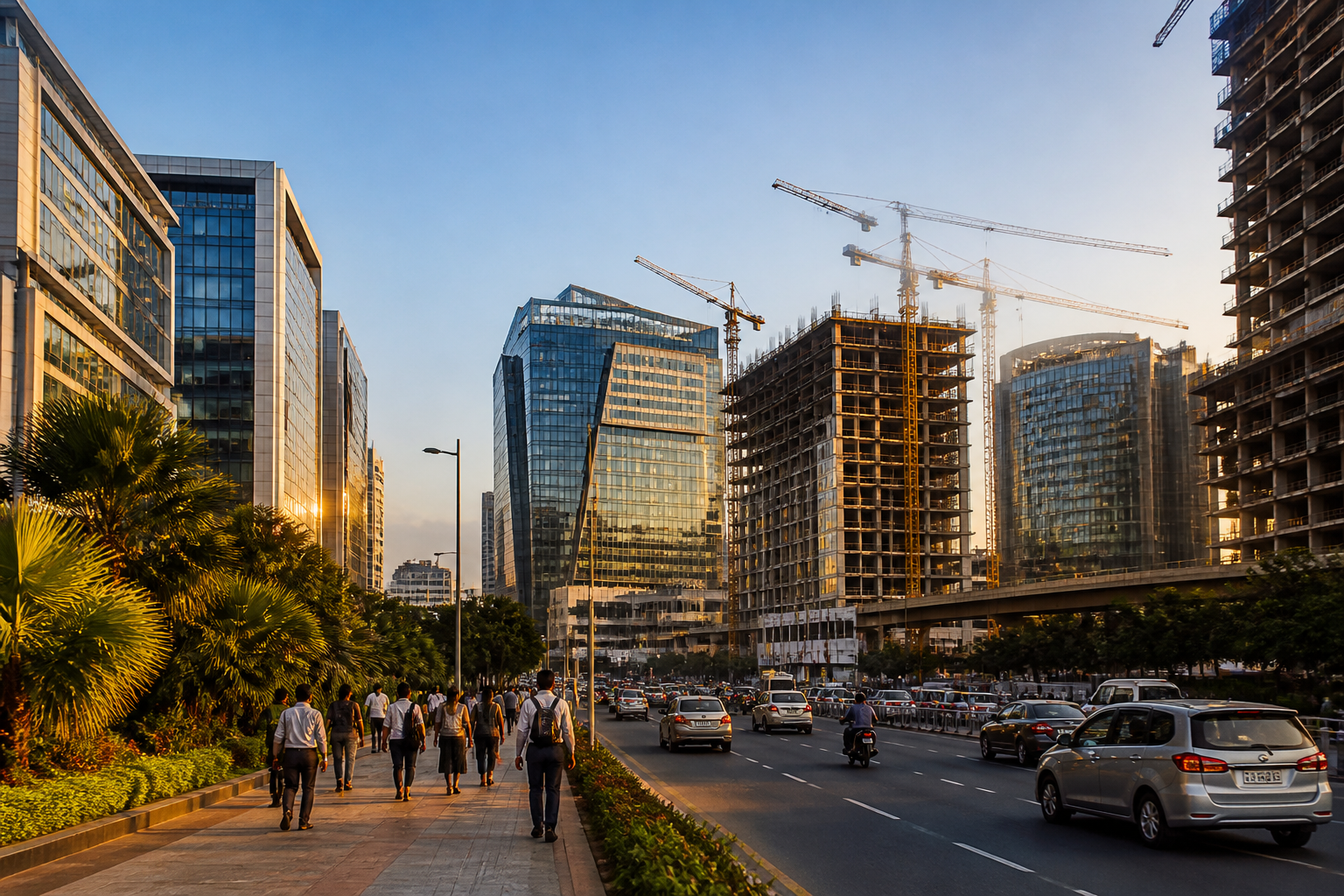
Telangana is positioning the Invest Telangana Global Summit 2026 as a new vehicle for attracting global capability centres, but the larger story is already visible in Hyderabad’s changing economic geography. The state expects companies from Japan and West Asia to announce proposals at the December summit, while its recent GCC expansion is strengthening demand for high-paying jobs, commercial space, supporting infrastructure and faster government approvals.
The summit is scheduled from December 7 to 9 at Bharat Future City. According to the industries department sources cited in the report, several global GCC companies are likely to sign memoranda of understanding with the Telangana government during the event. The government’s expectation is not limited to investment announcements. It is also treating GCCs as an instrument for technology, innovation and employment generation, placing the sector within the state’s broader Telangana Rising economic strategy.
That makes the summit more than a conventional investment event. It is a test of whether Hyderabad can convert its existing reputation as a global services destination into a durable urban development model. The city’s GCC growth has implications beyond office leasing. It affects where commercial districts expand, where high-income workers live, how transport demand changes and whether civic and administrative systems can keep pace with private investment.
The report says Telangana has attracted nearly 240 GCCs since the Congress government assumed office in December 2023. It also describes Hyderabad as one of India’s fastest-growing GCC markets over the past three years. Industry reports by Anarock-FICCI, Xpheno and UnearthIQ have highlighted this growth, with some estimates placing Hyderabad’s share at more than 40 per cent of GCCs established in India.
The figures indicate the scale of the concentration, although the supplied report does not provide a common methodology for comparing the estimates or define the period covered by the 40 per cent calculation. That limitation matters because GCC counts can vary depending on whether a centre is classified by its formal establishment, operational launch, workforce size or expansion from an existing office. Even so, the direction of the trend is clear in the account: Hyderabad is competing successfully for global back-office, technology, engineering and corporate capability functions.
The city’s banking, financial services and insurance ecosystem is identified as one of the factors supporting this expansion. Canadian banking major CIBC opened a technology centre in Hyderabad earlier this year, while DoorDash, Billtrust, Merck Sharp & Dohme, Acumatica, Baker Hughes and Regeneron Pharmaceuticals are among companies that have recently established GCCs in the city.
These examples show why GCC investment has an urban footprint. A capability centre requires office space, digital connectivity, transport access and a workforce able to operate in a competitive global services market. As more companies enter the city, the effect is likely to be distributed across commercial real estate, residential demand and everyday mobility. The supplied report specifically links the GCC push to commercial and real estate activity, though it does not quantify new office absorption, housing demand or traffic generated by these centres.
That missing detail points to an important distinction in Hyderabad’s growth story. Attracting a company is only the first stage. The deeper challenge is ensuring that the city can accommodate the workforce and services associated with sustained expansion. The report says the state government is seeking to improve infrastructure, speed up approvals and provide faster support to investors. Those priorities suggest that administrative execution, rather than only promotional activity, will determine how much of the announced investment becomes operational capacity.
The first meeting of the Invest Telangana Governing Council was held at the Secretariat under the leadership of Chief Secretary Sanjay Jaju. The meeting reviewed measures to strengthen the investment ecosystem, accelerate approvals, improve infrastructure and provide faster government support. Jaju directed officials to intensify global and domestic promotion of Telangana as an investment destination and maintain regular coordination with existing investors.
He also instructed departments to fast-track investment proposals and ensure their implementation within fixed timelines through inter-departmental coordination. This is significant because GCC projects typically cut across several administrative functions. Land and buildings, utilities, transport access, permissions, labour availability and digital infrastructure may involve different departments and agencies. The report does not identify a new single-window mechanism or provide implementation timelines for these changes, but the governing council’s agenda indicates that coordination has become a central part of the state’s investment policy.
The institutional question is therefore whether Invest Telangana will operate mainly as a promotion platform or as a delivery mechanism. The government is positioning it as both. Jaju said the platform should become a key instrument for achieving Telangana Rising goals related to investment, industrial growth and employment generation. That ambition will require the state to track proposals after MoUs are signed, distinguish announcements from implemented projects and maintain engagement with companies already operating in Telangana.
The emphasis on existing investors is particularly relevant. New investment announcements often receive the greatest public attention, but established companies provide a more direct measure of whether a city can support expansion. Regular coordination with them can reveal where approvals, infrastructure or service delivery are slowing growth. The report does not state how such coordination will be measured or which departments will be accountable for resolving investor concerns.
The summit is being presented as an investment-focused follow-up to the Telangana Rising Global Summit 2025. That earlier event unveiled the Telangana Rising Vision 2047 and set targets of building a $1 trillion economy by 2034 and a $3 trillion economy by 2047. The new summit places investment mobilisation within that long-term framework, with GCCs serving as one of the sectors expected to support the state’s economic and employment goals.
The targets establish the scale of the state’s ambition, but they do not by themselves explain the distributional or spatial consequences of growth. A larger economy can generate new employment and commercial activity while also increasing pressure on housing, transport and public services. The supplied report does not provide data on wages, local hiring, commuting patterns, office vacancy, residential prices or infrastructure capacity. Those indicators will be necessary to assess whether GCC expansion is producing broad urban benefits or concentrating gains in specific business districts and professional segments.
Hyderabad’s current position is strengthened by a combination of global company interest and an existing sectoral base. The presence of BFSI capabilities, along with recent entries from technology, healthcare, logistics and industrial companies, gives the city a platform for further diversification. Japanese and West Asian companies reportedly exploring Hyderabad would add to this international mix if their proposals are announced and subsequently implemented.
The distinction between exploration, an MoU and an operating centre remains important. The report says companies are exploring the city and may announce investment proposals at the summit. It also says several GCC companies are likely to sign MoUs. Neither outcome necessarily establishes the final investment value, project timeline, workforce size or completion status. Those details will determine the actual effect on Hyderabad’s built environment and labour market.
For the state government, the immediate administrative task is to turn investor interest into projects with clear milestones. For the city, the longer-term question is whether infrastructure planning is being aligned with the location and scale of new economic activity. The report’s reference to Bharat Future City adds a further spatial dimension, although it does not specify which summit-linked projects, if any, will be located there or how the new urban district will connect to existing employment clusters.
The GCC expansion also raises a question about the meaning of a high-paying jobs strategy. The state views these centres as drivers of employment, technology and innovation. That can strengthen the urban economy, but the available report does not establish how many jobs the recently announced or established centres have created, what proportion is filled by local workers or how employment is distributed across skill levels. Without that information, the employment impact remains an official objective rather than a measured outcome.
What the evidence confirms is that Hyderabad has become a major focus of Telangana’s investment policy and that GCCs occupy a prominent place in the state’s economic strategy. The reported figure of nearly 240 centres since December 2023, the participation of multiple global companies and the government’s decision to prioritise approvals and infrastructure all point to an expanding investment ecosystem.
What remains uncertain is how many prospective investments will become operational, how quickly projects will be implemented and whether the city’s housing, mobility and civic systems will expand alongside its office economy. The next significant evidence will come from the December summit’s actual announcements, followed by the conversion of MoUs into projects, jobs and functioning centres. Those milestones will show whether Invest Telangana can move beyond investment promotion and become an effective mechanism for managing Hyderabad’s next phase of urban growth.
