


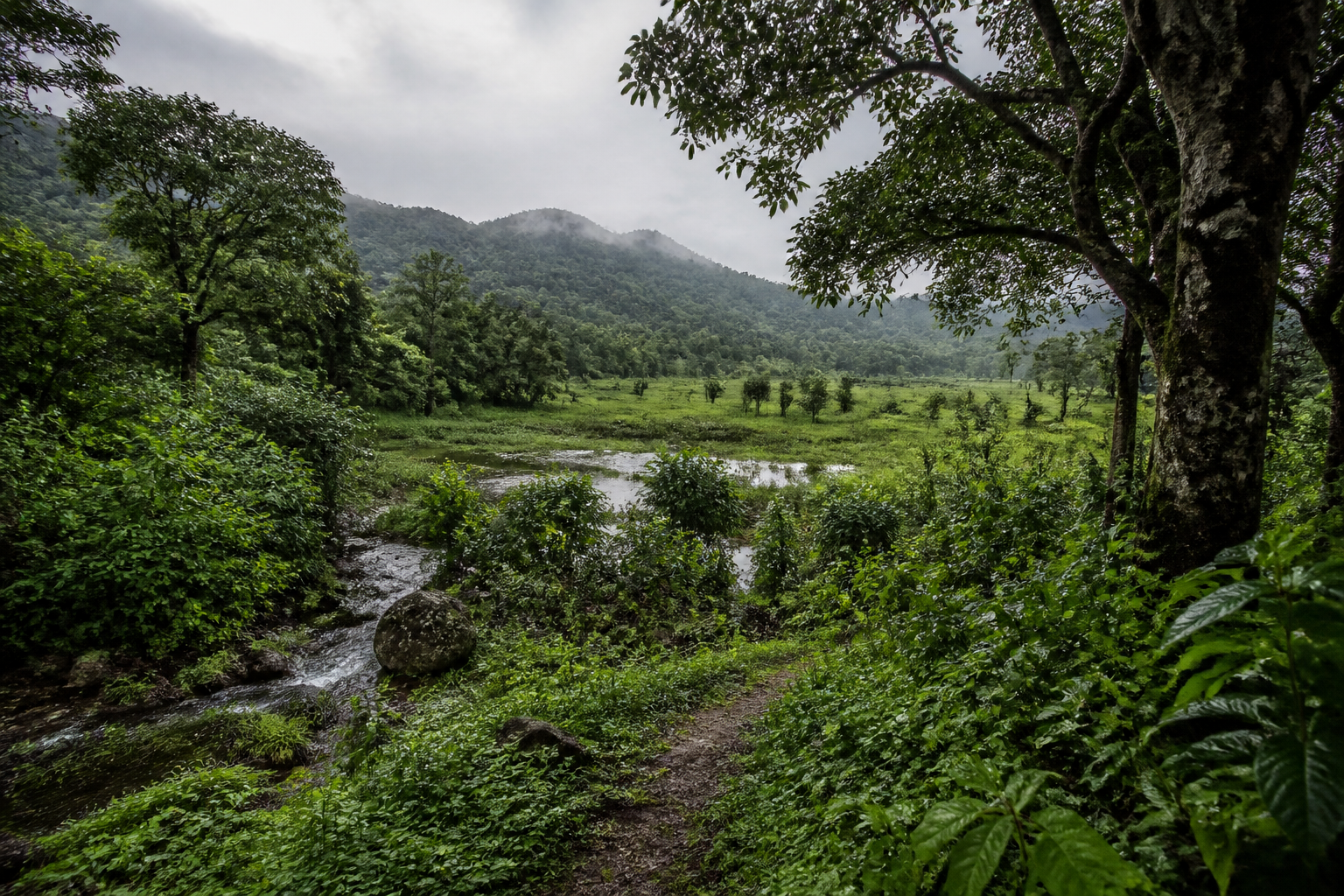
A warning from Kerala Agricultural University forestry dean P O Nameer has exposed a central problem in forest restoration in Kerala: interventions intended to improve habitats can weaken them when they are designed without a scientific understanding of local ecosystems. His concerns span path clearance, artificial waterholes, beach afforestation, grassland planting and the removal of invasive trees, showing that restoration is not simply a matter of adding vegetation or creating visible signs of activity.
Nameer made the remarks during a session on the status and rising threats facing Kerala’s wildlife at Vanaspandanam, organised by the Coexistence Collective and the State Central Library as part of Wildlife Week celebrations. His argument was direct: conservation interventions in protected areas must begin with scientific assessment of the ecosystem they are meant to repair. Without that assessment, an intervention may produce a landscape that appears greener or more managed while undermining natural regeneration, wetlands or the wider habitat system.
That distinction matters because restoration is often judged by what can be seen quickly. A cleared path, a newly planted area, an artificial waterhole or the removal of a conspicuous invasive species can all appear to demonstrate action. But Nameer’s examples suggest that the visible result may not reveal whether an ecosystem is recovering. The more important questions are whether young trees are regenerating, whether associated species are returning and whether water and habitat relationships are being preserved.
His reference to vista clearance illustrates the risk. In protected areas, vegetation may be removed up to 10 metres on either side of a forest path to improve visibility or access. Nameer cautioned that such clearance must be carried out carefully. Areas stripped of undergrowth may look open and green after the work, but removing vegetation can affect natural regeneration. The intervention therefore changes more than the appearance of a path: it may also alter the conditions under which new plants establish and mature.
Evidence from a study in the Wayanad forests adds a longer-term dimension to that concern. The study used trunk girth as an indicator of regeneration and found trees thicker than 60 centimetres, but no trees thinner than 10 centimetres. Nameer said the absence of young trees indicated that the forests could face poor regeneration over time. The finding is important because a forest can retain large, mature trees while losing the next generation needed to sustain the ecosystem.
This shifts the focus from forest cover to forest continuity. A landscape with older trees may still appear healthy from a distance, yet the absence of younger trees can indicate a break in the ecological cycle. For restoration planning, the implication is that success cannot be established by measuring only the area treated or the amount of vegetation visible after an intervention. The age structure of the forest and the presence of natural regeneration also need to be examined.
Water management presents a similar problem. Nameer cautioned against the indiscriminate construction of artificial waterholes, pointing to the relationship between proposed water infrastructure and existing wetland systems. Wayanad has 929.576 hectares of paddy fields in Kurichiat, Muthanga, Sultan Bathery and Tholpetty. He said large waterholes built near these fields could draw water away from them and affect the wetland ecosystem.
The concern is not simply whether an artificial waterhole holds water. It is whether the intervention changes the distribution and movement of water across the wider landscape. Nameer also cited studies indicating that animals did not always prefer artificial waterholes when natural flowing water sources were available nearby. This challenges the assumption that creating additional water bodies automatically improves habitat conditions. In some locations, the intervention may be unnecessary; in others, it may shift pressure onto connected ecosystems.
The same principle applies to beaches. Nameer said afforestation on open sandy beaches could damage coastal ecosystems. Such beaches are considered wetland ecosystems, and planting trees including casuarina, sometimes justified as protection against tsunamis, can alter their ecological character. The example demonstrates why a standardised idea of restoration can be harmful: an intervention regarded as beneficial in one landscape may reduce the ecological value of another.
Grassland restoration creates another layer of complexity. Nameer warned that the choice of grass species requires caution and said Pennisetum clandestinum, an invasive grass considered a noxious weed in the United States and Australia, was being used in some restoration efforts. In Pambadum Shola, he said, the removal of acacia had been followed by the emergence of another potentially dangerous invasive species.
These examples reveal a recurring institutional challenge. Removing one unwanted species does not necessarily restore the original ecosystem. It can create new conditions that favour another species, particularly when the replacement planting or follow-up management is not based on local ecological knowledge. Restoration therefore requires assessment before intervention and monitoring after it. Without both, the project may record an action while missing the ecological consequences.
The question of measurement is at the centre of Nameer’s criticism. He asked whether some interventions represented “green restoration or greenwashing”. The distinction is not about whether a project uses environmentally positive language. It is about whether the claimed improvement can be demonstrated through the recovery of the ecosystem’s functions and associated species.
His example of bison makes that point clearly. Restoration cannot be considered successful merely because bison return to an area, he said. The return of butterflies and other associated species is equally important. A single visible or charismatic species may indicate that part of a habitat has become usable again, but it does not establish that the full ecological community has recovered.
For protected-area managers, this expands the responsibility beyond managing individual sites or creating isolated features. Path edges, waterholes, paddy fields, sandy beaches, grasslands and forest patches are connected through water, vegetation and species movement. An intervention that improves one element may damage another if the assessment is confined to a narrow project boundary.
The evidence presented in the session does not establish that every intervention mentioned has caused lasting damage, nor does it reject restoration as a conservation tool. Instead, it identifies the conditions under which restoration can fail: when appearance replaces measurement, when local ecosystems are treated as interchangeable and when short-term visibility is valued over natural regeneration and ecological diversity.
That is also why the administrative design of restoration matters. The concerns raised by Nameer imply a need for site-specific ecological assessment, careful selection of species, monitoring of regeneration and evaluation of associated wildlife rather than relying on a single indicator. The supplied report does not set out a new government policy or implementation framework, so the responsibilities of particular departments and the status of the cited interventions cannot be established here. What it does show is that restoration decisions involve competing ecological functions and cannot be treated as routine landscaping.
Kerala’s protected areas and coastal ecosystems are therefore confronting a problem of definition as much as a problem of degradation. If restoration means returning an ecosystem’s capacity to regenerate and support its associated species, then planting, clearing or constructing alone cannot prove success. The Wayanad regeneration finding, the concerns over artificial waterholes, the warnings on beaches and the invasive-species examples all point to the same conclusion: restoration must be judged by ecological outcomes that may be slower and less visible than the intervention itself.
The next stage for any such project is consequently not simply more activity, but better evidence. Scientific assessment before intervention and ecological monitoring afterwards would determine whether young trees return, whether water systems remain connected, whether invasive species are controlled and whether the wider community of species recovers. Until those measures are applied consistently, a greener-looking landscape may not necessarily be a restored one.
