


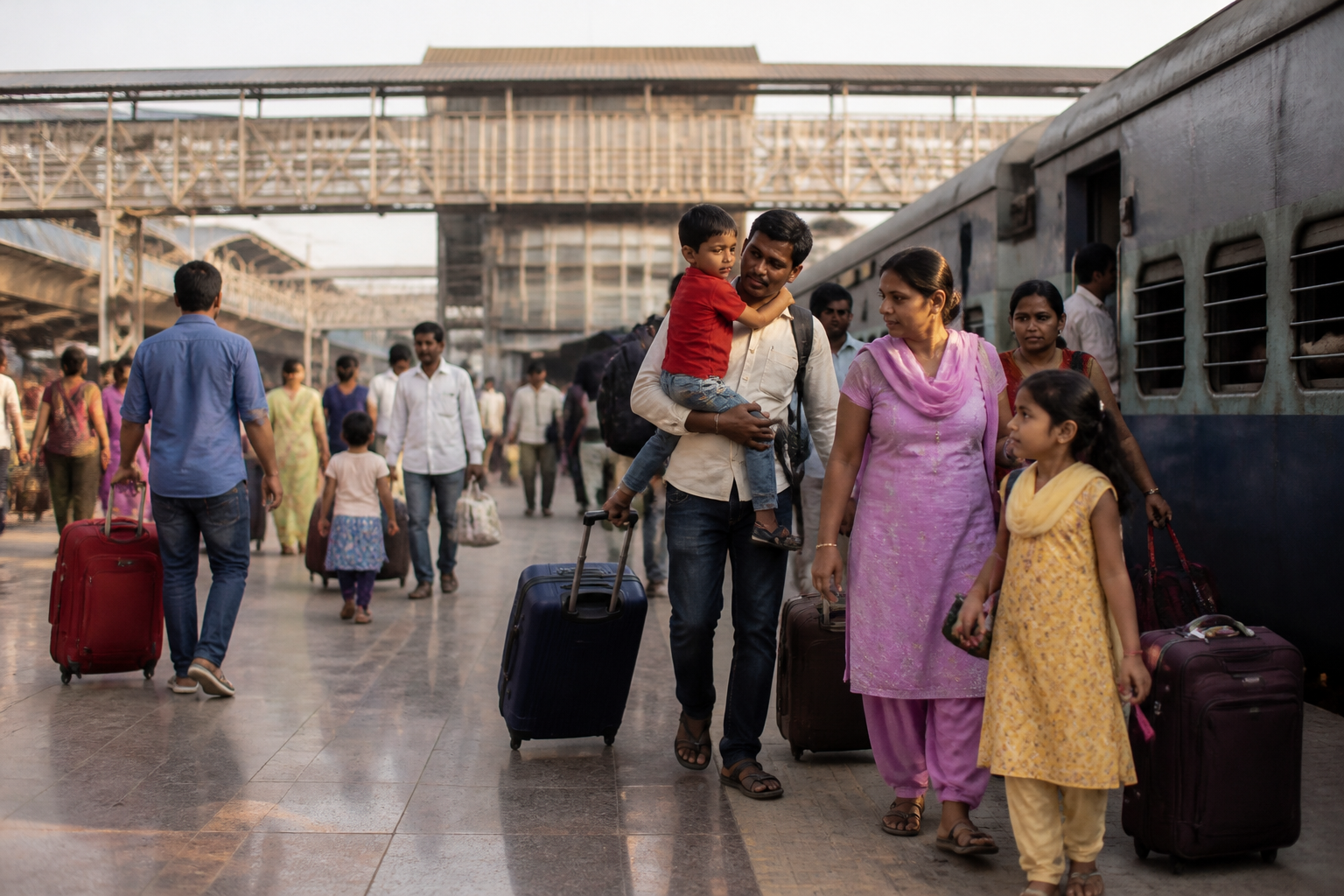
Hyderabad’s festival exodus is often visible as an unusual improvement in traffic. Roads that normally move slowly begin to clear, apartment parking spaces empty and office attendance falls. But the annual movement out of the city is more than a temporary dip in congestion. It reveals how Hyderabad is organised by people whose daily lives are urban but whose family, property and emotional responsibilities remain spread across other towns and villages.
During Bathukamma and Dasara in 2025, the Telangana State Road Transport Corporation operated 7,754 special buses, 617 more than the previous year, according to the supplied report. For Sankranti 2026, it arranged another 6,431 services. On some routes connecting Hyderabad with Andhra Pradesh, more than one lakh railway tickets were reportedly claimed within minutes of reservations opening. These figures show the scale of seasonal demand, but they also indicate something less visible: a large share of Hyderabad’s residents continue to maintain active relationships with places outside the city.
The festival journey therefore functions as a form of urban data. It maps where residents’ families live, where inherited property and land may remain, and where social obligations continue to be performed. Transport systems record the movement through buses, trains and highways. The deeper story is about the people making those journeys and the way migration has shaped Hyderabad without necessarily severing links with the places they left.
Migration is frequently described as a one-way transition from village to city. The experience described in the report is more complicated. A professional working in Hitec City may speak to parents in Karimnagar every evening. A student living in Tarnaka may return for important family occasions. A household in Kukatpally may have a housing loan and a settled routine in Hyderabad while also retaining land, property or responsibilities in a village several hours away.
Hyderabad provides employment, education, privacy and opportunity. The native place carries family history, childhood relationships and the social memory of being known before a job title, apartment number or office identity card became central to everyday life. These are not competing addresses in a simple geographical sense. They perform different functions. One supports the present; the other connects residents to origins, relationships and obligations.
The report describes such lives as translocal: lives organised across more than one place. The concept is useful because it challenges the assumption that becoming urban requires abandoning an earlier identity. A resident can build a career, raise children and pay rent or a housing loan in Hyderabad while continuing to participate in the economic and social life of a distant hometown. The city does not replace the earlier place. It becomes one part of a wider system of belonging.
Festival travel also sustains practical networks. The return journey is not only about nostalgia, familiar food or childhood rituals. A neighbour may watch over a locked house or agricultural land. A family member working in Hyderabad may contribute towards education, medical treatment or household expenses elsewhere. Money, information and care move in both directions. The people travelling between the city and the hometown are also maintaining the relationships that make life more manageable across distance.
This is a form of social infrastructure that rarely appears in urban plans. Roads, railway lines and bus services are physical systems, but they support a parallel network of family care and mutual assistance. A person may depend on relatives outside Hyderabad during a medical emergency, while relatives in the hometown may depend on income earned in the city. Festival visits renew these connections through face-to-face contact, gifts, shared meals and participation in family events.
Digital communication has reduced some of the difficulties of distance, but it has not removed the need to travel. WhatsApp and video calls can help families remain in touch during the year. They cannot fully replace physical presence at a festival, a visit to an elderly relative or the act of returning with food and gifts. The continuing demand for special buses and additional train services suggests that digital connectivity has supplemented, rather than displaced, physical relationships.
The same networks can also impose obligations. Belonging offers security, but it can involve expectations about attendance, financial support and participation in family life. A resident who cannot obtain leave, afford a ticket or manage the journey may remain in Hyderabad while others travel. The quieter city during a festival is therefore not a uniform experience. Some residents are returning to celebrate, while others remain at work in transport, retail, hospitality, security and other services that allow the city and the journeys to function.
This unequal capacity to travel is an important part of the urban picture. Festival mobility depends not only on the availability of buses and trains but also on income, leave arrangements, family circumstances and the strength of relationships at the destination. A city may register a large outward movement, yet the figures do not show who was unable to leave or who had no hometown that still felt like home. The transport count captures demand, but not the different conditions under which residents experience that demand.
The journeys also carry cultural change back and forth. People do not return to places that have remained frozen in time. Fields may have become layouts, shops may have closed, younger relatives may have moved away and old friends may meet mainly during festivals. At the same time, the traveller has changed through years of living in Hyderabad. Food, cinema, humour, everyday phrases and city routines become part of an identity that was formed elsewhere but reshaped in the urban environment.
This process does not require residents to surrender earlier identities. A Bengali, Marathi, Odia, Kannada-speaking or North Indian resident can participate in Hyderabad’s social and cultural life without giving up another cultural world. The city’s influence often becomes visible gradually, through preferences and habits rather than formal declarations of assimilation. Hyderabad is carried back to the hometown just as memories and obligations are carried into Hyderabad.
The meaning of home can also change over time. The first journey to Hyderabad may be made for education or employment, with the family home remaining the unquestioned destination. Years later, after a career, friendships and routines have taken shape, the city may become the place to which a resident returns. Children raised in Hyderabad may know the ancestral village largely through holiday visits, even when that village remains important to their parents.
This shift does not make the older home irrelevant. It produces layered belonging. The hometown remembers the beginning of a person’s life, while Hyderabad contains the life built afterwards. A resident can leave the city during a festival and still return to it as home. The apparent contradiction is central to understanding how contemporary Indian cities absorb migrants: urban attachment can grow without erasing earlier ties.
For Hyderabad’s institutions, the seasonal movement has a direct operational dimension. Special bus services and additional rail capacity are needed because the city’s population is not socially static. Its mobility patterns change sharply during major festivals, requiring transport agencies to respond to concentrated demand on particular routes and dates. The reported ticket rush and special services show that festival mobility is large enough to require advance planning rather than being treated as ordinary holiday traffic.
At the same time, the wider meaning of the movement extends beyond transport management. The annual exodus reveals a city whose residents maintain economic and emotional links across a broad regional geography. Urban policy commonly focuses on the neighbourhoods where people live and work. The festival journey shows that many households operate across multiple locations, with responsibilities that connect apartments, rented rooms and offices in Hyderabad to family homes, land and relatives elsewhere.
The evidence supplied in the report does not establish how many Hyderabad residents maintain such two-address lives, how long they remain away during each festival or how these patterns vary by income and occupation. It does, however, provide clear indicators of scale: thousands of special bus services, a year-on-year increase in festival buses and intense demand for railway tickets. Those numbers are sufficient to show that the movement is not a marginal cultural practice but a recurring urban and regional mobility pattern.
Hyderabad’s festival exodus should therefore not be read as evidence that residents are weakly attached to the city. It shows that belonging is not always exclusive and that migration does not necessarily end a person’s relationship with a place of origin. For a few days, the city loses part of its population while distant homes receive it. When the holidays end, residents return with food, gifts, memories and renewed obligations. The traffic returns too, confirming that the city’s temporary emptiness was not abandonment but movement between two homes.

