


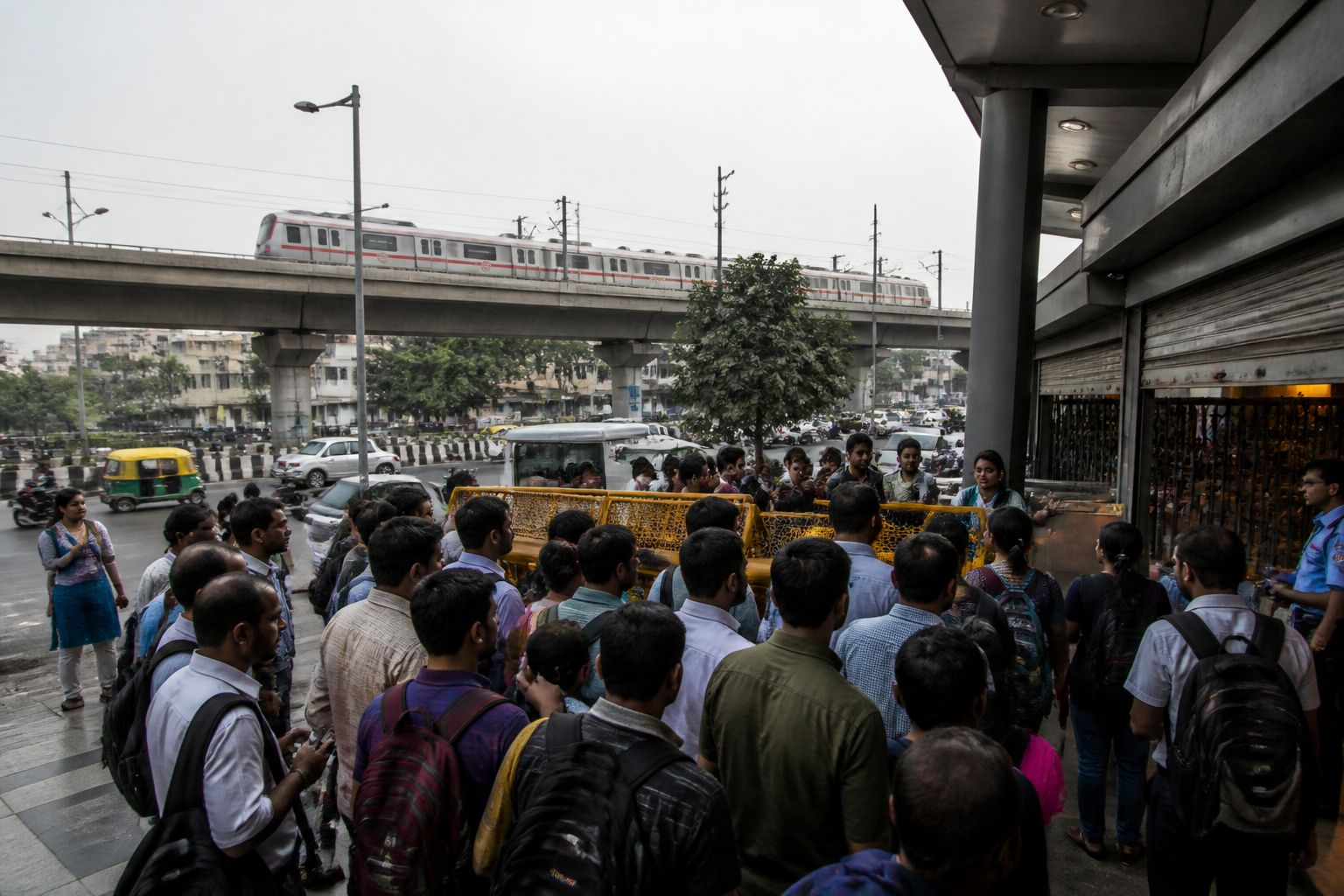
The Delhi Metro restrictions imposed during protests on October 10 have developed into more than a dispute over whether trains were technically running. The proceedings before the Supreme Court expose a difficult governance question for a city dependent on mass transit: when security agencies restrict access to stations, who is responsible for preserving mobility, communicating the disruption and complying with judicial directions?
The Delhi Metro Rail Corporation (DMRC) told the Supreme Court that entry and exit restrictions at stations were imposed on the instructions of the Delhi Police during protests by the Cockroach Janta Party. In an affidavit, DMRC Chairperson D Thara said the corporation had complied with the court’s October 9 direction “in letter and spirit” and offered an “unconditional apology” in response to a contempt notice.
The court’s earlier direction had required the Centre to ensure that there was no “complete prohibition” on the movement of Metro and other trains coming to Delhi on October 10. The order followed petitions challenging the closure of entry and exit gates at 57 Metro stations. On October 11, the court said the petitioners had made out a prima facie case of contempt and sought a response from DMRC.
DMRC’s defence rests on a distinction between train operations and passenger access. According to the affidavit, there was no curtailment or cancellation of train services and no reduction in the total number of train trips. A total of 271 trains operated and completed all 4,157 scheduled trips on October 10. At the same time, entry and exit restrictions affected 45 stations after the court’s order, down from the 57 stations identified in the petitions.
This distinction matters because a functioning train service does not necessarily mean a functioning public transport system. Metro access depends on the ability of passengers to enter stations, change lines, exit near their destinations and receive timely information about restrictions. If station access is closed while trains continue to run through the network, the system may retain operational continuity while losing practical usefulness for a substantial number of commuters.
DMRC said all 45 affected stations were opened by 10 pm on October 10 on the Delhi Police’s instructions. The corporation later received another communication from the police on October 12 directing the closure of entry and exit at six stations between 6 am and 4 pm. The restrictions were subsequently extended until 5 pm, according to the affidavit.
The numbers supplied by DMRC show the effect of the restrictions without establishing that the entire network stopped functioning. Approximately 32 lakh commuters travelled on the Metro network during operational hours on October 10, compared with around 58 lakh passengers on a normal second Saturday. Ridership was therefore lower by about 26 lakh passengers, although DMRC attributed the reduction to the protest, saying many commuters may have refrained from travelling or undertaking their usual daily activities.
DMRC also said the restrictions applied to 45 of the network’s 303 stations, or about 15 per cent of the system. The remaining 258 stations, it said, continued to be operational, accessible and functional. Fourteen key interchange stations, including Rajiv Chowk, Kashmere Gate, Central Secretariat, Mandi House and Hauz Khas, continued to provide uninterrupted interchange facilities.
The figures offer an important operational picture, but they do not by themselves resolve the legal or public-policy question. A station’s formal status as operational does not capture how passengers were affected when access was restricted at particular locations, especially stations serving protest sites, educational areas, commercial districts or interchange points. Nor does the network-wide ridership figure show how disruption was distributed between neighbourhoods and passenger groups.
The affidavit indicates that passenger movement at sensitive stations such as GTB Nagar and Vishwavidyalaya was regulated rather than completely stopped. At Vishwavidyalaya, exit gates remained operational, while Gate 3 at GTB Nagar was kept open to facilitate passenger exits. These arrangements suggest that the authorities were attempting to manage crowd movement and security risks without fully suspending train services.
That approach places the Metro at the centre of a multi-agency decision-making chain. The police assess the law-and-order situation and issue directions. DMRC controls train operations, station management and passenger communication. The Centre was involved because the Supreme Court’s October 9 order directed it to ensure that movement was not completely prohibited. The court, meanwhile, examined whether the actions taken by the authorities complied with its order.
The episode shows how responsibility can become difficult to identify during an emergency. DMRC’s affidavit says the restrictions were imposed pursuant to the assessment of law-enforcement agencies and in accordance with their directions. At the same time, commuters experience the result as a single transport system, not as separate decisions by the police, the Metro corporation and the Union government. The institutional division may be clear internally, but accountability is less clear at street level.
Communication is therefore not a secondary operational issue. DMRC said its official accounts on X, Facebook, Instagram and LinkedIn provided regular updates on planned regulations. Announcements were made from the Operations Control Centre and by train operators, while advisory signboards were placed at station gates. Such measures can help commuters change routes or avoid unnecessary journeys, but their value depends on how early, specific and consistent the information is.
The dispute also highlights the limits of measuring public transport availability through train frequency alone. DMRC’s statement that all 4,157 scheduled trips were completed establishes that the core service plan remained intact. But the Supreme Court proceedings arose because access to stations was restricted. For passengers, the relevant journey begins before boarding and ends after leaving the station. A train passing through a station cannot substitute for an open entrance, an available exit or a usable interchange.
The ridership decline reinforces this point. The network carried approximately 32 lakh passengers on October 10, compared with about 58 lakh on a normal second Saturday. The supplied material does not establish how many journeys were cancelled because of direct station restrictions, how many were avoided because of the protest, or how many passengers used alternative modes. That uncertainty is important: network-wide operations data can show the scale of reduced usage, but not the complete distribution of inconvenience or economic loss.
The case also raises a structural question about the legal framework for restricting access to urban transport. The source material does not set out a formal protocol governing station closures during protests, nor does it specify how decisions are reviewed, recorded or communicated across agencies. What it does show is that the authority to assess security conditions and the responsibility to operate a public transport network can produce competing imperatives.
For a city as dependent on the Delhi Metro as the National Capital Region, those imperatives require an approach that distinguishes among different types of restrictions. Closing an entire station, restricting only entry, keeping exits open, limiting interchange or temporarily managing passenger flows are not operationally equivalent. Each creates a different impact on mobility and requires different public communication. The affidavit’s account of GTB Nagar and Vishwavidyalaya demonstrates that authorities were already using differentiated measures, but the court proceedings indicate that the legal interpretation of those measures remains consequential.
The Supreme Court’s contempt proceedings have consequently made the October 10 episode a test of institutional coordination, not merely a question of whether trains ran on schedule. DMRC maintains that there was no blanket shutdown and that more than 85 per cent of the network remained fully operational. The petitioners’ challenge, as described in the report, questions whether restrictions nevertheless violated the court’s direction against a complete prohibition on movement.
The evidence currently confirms three points: scheduled train services continued; access restrictions were imposed at a significant number of stations on police instructions; and ridership was substantially lower than on a comparable normal Saturday. It does not, from the supplied material, establish the full passenger-level consequences of each restriction or the court’s final determination on contempt. The next significant development is therefore the Supreme Court’s consideration of DMRC’s affidavit and the responses concerning compliance with its October 9 order.

