


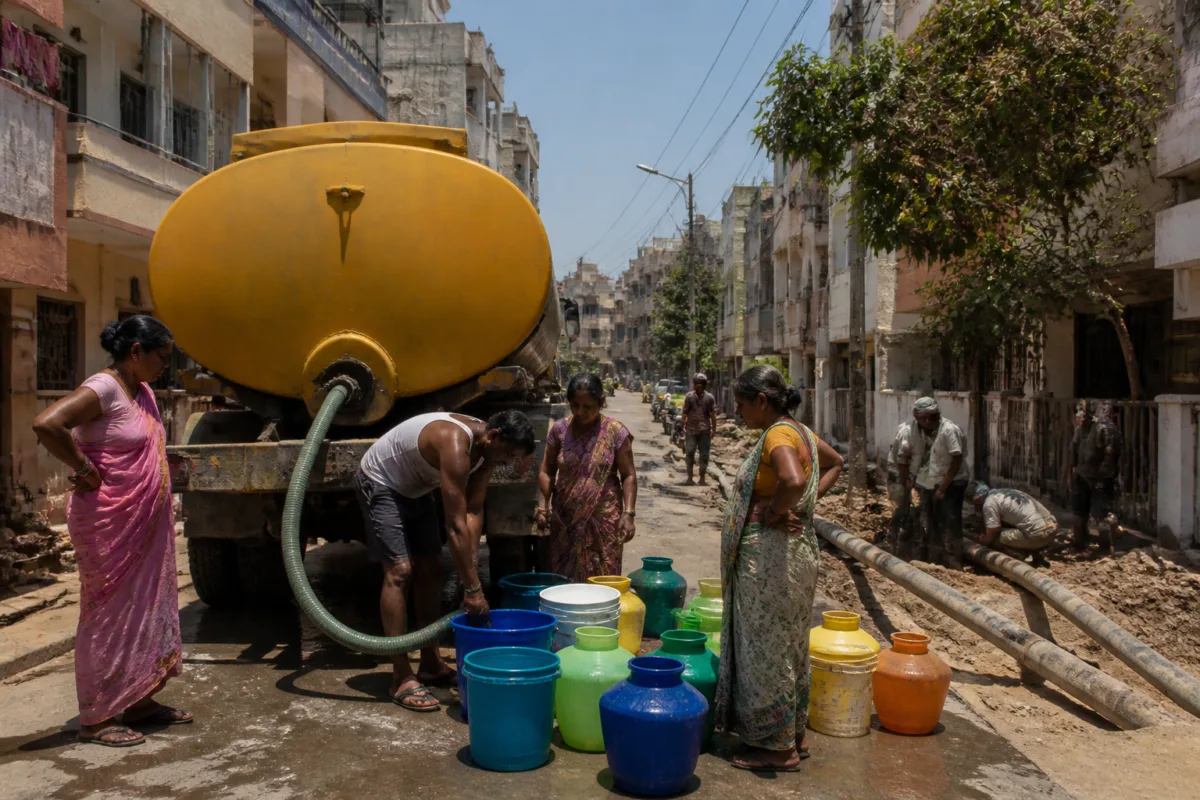
Hyderabad’s latest water-stress warning is being shaped by weak rainfall, low reservoir levels and higher tanker demand. But the figures presented by public policy researcher Devana Varshith point to a deeper urban problem: a large share of the water already entering the city’s distribution system may be lost before it reaches consumers.
Writing in Telangana Today, Varshith argues that Hyderabad’s water crisis cannot be explained by El Niño or a single poor-rainfall season. The city’s reservoirs were reported to be about 25 per cent full, compared with 65 per cent in October of the previous year. Tanker bookings reached around 1.48 lakh in September, against 47,000 in the same month a year earlier. Telangana also recorded a 17 per cent rainfall deficit, while storage in the Krishna and Godavari basins was reported to be 72 per cent and 40 per cent lower, respectively, compared with the same period last year.
Those figures explain the immediate pressure on supply. They do not, however, explain why neighbourhoods such as Kukatpally, Miyapur, Manikonda, Gachibowli and Madhapur face shortages almost every year. The argument advanced in the article is that rainfall variability is exposing an existing weakness in the way Hyderabad stores, distributes, measures and repairs its water network.
The scale of that weakness is captured in the estimate for non-revenue water, or NRW. This refers to water supplied into a network but lost through leakages, theft, unauthorised use, metering failures and other operational inefficiencies. Varshith estimates that about 35 per cent of the water supplied in Hyderabad is lost in this manner. At a reported supply of more than 2,600 million litres per day, that would amount to approximately 910 MLD every day.
The estimate is significant because it changes the nature of the water debate. A city facing scarcity is usually understood to need new sources, larger reservoirs or additional pumping capacity. Those investments may still be required, particularly when rainfall is unreliable. But a high NRW level means that part of the immediate supply challenge exists inside the city’s own network. Water is being brought into the system, but not all of it is reaching paying consumers or households that depend on regular piped supply.
The article places Hyderabad’s reported supply at around 200 litres per capita per day, above the Union government’s urban benchmark of 135 LPCD. It also compares the figure with reported supply levels in London, Amsterdam, Tokyo, Paris and Dallas. These comparisons do not by themselves prove that every neighbourhood receives adequate water, because citywide supply averages can conceal sharp differences between areas and between formal and informal connections. They do show why the problem cannot be assessed only by measuring how much water enters the metropolitan system.
The more relevant question is how evenly and reliably that supply is distributed. A city may have a high average allocation and still leave some neighbourhoods dependent on tankers if pipelines are ageing, local pressure is unstable, consumer connections are poorly installed or repairs are delayed. The distinction between system-wide availability and household-level access is therefore central to Hyderabad’s water question.
Varshith’s proposed benchmark is a reduction in NRW from 35 per cent to 15 per cent. On the figures cited in the article, that would reduce daily losses from about 910 MLD to around 390 MLD, recovering approximately 520 MLD. At the benchmark of 135 LPCD, the recovered quantity could meet the daily requirements of roughly 39 lakh people. The calculation is an estimate, and the water saved would not automatically translate into equal supply for every resident. It would depend on how the recovered water was allocated, how the network was rebalanced and whether treatment, pumping and storage capacity could support the change. Even with those qualifications, the calculation illustrates the size of the potential gain from reducing losses.
The examples cited from other cities are intended to show that NRW is not an unavoidable feature of urban water systems. Puri reportedly reduced its NRW from 47 per cent in 2019 to 15 per cent by 2022. Dhaka reduced its reported level from 40 per cent to 5 per cent, Manila from 63 per cent to 13 per cent, and Jamshedpur from 36 per cent to 10 per cent. These comparisons are not directly transferable to Hyderabad: network size, institutional arrangements, geography, consumer density and measurement methods can differ substantially. They nevertheless provide evidence that sustained operational interventions can produce large reductions in water losses.
The Puri example offers the most detailed institutional lesson in the supplied material. Under Odisha’s Sujal “Drink from Tap” Mission, officials first conducted a water audit to establish how much water entered the network, how much was lost and where those losses occurred. The distribution network was mapped to identify defective or ageing pipelines. Sensors were installed to monitor water pressure and flow remotely, allowing officials to identify unusual variations that could indicate underground leaks.
The second intervention involved consumer connections. According to the article, connections had previously been installed by local contractors or plumbers after approval, a process that could result in poor-quality work and damage to the main distribution network. The system was changed so that connections were installed under government supervision using qualified contractors and standard materials. The intended effect was to prevent new leakage points from being created when consumers were connected to the network.
The third measure was the creation of a dedicated NRW cell to monitor losses continuously and ensure that problems were addressed. The importance of this step lies in institutional ownership. Leakage reduction is not a one-time construction project. Pipes deteriorate, pressure changes, meters fail and illegal connections can reappear. Without a unit responsible for tracking the network over time, a city may repair visible leaks while allowing less obvious losses to continue.
The financial argument is equally important. The article estimates that applying Puri’s reported per-capita expenditure to Hyderabad would require an investment of around Rs 12,000 crore, spread over two years. It compares this with Telangana’s FY 2026–27 budget of more than Rs 3.2 lakh crore and calculates that an annual allocation of Rs 6,000 crore would be less than 2 per cent of the State budget. These are estimates presented by the author, not a confirmed project cost or an approved government allocation. The actual requirement would depend on Hyderabad’s network condition, the number of connections, land and access constraints, sensor coverage, pumping systems and implementation design.
The funding calculation nevertheless highlights a recurring governance issue in urban infrastructure. New water sources and large capital projects are politically visible because they produce identifiable assets such as reservoirs, treatment plants and pipelines. Distribution efficiency is less visible. It requires detailed audits, repeated repairs, accurate consumer databases, metering, pressure management and administrative coordination. The benefits are dispersed across neighbourhoods and may be difficult to associate with a single project. Yet these less visible functions determine whether a city’s existing assets perform as intended.
The Hyderabad Metropolitan Water Supply and Sewerage Board is the key institution identified in the article as the city’s water supplier. A serious NRW programme would therefore require more than a target percentage. It would need a reliable baseline, division of the network into measurable zones, regular flow and pressure monitoring, a plan for replacing defective pipelines, standardised connection procedures and a system for publishing progress. The source material does not establish whether all these components currently exist at the required scale in Hyderabad. That gap is itself relevant because the success of a reduction target depends on the quality of measurement behind it.
The analysis also places distribution losses alongside other parts of the urban water system. Lake restoration, rainwater harvesting and expanded sewerage infrastructure are identified as important measures, but the immediate opportunity is described as improving the efficiency of the existing distribution network. This is not an argument that source augmentation is unnecessary. It is an argument that adding supply without reducing losses can leave the city with a larger but still inefficient system.
Hyderabad’s experience reflects a wider tension in Indian cities between aggregate infrastructure capacity and dependable service delivery. A city can report substantial daily supply while households in fast-growing peripheral areas face irregular schedules and tanker dependence. Rapid development in locations such as Gachibowli, Madhapur, Manikonda and Miyapur increases the pressure on systems designed for different population and land-use patterns. Where network expansion, metering and maintenance do not keep pace with construction, water stress becomes a recurring feature rather than an exceptional emergency.
The immediate evidence confirms that Hyderabad is facing pressure from weak rainfall, depleted basin storage and rising tanker demand. It also supports the case that the city’s response cannot be limited to finding more water. The figures on NRW, if validated through an updated water audit, would make distribution efficiency one of the most important available sources of additional effective supply.
What remains uncertain is the precise condition of Hyderabad’s network, the independently verified level of NRW, the cost of reducing it and the institutional plan for doing so. Those are the facts that should determine the next stage of public debate. Until they are established and acted upon, each weak-rainfall year will continue to test not only the city’s water sources but also the management of the system that carries water to its residents.

