


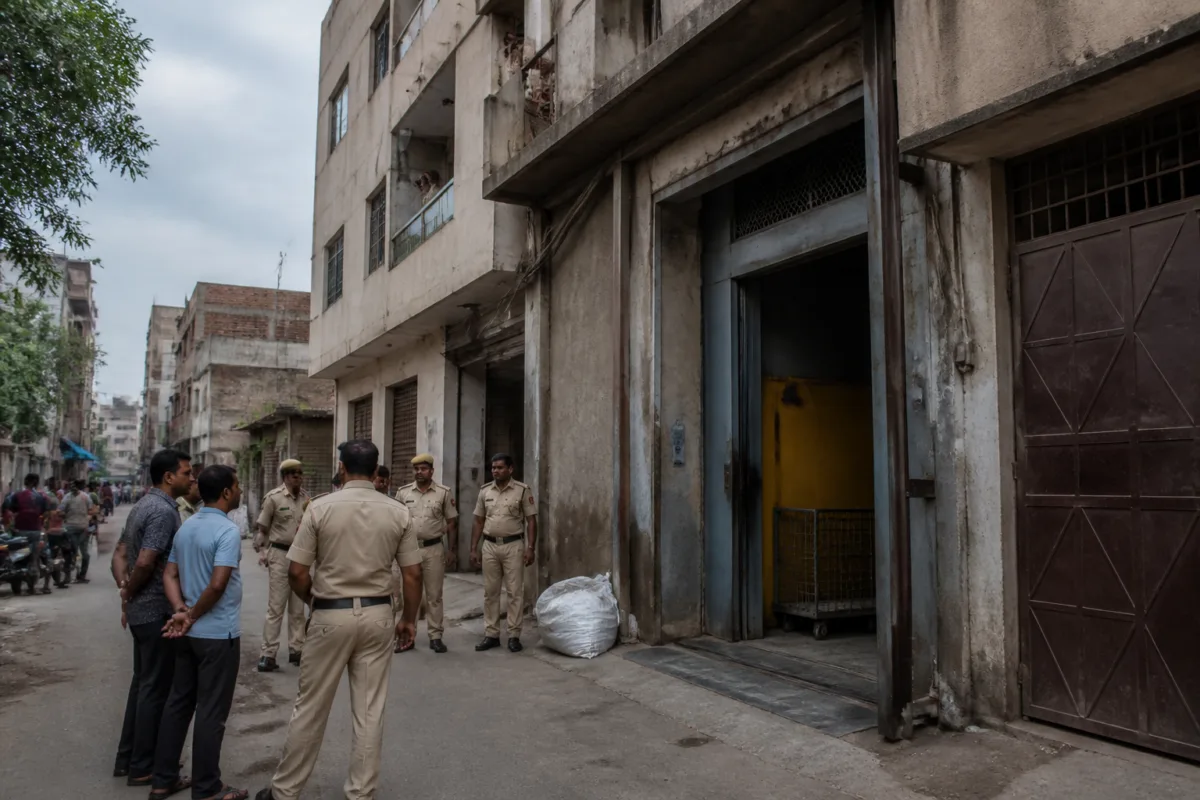
The death of 71-year-old Baijnath Pandey after he became trapped inside a lift at a three-storey warehouse in Delhi’s Dilshad Garden is more than an isolated accident. It places the safety of ordinary commercial buildings, the maintenance of lifts and the accountability of property operators under scrutiny. Police have registered a case and are investigating whether negligence in maintenance or safety standards contributed to the incident.
According to the report, the incident took place at about 2.33 pm on November 13. Pandey, a resident of Gali Number 6 in Subhash Vihar, Garhi Mendu, Bhajanpura, had come to the warehouse for work. The building had a lift connecting the ground floor with the second floor. He became trapped inside it during his visit.
The police were alerted through a PCR call. The caller reportedly said that his companion was trapped in the lift and had died. A team from Seemapuri police station reached the site, removed Pandey with the assistance of local residents and took him to Rajiv Gandhi Hospital. Doctors declared him dead after examination.
The immediate facts establish the sequence of the emergency, but they do not yet establish why the lift stopped, how long Pandey remained trapped or whether the lift had a functioning alarm, communication system or emergency release mechanism. Those details are central to determining whether this was a mechanical failure, an operational lapse, a failure of supervision or a combination of factors.
That uncertainty is significant because lifts in warehouses and other low-rise commercial premises occupy a difficult regulatory and administrative space. They are part of a building’s everyday movement system, but their safety depends on several actors: the property owner or occupier, the lift maintenance agency, people operating the premises and the authorities responsible for investigating a death. The police investigation will have to establish what happened at the site and identify which records or physical evidence can support the conclusion.
The report states that a crime team inspected the location and collected necessary evidence. No eyewitness was found at the scene. This means the investigation may have to rely heavily on the condition of the lift, statements from people connected to the warehouse, maintenance records and the timeline recorded through the PCR call and emergency response. The supplied report does not say whether any inspection certificate, service log or maintenance contract was recovered.
That missing information is not a minor detail. A lift is a confined mechanical system. When it fails, the person inside may have no control over the equipment or the means of escape. The safety chain therefore depends on preventive maintenance, reliable emergency systems and a rapid response once a person is trapped. If any one of those links is weak, a routine trip between floors can become a medical and safety emergency.
The location also matters. Dilshad Garden is a mixed urban area where residential neighbourhoods exist alongside commercial premises and warehouses. A three-storey warehouse may not resemble a high-rise building, but its lift still serves people moving through a working environment. Visitors, workers, delivery personnel and older people can all depend on equipment that they did not install and cannot independently assess before using.
The incident therefore raises a broader question about how safety is managed in smaller commercial buildings. Public attention often focuses on major construction sites, large residential towers and transport infrastructure. Yet many urban risks are encountered inside ordinary premises: warehouses, workshops, shops and mixed-use buildings. Their scale can make them less visible, while the people using them may have little information about maintenance responsibility or emergency procedures.
The police case is now the principal institutional response identified in the report. The investigation is examining the cause of the accident and whether there was negligence related to lift maintenance and safety standards. Further legal action will depend on the findings. Until those findings are available, it would be incorrect to conclude that a particular person, company or agency was responsible for Pandey’s death.
This distinction is important in reporting building accidents. The death is confirmed, the location and timing are reported, and a case has been registered. The cause, however, remains under investigation. Treating a suspected maintenance failure as an established fact would move beyond the available evidence. At the same time, the fact that police are examining maintenance and safety standards shows that the condition and management of the lift are central to the case.
The event also exposes an information gap for building users. The supplied report does not identify the lift manufacturer, the maintenance contractor, the owner or operator of the warehouse, the last date of servicing, or whether the equipment had been subject to a recent safety inspection. It also does not state whether the lift had an alarm or whether anyone attempted to communicate with Pandey before the police arrived. These are the questions that can convert a general account of an accident into an evidence-based account of institutional responsibility.
For urban governance, the lesson is not that every lift failure is preventable or that the cause can be inferred from a single death. It is that safety systems must remain visible even in buildings that do not attract regular public scrutiny. When an accident occurs, authorities need to be able to establish quickly who controlled the premises, who maintained the equipment, what inspections had taken place and whether emergency procedures were available and usable.
The case also highlights the vulnerability of older people in unfamiliar buildings. Pandey was 71 and had entered the warehouse for work. The report does not say whether his age or health played any role in the death, and no such conclusion can be drawn. But a person trapped in a lift may depend entirely on the equipment’s emergency features and the speed of outside assistance. The reported delay, if any, has not been established and should be determined by the investigation rather than assumed.
The report contains a separate account of a fire at a scooter-parts shop near Green Park Metro station, where two women were rescued from a three-storey building. That incident is not connected to Pandey’s death and does not provide evidence about the warehouse lift. Its inclusion underlines a wider pattern in the source report—urban safety incidents often appear together in daily news coverage—but the two cases require separate investigations and should not be combined when assessing responsibility.
What is established so far is limited but consequential: a man entered a warehouse in Dilshad Garden, became trapped in a lift connecting the ground and second floors, was removed after a PCR call and was declared dead at Rajiv Gandhi Hospital. Police registered a case on November 13, and a crime team examined the site. What remains unresolved is the mechanical and administrative chain behind the incident.
The next meaningful developments will be the police findings, the identification of the lift’s maintenance and operating responsibilities, and any evidence regarding safety checks or equipment failure. Until those details emerge, the case should be understood as a confirmed death inside a commercial building with a suspected safety failure still under investigation—not as a completed finding of negligence.

