


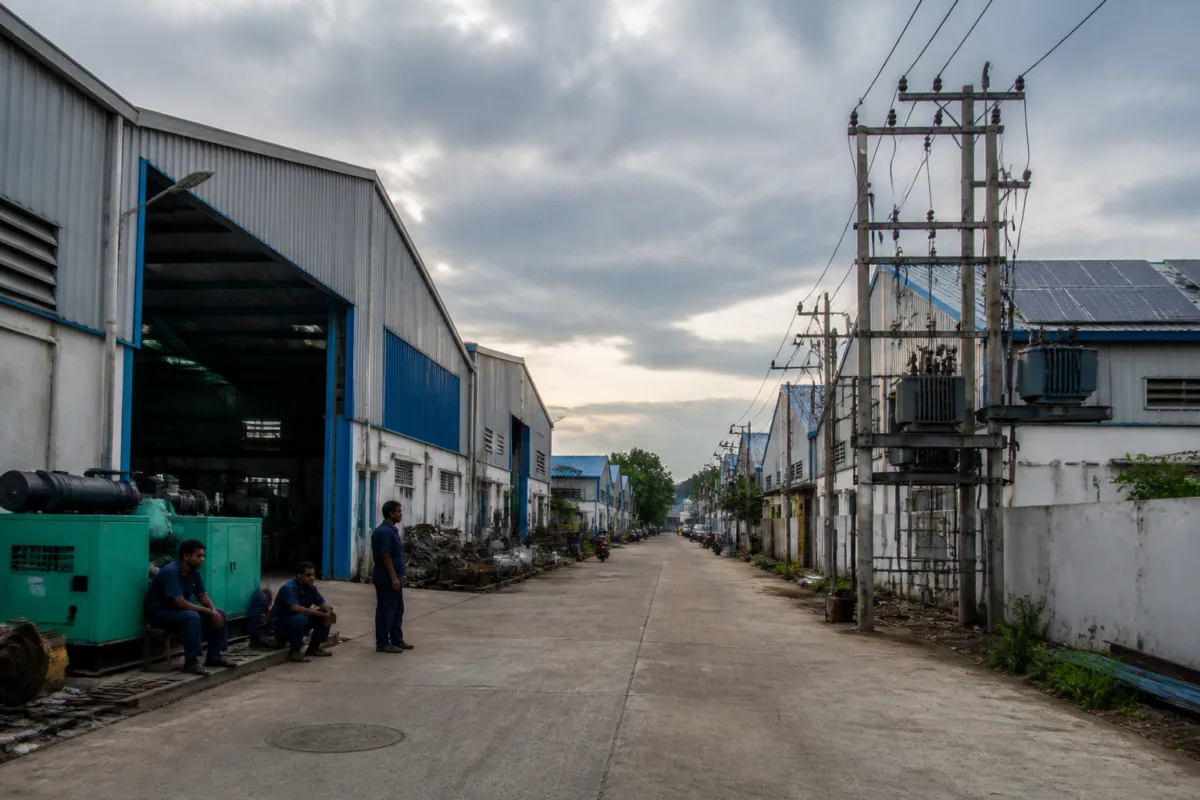
Unscheduled power cuts in and around Hyderabad are exposing a weakness in the city’s industrial infrastructure: many small and medium-scale units have built their operations around the assumption of stable electricity, but now have limited and expensive alternatives when supply is interrupted. The immediate concern is not only the duration of a disruption, but the time and cost required to restart machinery, restore production and keep workers and equipment productive.
The issue has emerged across industrial hubs such as Cherlapally, Nacharam, Mallapur, Uppal, Jeedimetla, Balanagar and Patancheru. The Telangana Today report estimates that 30,000 to 40,000 small and medium-scale industrial units operate in and around Hyderabad, although it notes that no official count is available. Even if the precise number remains unverified, the geography of the concern indicates that this is not a problem limited to a single factory or estate.
For these units, electricity is not simply an overhead cost. It is an operating condition on which production processes, boilers, machinery and labour schedules depend. Industrialists told Telangana Today that a power interruption lasting about 30 minutes can significantly affect production in many processing units. Returning to normal operations can take nearly three hours because equipment needs time to reach working conditions again. Employees may remain idle during that period, while unfinished processes, delayed orders and lost output add to the cost of the interruption.
That operating pattern changes the meaning of a power cut. A disruption measured in minutes can produce a much longer interruption at the factory floor. The network may restore supply relatively quickly, but the industrial system does not recover at the same speed. The gap between restoration of electricity and restoration of production is where much of the economic damage occurs.
The backup problem is equally revealing. With power supply considered stable over the past decade, many industrial units discarded or stopped maintaining diesel-operated generators. That decision would have reduced routine maintenance and fuel expenses during periods of reliable supply. It has also left units less prepared for a period of renewed uncertainty.
A member of the Balanagar Micro Unit Association told the publication that rebuilding generator infrastructure could require an investment of Rs.15 lakh to Rs.20 lakh, depending on the size of the unit. The expenditure would not end with installation. The same representative said diesel-generated electricity could cost as much as Rs.15 per unit, compared with an existing electricity cost of Rs.8 per unit. For small and medium-scale enterprises, that difference can make backup power a temporary emergency measure rather than a viable operating model.
The distinction between short-term protection and long-term resilience is central to the debate. A member of the Cherlapally Industries Association said generators could be used as an alternative for two to three months, but that running them for eight to 10 months would be unaffordable. This suggests that the industrial response is not merely about purchasing equipment. It is about whether the city’s energy system can provide dependable supply at a cost that manufacturing units can absorb over an extended period.
The comparison with agricultural operations has further sharpened the concern. The Congress government has appealed to farmers to defer cultivation during the Yasangi season. Industrialists, however, say factories cannot suspend or postpone production in the same way. Manufacturing commitments, labour arrangements, equipment cycles and customer orders make industrial output less flexible once operations are interrupted.
This difference matters for urban governance because the two sectors face different forms of exposure. A farm may be able to change its cultivation timing, although that decision carries its own risks. A factory operating within Hyderabad’s industrial belt is tied to fixed premises, installed machinery, employees, suppliers and buyers. A power disruption therefore affects not only the unit but also the network of economic activity around it.
The reported response from industrial associations is to seek a longer-term strategy rather than rely exclusively on diesel. Industry representatives are urging the State government to promote rooftop solar power generation through a dedicated policy, subsidies and other incentives. The proposal reflects the search for an energy source that can reduce dependence on emergency generation while also limiting the recurring cost of diesel-based backup.
The source does not establish how much rooftop solar capacity Hyderabad’s industrial units could add, how much investment would be required, or whether existing distribution arrangements can accommodate a large expansion of behind-the-meter generation. Those questions will determine whether rooftop solar becomes a practical resilience measure or remains a broad policy demand. What the report does establish is that industrial associations see distributed generation as a more sustainable option than operating diesel generators for most of the year.
The institutional pathway is still at an early stage. Telangana Industrialists Federation president K Sudheer Reddy said the federation planned to convene a meeting with representatives of various industrial associations by the end of October to discuss the issue. He said the concerns would subsequently be taken up with the State government and expressed hope that the government would take appropriate measures.
That proposed meeting is important because Hyderabad’s industrial areas are spread across multiple associations and clusters. A coordinated discussion could bring together units facing similar interruptions but different production requirements. It could also clarify whether the problem is primarily one of distribution reliability, local network capacity, planned maintenance, seasonal demand or the availability of information about outages. The supplied report does not provide technical details on the causes of the unscheduled cuts, so the operational diagnosis remains incomplete.
This lack of technical clarity is itself significant. Industrial users need more than a general assurance of supply. They need to know the reliability of the network serving their cluster, the likely duration of an interruption and the institutional channel through which problems can be escalated. Without such information, each unit is pushed towards an individual backup decision, even though the underlying risk may be shared across an entire industrial estate.
The figures cited by industry show why individual solutions can become inefficient. Rebuilding a generator may cost Rs.15 lakh to Rs.20 lakh for one unit, while the electricity produced through it may cost nearly twice the existing tariff. If many units make that investment separately, the city could see substantial private spending on equipment that remains economically unattractive outside emergency periods. If generators are not rebuilt, units remain exposed to production losses during interruptions.
Rooftop solar changes the investment question but does not remove it. A dedicated policy supported by subsidies and incentives would be intended to lower the initial barrier for industrial units. However, the report does not specify the proposed subsidy structure, financing mechanism, installation timeline, storage requirement or responsibility for maintenance. It also does not indicate whether industrial associations are seeking solar only for routine electricity consumption or as part of a wider backup system.
The evidence therefore points to a three-part urban infrastructure challenge. The first is supply reliability: industrial operations are being affected by unscheduled interruptions. The second is recovery time: production does not restart as soon as electricity returns. The third is resilience financing: conventional backup is expensive to reinstall and operate, while a distributed renewable alternative requires policy support and upfront investment.
For Hyderabad, the issue reaches beyond factory management. Industrial clusters are part of the city’s employment, supply and logistics system. When production stops, the effects can extend to workers, suppliers, transport operators and customers, although the supplied report does not quantify those wider losses. The city’s ability to support manufacturing therefore depends not only on land, roads and industrial approvals, but also on whether its electricity system can meet the operational needs of units that cannot easily pause.
The immediate next step is the proposed meeting between the Telangana Industrialists Federation and representatives of industrial associations by the end of October. Its significance will depend on whether it produces a documented account of affected areas, outage patterns, restart losses and feasible alternatives. Until then, Hyderabad’s power-cut problem remains a warning about the limits of treating reliable electricity as a background condition rather than as core industrial infrastructure.

