


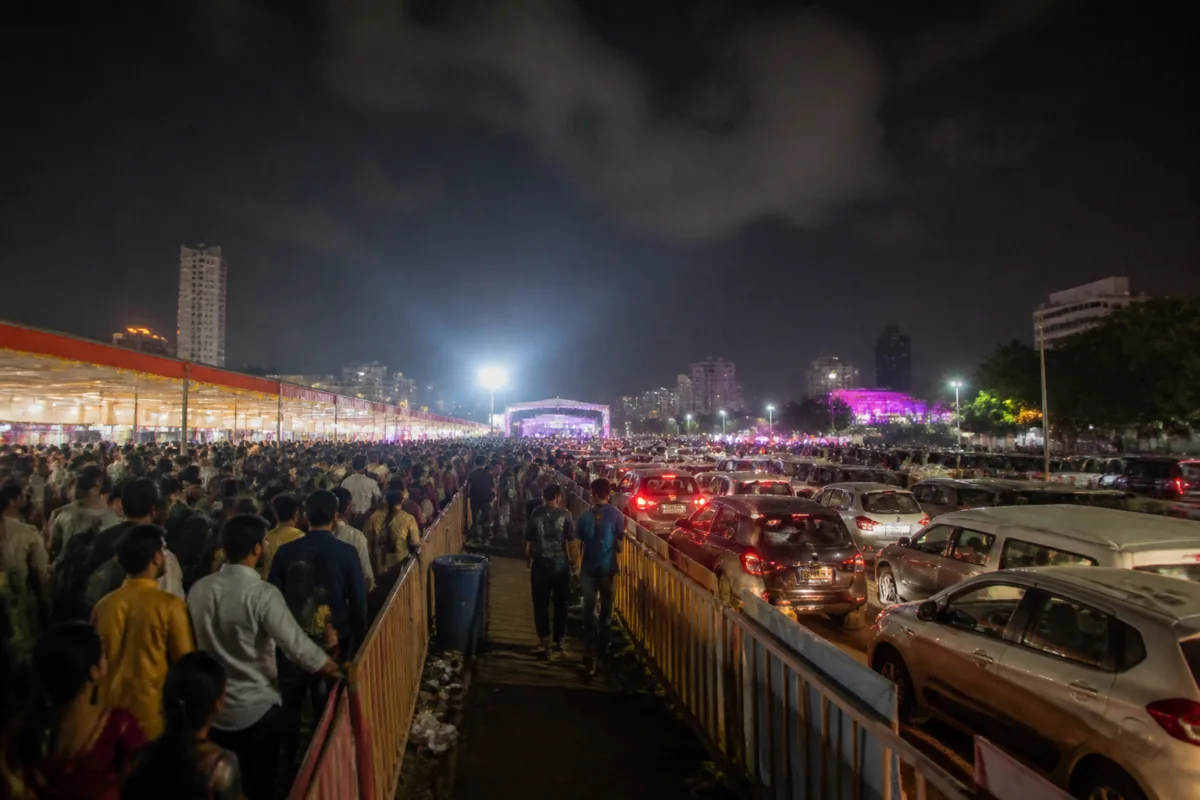
Ahmedabad’s garba season has exposed a familiar weakness in the management of large urban events: the ability to sell a premium experience has grown faster than the ability to deliver safe, functional public infrastructure around it. A report by Gujarat Samachar – Ahmedabad describes viral videos showing crowding, food-court congestion, parking difficulties and traffic disorder at several garba grounds, including venues where passes reportedly cost up to Rs 15,000.
The report does not present the problem as limited to one expensive venue. It describes complaints from players and visitors across multiple grounds, including a lack of space to stand or dance, difficult parking conditions and congestion at food counters. The videos circulating on social media have placed these experiences alongside the elaborate stages, lighting, publicity campaigns and premium passes promoted by organisers.
That contrast is important because a large garba event is not only a cultural programme. It is a temporary urban system. For several hours, a ground becomes a high-density public space with its own requirements for entry, movement, emergency access, parking, food distribution, sanitation, traffic control and crowd dispersal. If one part of that system fails, the inconvenience is experienced collectively, regardless of how impressive the stage or promotional campaign may be.
The central issue raised by the report is the relationship between ticket sales and actual site capacity. It says that allegations of passes being sold beyond the practical capacity of some grounds have led to complaints that visitors who paid heavily could not find adequate room to participate. The report does not provide independent capacity figures, ticket-sale records or official inspection findings. But the repeated nature of the complaints points to a question that organisers and authorities would need to answer: how are attendance limits being calculated, and who checks whether those limits match the ground’s usable area and operational infrastructure?
Capacity in a temporary event cannot be understood simply as the physical size of a plot. A ground may lose usable space to stages, barricades, food courts, entry lanes, sponsor installations, service areas and emergency corridors. The number of people it can safely accommodate also depends on how quickly they enter, move between zones and leave. A venue that appears large in promotional material may have much less space available for active participation once these functions are included.
This is where the reported complaints about food courts become relevant. Food counters are often treated as an additional commercial facility, but at a crowded event they are also movement nodes. Visitors leave the main activity area, form queues, gather around counters and return through routes that may already be carrying other people. If the food court is too small, poorly distributed or inadequately separated from circulation paths, congestion can spread beyond the counters themselves.
The report also describes uneven parking near several grounds around the S.P. Ring Road, with visitors complaining about rough or difficult parking surfaces and problems aligning their vehicles. Parking is not a peripheral concern for a city event that attracts large numbers of people by private vehicle. The quality of the arrival experience affects traffic flow, pedestrian safety and the time required to clear the area after the programme ends.
A large event can therefore create pressure well beyond its boundary. Vehicles entering and leaving a venue interact with ordinary city traffic. Pedestrians may have to cross access roads or walk through poorly defined spaces between parking areas and gates. If the approach roads, parking layout, lighting and crowd barriers are not planned together, local congestion becomes an operational consequence rather than an unexpected inconvenience.
The source report’s most significant observation is that similar complaints have emerged at different venues. That pattern, if established through venue-level records and inspections, would suggest a system-wide planning problem rather than an isolated failure by one organiser. It could indicate that event approvals focus more on the programme and temporary structures than on the full chain of crowd movement, transport access and visitor services.
However, the available report does not establish how many venues faced these problems, how many visitors were affected or whether any authority issued notices, imposed penalties or ordered corrective measures. It also does not independently verify every social-media video described in the report. These gaps matter. Viral footage can reveal a real problem, but it usually captures a particular moment and location. It cannot by itself establish total attendance, the duration of congestion or whether the situation was temporary or persistent.
That limitation should not obscure the governance question. When organisers sell high-value passes, the transaction creates clear expectations about access and basic functionality. The price of a pass does not determine whether an event is safe, but it makes the gap between marketed quality and delivered conditions more visible. Visitors who cannot find sufficient space, face severe queueing or struggle with parking are not merely expressing dissatisfaction with entertainment; they are reporting the performance of a temporary public facility.
Responsibility in such settings is distributed. Organisers control ticketing, site design, food services, private security and internal circulation. Municipal agencies and traffic authorities may have responsibilities relating to roads, parking, public safety, permissions and external traffic management. Police and emergency services may also need access plans for high-density gatherings. The report does not identify the exact approval structure for the venues discussed, so it cannot establish which agency was responsible for each reported problem.
That institutional division makes transparent planning particularly important. If capacity is approved by one authority, traffic by another and event operations remain with a private organiser, visitors experience the combined result rather than the separate responsibilities. A complaint about crowding may therefore require examination of ticketing records, site plans, emergency routes, parking arrangements, food-court layouts and the conditions attached to event permissions.
Social media has changed how these events are evaluated. Earlier, organisers could measure success through attendance, celebrity performers, lighting and stage design. Mobile-phone videos now document queues, blocked movement, overcrowded areas and difficult exits in real time. This does not make every online claim conclusive, but it creates a wider public record of the visitor experience and makes operational shortcomings harder to keep separate from the event’s promotional image.
The Ahmedabad report also illustrates a broader urban pattern: private events increasingly rely on public roads, public access networks and city-scale services while presenting themselves as managed, premium environments. The commercial benefits may be concentrated among organisers, sponsors and vendors, but the pressure on traffic and surrounding infrastructure is shared by residents, workers and other road users.
The evidence currently available confirms a dispute between the promise of premium garba experiences and complaints about overcrowding, parking, food-service congestion and traffic disorder. It does not establish the precise scale of over-ticketing, identify official violations or show whether corrective action followed. Those questions require venue-wise attendance data, sanctioned site plans, capacity calculations, traffic-management records and responses from organisers and authorities.
For Ahmedabad, the larger lesson is straightforward but consequential: a successful large-scale cultural event cannot be judged only by its stage, publicity or number of passes sold. Its performance also depends on how well the temporary city around the event works. The next meaningful test will be whether organisers and authorities respond to the reported complaints with documented capacity standards, better circulation planning and publicly accountable operational arrangements.

