


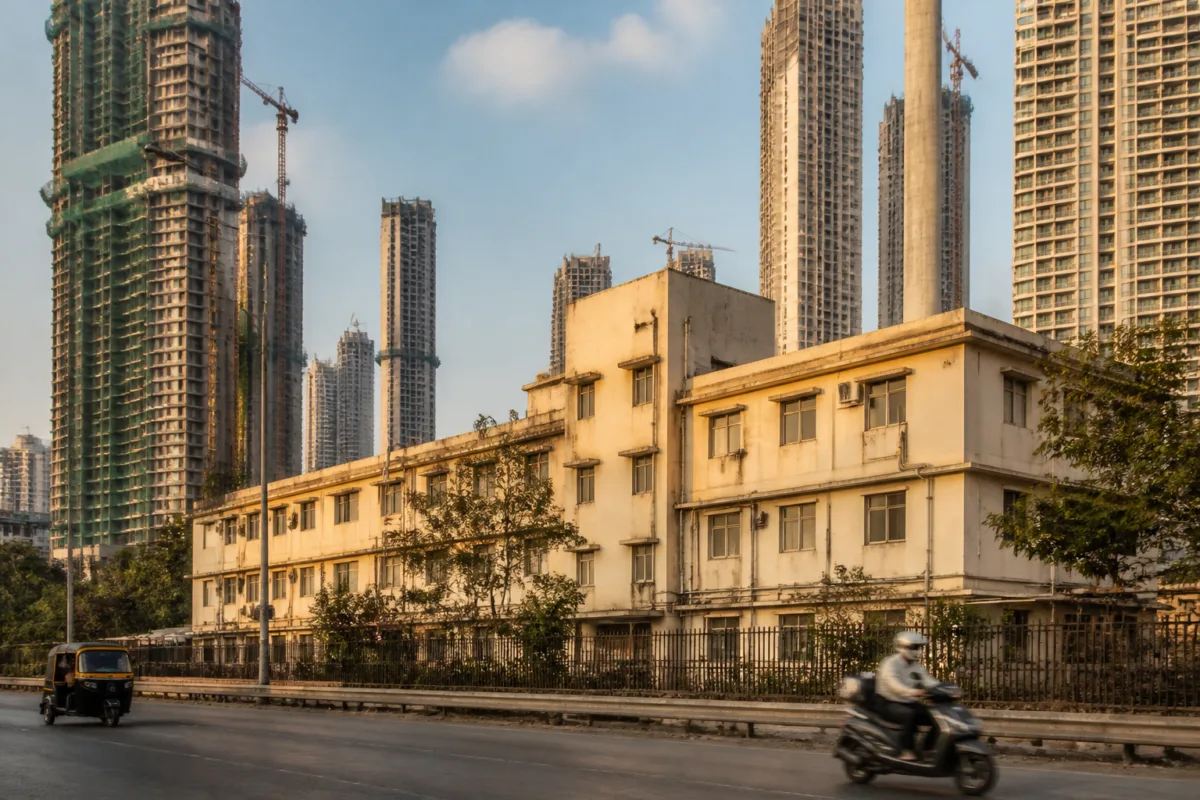
The proposed lease of a BMC laboratory plot in Lower Parel is more than a high-value land auction. It brings together three decisions that usually shape the long-term functioning of a city: whether public land should be monetised, how essential civic facilities are protected during redevelopment, and what safeguards apply when a municipal asset is transferred to private development for as long as 60 years.
The Brihanmumbai Municipal Corporation has received a top bid of Rs 470 crore from Skystead Constructions LLP for its 5,166-square-metre property in Lower Parel. The plot currently houses the civic body’s municipal testing and laboratory facility. The proposal before the improvements committee seeks approval to award the lease, remove the existing reservation for ‘Other Institutions’ under Development Plan 2034 and enable the redevelopment of the site.
The bid is only 3.3% above the BMC’s base price of approximately Rs 455 crore. The other bidder, Skylark Private Limited, quoted Rs 459 crore. The narrow spread between the two bids means the financial outcome is relatively clear, but the larger institutional questions lie in the conditions attached to the transaction and the process required before the lease can be completed.
The proposed arrangement is for 30 years, with a further 30-year extension. The extension would be subject to the policy prevailing at the time of renewal. In practical terms, this creates a possible 60-year relationship between the private developer and a parcel of municipal land, although the second 30-year period is not governed by exactly the same conditions as the first.
The reservation change is central to the transaction. The plot is currently reserved for ‘Other Institutions’ under Development Plan 2034. The BMC proposal says the modification will be processed under Section 37(1) of the Maharashtra Regional and Town Planning Act, 1966. That process includes inviting public objections and suggestions before an approved development plan can be modified.
This makes the transaction different from a straightforward disposal or commercial lease. The land’s planning status must change before the letter of acceptance is issued to the successful bidder. The auction has therefore produced a leading bid, but the transaction still depends on an urban planning process and the approval of the relevant civic authorities.
The plot is part of land parcel No. 1629 in the G/South ward and has direct access from Sudam Kalu Ahire Road, which is 18.3 metres wide. The land is also affected by an approved road line of the same width. These details matter because the usable development area and the eventual value of the site are linked not only to its location but also to road reservations, planning controls and the final measurement of the land.
The final plot area has not yet been confirmed. A joint measurement by the Superintendent of Land Records is required, and the bid amount may change after that exercise. Until the measurement is completed, the headline value of Rs 470 crore remains subject to a potential adjustment linked to the confirmed area.
The redevelopment proposal also includes a condition intended to preserve the BMC’s laboratory function. The successful bidder must construct a replacement municipal testing laboratory with a built-up area of 1,299 square metres and hand it over to the civic body at the developer’s own cost. The existing building cannot be demolished until suitable temporary arrangements are made in consultation with the concerned department.
That condition places continuity of civic operations at the centre of the project. Municipal testing and laboratory facilities may not have the public visibility of roads, bridges or hospitals, but they are part of the administrative infrastructure through which a city tests materials and supports civic functions. The proposal recognises that replacing the building is not enough; the service must continue while construction takes place.
The sequence is therefore important. Temporary arrangements must be made first, the replacement facility must be built, and the existing building can be demolished only after an alternative is ready. The source material does not establish the duration or location of the temporary facility, nor does it specify the construction timeline for the replacement laboratory. Those details will be important to the project’s operational feasibility.
The payment structure gives the BMC an early inflow while spreading the balance over a defined period. The successful bidder would have to pay 30% of the accepted bid amount within one month of the letter of acceptance, with the remaining 70% payable in instalments over the next eight months. Delayed instalments would attract interest at 12% per annum. Failure to pay within the stipulated period could result in cancellation of the bid and forfeiture of deposits.
However, the letter of acceptance would be issued only after the reservation is removed. This means the payment schedule is connected to the planning modification rather than beginning immediately after the bid is declared. The transaction’s financial timetable will consequently depend on how the Development Plan process proceeds and when the required approvals are secured.
The proposed lease rent is another significant feature. For the first 30 years, the initial rent is proposed at Rs 1 per square metre per annum, subject to a minimum of Rs 1,000 for open land. Rent for the subsequent period would be determined under the policy in force at that time. The structure separates the upfront bid consideration from the recurring lease rent, making the initial auction payment the primary stated financial return during the first lease period.
The BMC has described the auction as a means of generating additional revenue while facilitating redevelopment of its existing testing and laboratory building. That dual purpose reflects the broader tension in municipal land transactions. A civic body can unlock value from a strategically located property, but it must also ensure that the public function occupying the site is not weakened, delayed or displaced during the process.
The Lower Parel proposal is also part of a wider pattern in the area. In September, BMC’s civic house of corporators cleared a proposal to lease its 6.17-acre Century Mills land in Lower Parel to a private developer under a similar 30-year lease structure, renewable for another 30 years. The two proposals are not identical in land area or facility use, but their common lease model places long-term municipal land management in focus.
For Mumbai, the key issue is not simply whether a municipal plot can command a large bid. It is how the corporation defines public value when land is leased for several decades. That value includes the immediate revenue, the replacement of the civic facility, the planning status of the property, the obligations imposed on the developer and the conditions that will apply if the lease is extended.
The proposed transaction also shows why municipal land auctions cannot be assessed only through the winning bid. The bid is one measurable outcome. The public planning process, the confirmed land area, the replacement laboratory, temporary operational arrangements, payment enforcement and future lease conditions determine whether the transaction delivers the wider purpose stated by the civic body.
At present, the proposal has not yet completed those steps. The improvements committee must consider the agenda item, the reservation modification must proceed under Section 37(1), the land must be jointly measured and the replacement laboratory arrangements must be established before the existing structure is demolished. The final shape of the lease will depend on how these administrative and planning conditions are resolved.

