


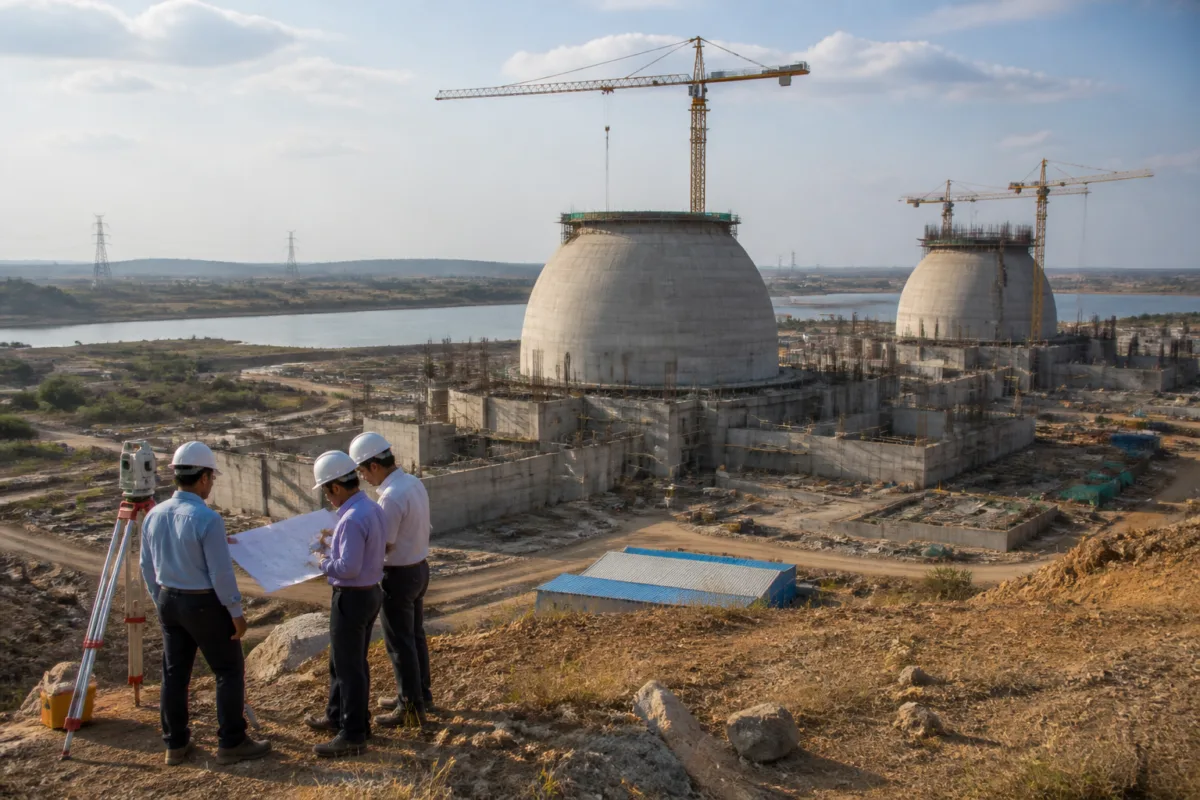
NTPC’s plan to begin feasibility studies for nuclear power projects in more states, including Uttar Pradesh, is an early but important step in India’s attempt to expand nuclear capacity from 8.8 GW to 100 GW by 2047. The announcement also shows that the target will require more than reactor construction: it will involve a long chain of site selection, water access, capital mobilisation, technology partnerships and regulatory review.
The state-owned power generator is targeting 30 GW of nuclear capacity as part of the national expansion. According to a senior official cited by the Press Trust of India, NTPC has completed feasibility studies in Madhya Pradesh, Bihar and Odisha and will now explore additional locations. Banka in Bihar, Basai in Madhya Pradesh and Nabarangpur in Odisha have been identified as potential sites through those studies. Uttar Pradesh is also on the company’s list for upcoming assessments.
The significance of this stage is that the locations are not yet nuclear power stations. A feasibility study is part of the process through which a potential site is assessed before it can proceed through the country’s atomic-energy approval structure. NTPC’s official, as reported by PTI and published by Business Standard, said the study for a nuclear project is submitted to the Department of Atomic Energy. The Standing Site Selection Committee reviews the proposal and, if it finds the location technically feasible, sends it to the Atomic Energy Commission for further processing.
That sequence places the current announcement within a longer institutional pathway. NTPC may identify a location and prepare a proposal, but the project still has to pass technical scrutiny and move through the relevant atomic-energy authorities. The feasibility studies therefore represent an expansion of the potential project pipeline rather than a final investment or construction approval.
The proposed project configuration provides another indication of the scale involved. NTPC is considering an average project of 1,400 MW, comprising two units of 700 MW each. At the national level, the Central Electricity Authority has estimated that achieving 100 GW of nuclear capacity would require around Rs 15 lakh crore in investment. The target would involve adding approximately 91 GW to the country’s existing 8.8 GW nuclear capacity.
These figures turn the 100 GW ambition into a major infrastructure and financing challenge. The CEA estimate covers the scale of investment needed for the national target, while industry estimates cited in the report place the typical cost of one gigawatt of nuclear capacity at Rs 15,000-20,000 crore. The same estimates suggest that the period from concept to commissioning could be at least three years, although the feasibility and approval process described by NTPC precedes the construction stage.
For a company with more than 91,000 MW of installed capacity, the nuclear programme represents a further diversification of NTPC’s generation portfolio. The company began with thermal power and has since expanded into coal, gas and liquid fuel, hydro and solar generation. It currently caters to one-fourth of India’s electricity demand, according to the report. Its nuclear plans would add a new category to that portfolio, but one requiring a distinct set of technical, regulatory and site-management capabilities.
The location question is central because nuclear projects are dependent on physical conditions that cannot be resolved through financial approvals alone. The report identifies continuous water supply as a key requirement. It also cites an estimate that five litres of water are needed to produce one unit of nuclear power. Land requirements vary by project size, while a one-square-kilometre exclusion zone is cited among the project parameters.
These requirements make feasibility studies consequential for the regions being considered. A potential site is not simply a vacant parcel available for a power plant. It must be examined in relation to water availability, land configuration, surrounding settlements and the safety conditions required for the project. The supplied material does not establish whether any of the identified locations have received final site approval, land acquisition clearance or local consent. Those questions remain part of the process ahead.
The choice to explore more states also suggests that the national target will depend on a geographically distributed project pipeline. The locations named so far span Bihar, Madhya Pradesh and Odisha, while Uttar Pradesh is expected to be examined next. The report does not state how many sites will ultimately be selected or how the proposed capacity will be distributed among states. It does, however, make clear that NTPC intends to continue searching beyond the locations already assessed because its stated ambition is 30 GW by 2047.
Technology partnerships are another part of the proposed model. NTPC is exploring collaborations with Westinghouse of the United States, Russia’s Rosatom and France’s EDF for the deployment of large pressurised water reactor projects in India. The report does not say that any final technology agreement has been signed. Instead, the discussions indicate that the company is examining possible international collaboration while it expands its domestic site pipeline.
This distinction matters because the programme has several decisions to resolve at the same time. The company must determine where projects can be located, what reactor technology could be used, how the required capital would be arranged and how proposals would proceed through the Department of Atomic Energy, the Standing Site Selection Committee and the Atomic Energy Commission. The announcement concerns the first of these decisions, but the scale of the target means that each decision will affect the others.
The timing of the feasibility work also has to be read against the 2047 national objective. India’s stated target is 100 GW of nuclear capacity by that year, while NTPC is positioning itself to contribute 30 GW. The gap between the existing 8.8 GW and the proposed national capacity is approximately 91 GW. The CEA’s Rs 15 lakh crore estimate and the project-level cost range cited in the report show that the target involves a large, sustained build-out rather than a limited set of demonstration projects.
At the same time, the source material does not provide a detailed implementation calendar for NTPC’s 30 GW plan. It does not specify when feasibility studies in Uttar Pradesh or other states will begin, when individual projects could receive approval, or when construction and commissioning would take place. It also does not identify the proposed financing structure, the ownership model for future plants or the timetable for selecting technology partners.
That leaves the feasibility stage as the immediate milestone to watch. The studies in Bihar, Madhya Pradesh and Odisha have produced potential locations, while more states are expected to be explored. Each proposal must then move through the stated review mechanism. The outcome of that process will determine whether the locations can advance from potential sites to technically accepted project sites.
NTPC’s nuclear programme therefore illustrates the administrative depth behind India’s capacity target. The headline number is 100 GW, but the path to it runs through individual sites, water systems, land controls, reactor choices, capital requirements and sequential institutional approvals. The company’s latest move expands that pipeline, but the evidence currently confirms feasibility work and project ambition—not final project sanctions or construction commitments. The next significant developments will be the results of studies in additional states and the decisions of the authorities that review the proposed sites.

