


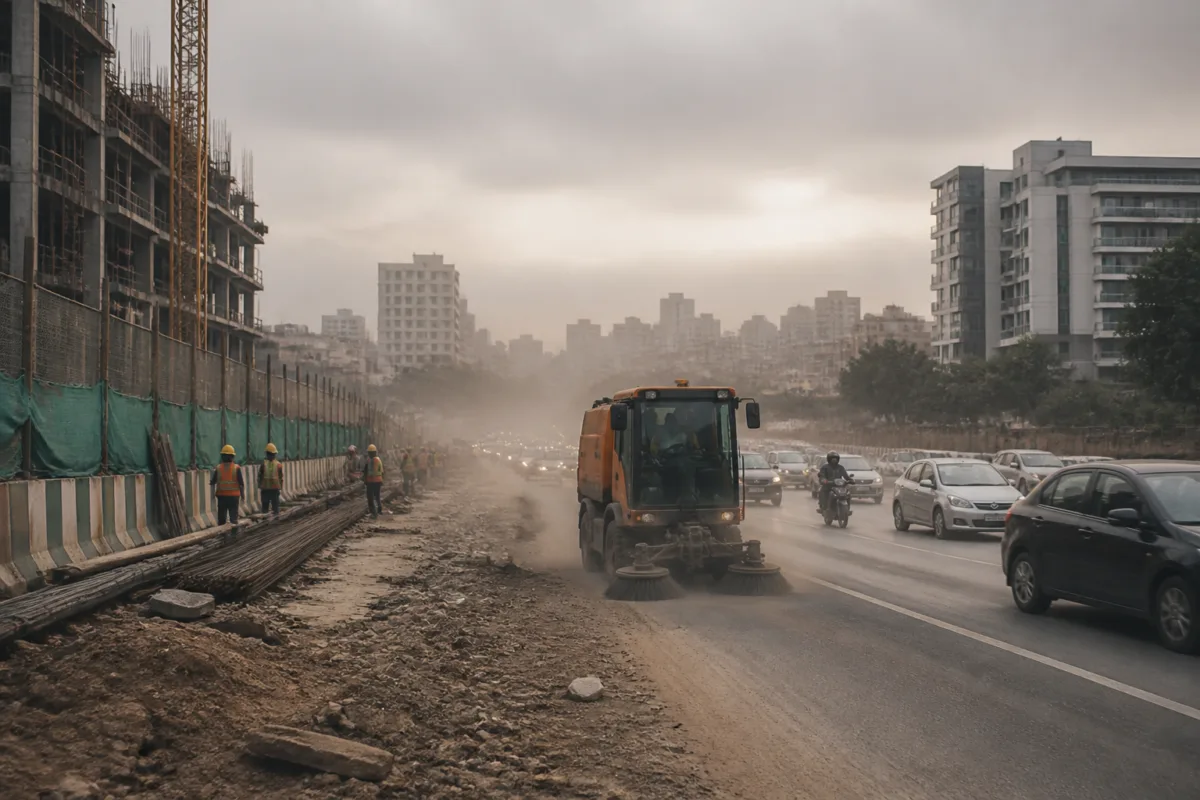
Pune air pollution has worsened despite the city spending Rs 275.28 crore on measures funded under the National Clean Air Programme and the 15th Finance Commission over the past seven years. Government data cited in the report shows that annual average PM10 concentration reached 101 micrograms per cubic metre in 2025-26, the highest level recorded in the period and more than one-and-a-half times the national standard of 60 micrograms per cubic metre.
The figures expose a central weakness in the way urban air-quality programmes are often assessed: expenditure is easier to record than impact. Pune received a total allocation of Rs 418.45 crore under the two funding channels during the seven-year period. Of this, 66 per cent, or Rs 275.28 crore, was spent on various measures. Yet the available figures do not show a corresponding improvement in particulate pollution.
The Pune Air Action Hub, an organisation working on air-quality issues, has claimed that the city’s PM10 level rose to 101 micrograms per cubic metre in the current financial year. The organisation has questioned where and how the money was spent, particularly because the reported pollution outcome remains substantially above the national standard. The report does not provide a project-wise expenditure statement or an independent assessment linking each intervention to a measured change in pollution.
That gap matters because PM10 is not simply an abstract environmental indicator. These airborne particles have a diameter of 10 micrometres or less and can enter the respiratory system when inhaled. Experts cited in the report said PM10 can contribute to respiratory illness and worsen conditions affecting the lungs and heart. A high annual average therefore indicates a sustained urban exposure problem rather than only a short-term episode caused by weather or traffic.
The data also complicates the assumption that a larger allocation automatically produces cleaner air. Funding can support equipment, road cleaning, water sprinkling, construction controls and other activities, but the effect depends on whether the interventions address the main sources of pollution, are implemented consistently and are monitored against measurable outcomes. The report states that experts have warned that spending alone is not evidence of improved air quality.
The most important issue emerging from the report is the mismatch between broad, visible interventions and the specific processes generating Pune’s particulate pollution. Experts identified construction dust and the re-suspension of dust already deposited on roads and other surfaces as major contributors to PM10. Both sources are closely connected to the city’s expanding built environment, the condition of roads and shoulders, construction-site practices, vehicle movement and street-level maintenance.
This makes Pune’s air-quality challenge partly an infrastructure and construction-governance problem. Dust is generated not only at a construction site but also when loose material escapes from the site, when debris is transported without adequate control, when uncovered surfaces are disturbed and when traffic repeatedly lifts settled particles back into the air. Measures designed without distinguishing between these pathways may produce activity on the ground without reducing the overall pollution load.
The report specifically questions the effectiveness of water sprinklers and mechanical road-sweeping machines currently in use. Experts cited in the report said these measures have not produced the expected results at a sufficient scale. They also said that the connection between the interventions being implemented and their actual outcomes is not strong enough. This does not establish that every such measure is ineffective, but it does show that the available evidence is insufficient to demonstrate that the measures are working as intended across the city.
A further concern is that the same intervention may perform differently depending on local conditions. The report points to construction methods, the manner in which work is carried out, maintenance practices and the circumstances at individual locations as factors that should shape the response. A city-wide programme that treats all roads, construction sites and dust sources in the same way may therefore miss the locations where the greatest reduction can be achieved.
The institutional framework behind the spending is also significant. The National Clean Air Programme and the 15th Finance Commission provided the funding routes through which Pune received Rs 418.45 crore. However, the report does not specify the division of responsibility among the municipal administration, pollution-control authorities, agencies managing roads and public works, or construction regulators. Nor does it provide a public account of how the Rs 275.28 crore was distributed among different interventions.
Without that information, residents cannot easily distinguish between money sanctioned, money released, money spent and money that produced a measurable result. These are different stages of public finance. A high utilisation rate may indicate that funds were disbursed and recorded, but it does not by itself establish that pollution sources were controlled. For air-quality programmes, financial reporting needs to be read alongside source inventories, location-specific monitoring and outcome indicators.
The available PM10 figures underline the scale of the problem. The annual average of 101 micrograms per cubic metre is 41 micrograms above the national standard of 60 micrograms per cubic metre. It is also the highest level reported for Pune in the seven-year period covered by the report. The supplied material does not provide the annual values for each preceding year, so it cannot establish the exact trend year by year. It does, however, establish that the latest reported annual average is substantially above the prescribed benchmark despite considerable spending.
The distinction between PM10 and other pollutants is important for policy design. The report focuses on coarse particulate matter associated with dust, construction activity and re-suspension. That means actions aimed at other sources or other pollutants may not directly address the city’s most visible PM10 burden. The experts’ call for source-specific and scientifically selected interventions is therefore central to interpreting the funding figures.
For Pune, the larger urban question is whether clean-air spending is being managed as a measurable public-service programme or primarily as a collection of activities. The difference lies in how the city defines success. Sprinklers deployed, roads swept or funds spent are implementation measures. Lower particulate concentrations at affected locations, fewer uncontrolled construction sites and sustained compliance with dust-management requirements would provide stronger evidence of impact. The report supplies the first set of concerns but not enough public evidence on the second.
That uncertainty should guide the next stage of scrutiny. The city’s agencies will need to show how the funds were allocated, which pollution sources each intervention targeted, where the work was carried out and how performance was evaluated. The available report does not say whether such a consolidated assessment has been published. It also does not establish which individual agency is responsible for the gap between expenditure and air-quality outcomes.
What the evidence confirms is narrower but consequential: Pune received Rs 418.45 crore for clean-air measures over seven years, spent Rs 275.28 crore, and nevertheless recorded an annual PM10 average of 101 micrograms per cubic metre in 2025-26, according to the data and claims cited in the report. What remains unresolved is whether the problem lies primarily in the choice of interventions, their enforcement, their scale, their maintenance or the way results are measured. Until that connection is documented, expenditure will remain a poor substitute for cleaner air.

