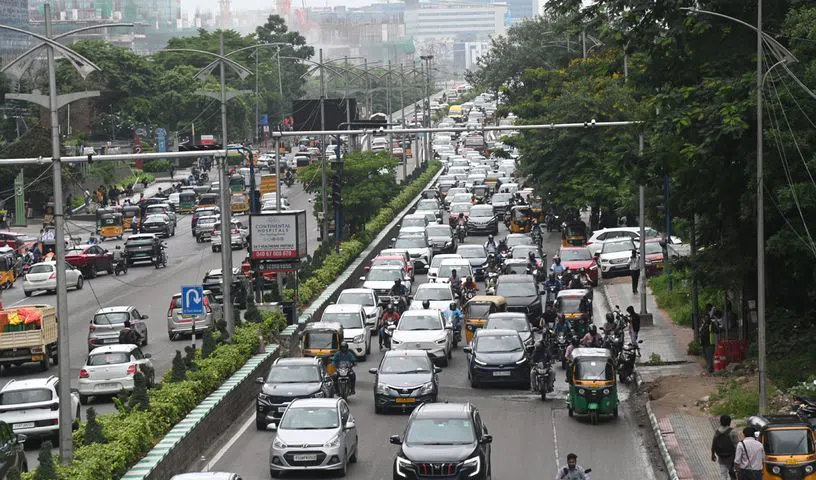
Hyderabad: Cyberabad Traffic Police are examining a proposal for a dedicated carriageway between JNTU and Synchrony near Raidurgam Metro Station as weekday congestion continues to affect one of Hyderabad’s busiest technology corridors.
The proposed arrangement is aimed at creating smoother movement for IT employees and regular commuters travelling towards Raidurgam during peak hours. Traffic officials are also assessing road-safety measures, U-turns, free-left movements and locations where different traffic streams merge. A recent field inspection covered the road connecting JNTU with Synchrony at Raidurgam Metro Station, falling under the KPHB and Madhapur traffic police jurisdictions. Officials are expected to study the feasibility of separating traffic flows and identify locations where bottlenecks can be reduced. The JNTU–Raidurgam corridor carries substantial weekday traffic, particularly from Monday to Friday when thousands of employees travel towards Hyderabad’s western IT districts. A dedicated carriageway could help reduce conflicts between vehicles with different destinations, although its effectiveness will depend on how existing road space and junction movements are reorganised.
The traffic police are also looking beyond road engineering to address the demand generated by large corporate campuses. Office-gate congestion caused by cabs and autos waiting on public roads, single-occupancy vehicles and concentrated login and logout timings has emerged as a major concern. At a stakeholder meeting with IT-sector representatives, companies were encouraged to create internal pick-up and drop-off areas so commercial vehicles do not occupy public roads. Some establishments have already begun adopting such arrangements. Corporate transport practices are also being examined as part of the wider response. Police have recommended greater use of carpooling, priority parking for shared vehicles and centralised corporate buses serving major residential clusters. The objective is to replace multiple low-occupancy trips with fewer, more efficient employee transport movements.
Staggered office timings have also been suggested to spread commuter demand across a longer period instead of concentrating thousands of trips within the same peak windows. The proposals point to a broader challenge for Cyberabad. As employment centres have expanded around Madhapur, Raidurgam and Gachibowli, transport demand has grown faster than the capacity of several key corridors and junctions. Building additional road capacity can provide relief, but managing when and how people travel is becoming equally important. For Hyderabad’s expanding IT districts, a more effective transport strategy will therefore require a combination of junction improvements, safer road design, organised corporate transport and stronger public-transit integration. The proposed JNTU–Raidurgam carriageway is one such intervention, but its long-term value will depend on whether it forms part of a wider effort to make daily commuting more predictable and efficient.