


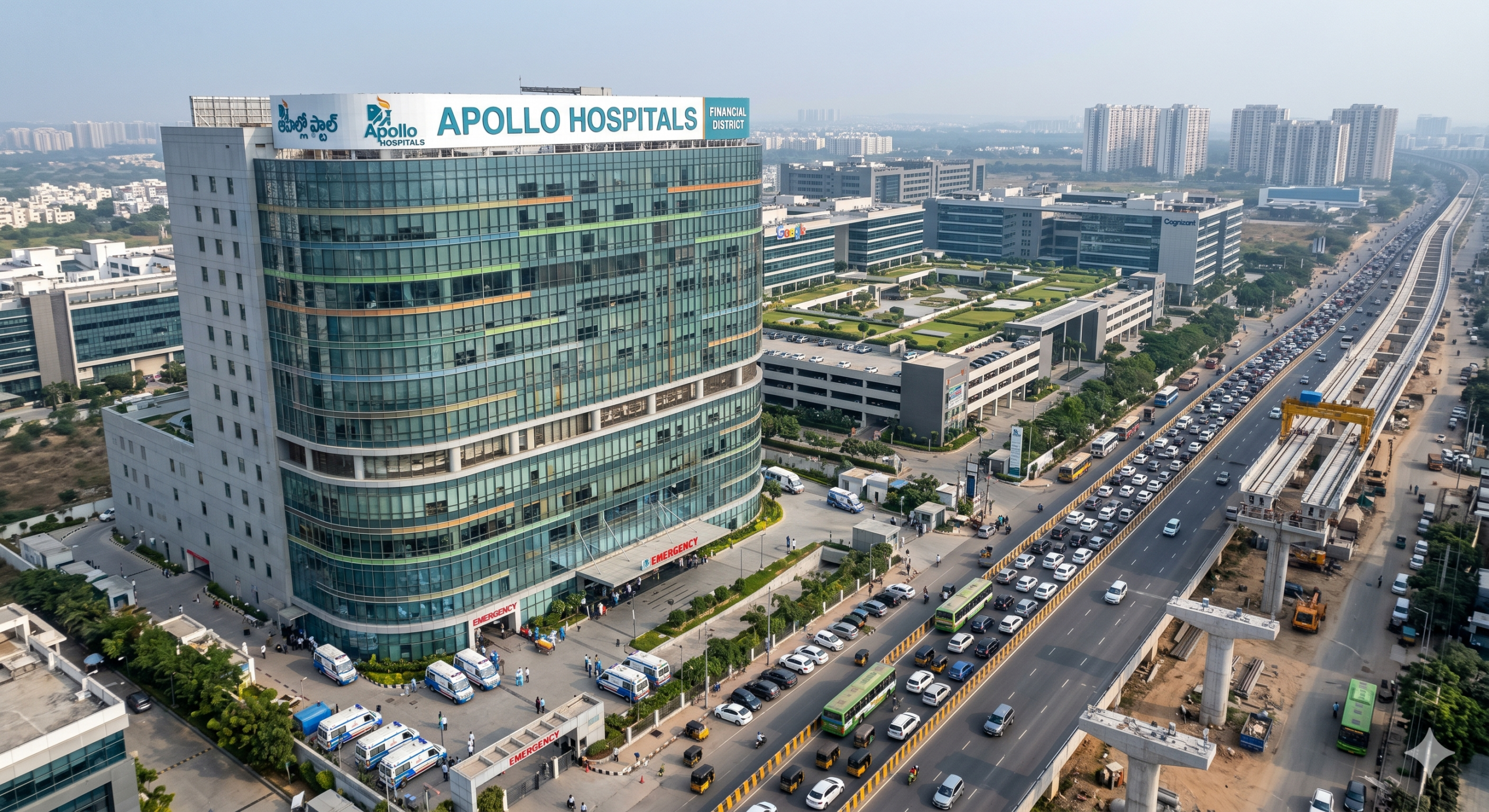
Hyderabad’s Financial District now adds another major private healthcare anchor, with Apollo Hospitals opening a 400-bed tertiary care facility at Nanakramguda on Monday, expanding high-end medical capacity inside the city’s fastest-growing corporate corridor.
The new Apollo Hospitals Financial District campus becomes the group’s 76th hospital nationally and one of its largest fresh additions in Telangana, positioned between Gachibowli’s office belt, Kokapet’s residential expansion and the high-density employment zones that continue to pull working populations westward. Apollo says the facility has been built as a digitally integrated “smart hospital” with AI-enabled scheduling, advanced imaging, robotic care support and critical care units designed for complex speciality treatment.
In practical terms, Hyderabad is not merely getting another hospital building. The western growth corridor is now receiving another 400 private beds in the same geography where offices, gated housing and premium commercial developments have multiplied faster than civic institutions over the past five years.
That location choice matters.
Nanakramguda and the Financial District have become one of Hyderabad’s most infrastructure-loaded urban pockets — office campuses, elevated roads, luxury towers, international schools and now a deepening chain of tertiary hospitals. Public records and real estate tracking show this corridor continuing to absorb the city’s largest volume of white-collar expansion and upper-income residential migration, making private healthcare providers increasingly willing to place advanced care where insured and corporate patients are concentrated.
The authority priority is not difficult to read, even though this is a private project.
Hyderabad’s western edge is being allowed to mature as a self-contained urban service district — one where workspaces, housing, education and healthcare are stacked close enough to reduce dependence on the older central city. Apollo’s new hospital fits directly into that metropolitan pattern.
But the trade-off is equally visible.
A 400-bed high-technology hospital strengthens specialist access for Financial District, Gachibowli, Kokapet and nearby high-income residential clusters far more immediately than it changes healthcare access for eastern or peripheral neighbourhoods that still depend largely on state hospitals and lower-cost nursing homes. The expansion adds medical capacity, but it adds it where purchasing power is already strongest.
That distinction has become common across Indian metros: healthcare beds are increasing, but premium tertiary beds are often following real estate concentration before they follow population deficit.
Apollo itself has indicated that its current expansion strategy is centred on complex care growth and high-value specialties as demand for private advanced treatment rises nationally.
So the building now visible on the Financial District skyline is not just a hospital inauguration.
It is another sign that Hyderabad’s west is becoming a city within the city — with faster access to everything expensive, including healthcare.
