


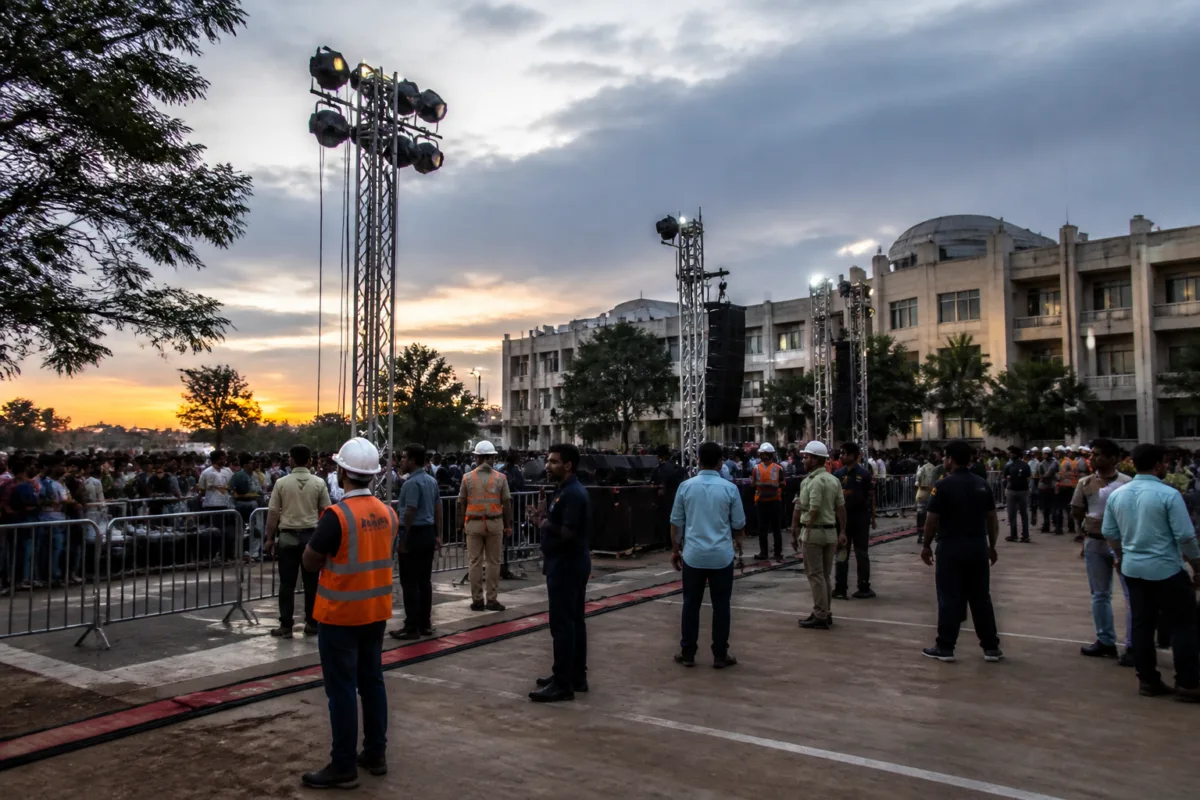
The death of a student and injuries to several others after a lighting structure collapsed during Dandiya celebrations at MVSR Engineering College in Nadargul have brought a recurring urban safety problem into focus: large gatherings are being organised in spaces that may not be equipped to manage temporary structures, crowd movement and medical emergencies together. The incident has also revived questions about how educational institutions plan events that increasingly resemble commercial spectacles.
The reported accident was not an isolated concern. Less than two months earlier, a sound equipment structure collapsed during a pre-release event for actor Yash’s film ‘Toxic’ at Malla Reddy University in Maisammaguda, injuring several people. That incident had already raised concerns about crowd management and the safety of temporary infrastructure used for large campus events. Student Federation of India secretary Nagaraju said the earlier episode had failed to serve as a warning and alleged that colleges were conducting events as a business.
The two incidents point to a common risk pattern without establishing that their immediate causes were identical. In both cases, temporary equipment or structures formed part of an event that attracted large crowds. Lighting towers, sound systems and related installations can change the physical conditions of a campus quickly. They introduce elevated or heavy equipment, cables, restricted movement areas and pressure on organisers to accommodate performances and audiences within a limited space. The report does not establish which specific safety procedures failed at MVSR Engineering College, but the recurrence of structural concerns makes inspection and accountability central to the public debate.
That distinction matters. A collapse during a college event is not only a question of construction quality or equipment placement. It also raises questions about who approves the event, who checks the temporary installation, who controls entry and movement, who plans emergency access, and who is responsible when an event becomes larger than the campus was designed to handle. The source report records student unions calling for college managements and authorities to take responsibility for crowd management, emergency medical arrangements and inspections before events.
The campus setting can make such gatherings appear easier to manage than public festivals or large commercial venues. Colleges already have internal spaces, student communities and administrative systems. But the reported incidents show that an educational campus can become a high-density event venue when celebrity appearances, film promotions or large cultural celebrations are added. The relevant safety question is therefore not simply whether the event is held inside a college, but whether the institution has planned for the scale and character of the gathering.
The reported criticism from student unions focuses on the changing purpose of college events. Nagaraju said educational institutions should avoid bringing celebrities to campuses for large events and demanded a government inquiry and a committee to prevent similar incidents. His allegation that colleges are treating events as business is a claim attributed to him, not an established finding in the report. It nevertheless identifies an important institutional tension: when an event is designed to attract attention, visitors or commercial value, the responsibilities associated with a public gathering may become more demanding than those associated with an ordinary campus programme.
The issue extends beyond temporary structures. The report refers to earlier incidents involving large gatherings in Hyderabad, including the death of 19-year-old BTech student S. Badrinath during a Ganesh idol Aagaman procession in Ramnagar on September 5. Police said there was no stampede and suspected asphyxiation. A traffic reserve sub-inspector attempted CPR before Badrinath was taken to Gandhi Hospital, where he was declared dead. Musheerabad police registered a case as a suspicious death and began an investigation.
On September 25, a 24-year-old delivery worker, identified as Shiva, died after slipping under the wheels of a lorry carrying a Ganesh idol during an immersion procession near Khairatabad crossroads. Police said he had attempted to board the vehicle while walking alongside it. The circumstances differed from the college-event incidents, but the cases share a broader setting: dense public gatherings where people, vehicles, temporary installations and moving crowds occupy the same limited urban space.
These examples should not be treated as evidence of one common cause. The report does not say that the deaths during the religious processions resulted from failures identical to those associated with the college events. It does, however, show how safety risks can multiply when crowd movement is not considered alongside event infrastructure. A structure may be stable but still create danger if it narrows a route. A vehicle may be part of a planned procession but become hazardous when people walk close to its wheels. A large gathering may remain orderly yet still leave an individual vulnerable to suffocation or delayed medical assistance.
This is why emergency planning cannot be reduced to crowd control alone. Student unions have called for emergency medical arrangements, inspection of temporary structures and clear accountability for lapses. Those demands cover three separate but connected functions. Inspection addresses whether the temporary installation is safe before people arrive. Crowd management addresses how people enter, stand, move and leave. Medical preparedness addresses what happens when preventive measures fail or when a person suffers a sudden medical emergency.
The source report does not identify the approval process, the inspecting authority, the event contractor, the structural designer or the precise emergency arrangements at MVSR Engineering College. It also does not establish whether the lighting structure had been inspected before the Dandiya celebration. Those unanswered questions are important because responsibility can become fragmented when an event involves college administrators, outside performers, equipment suppliers, contractors, security personnel and public authorities. Without a documented chain of responsibility, an investigation may establish what happened without resolving how the same risk will be prevented at the next event.
The demand for a government inquiry reflects this gap. A single investigation into an accident can determine immediate responsibility, but the student unions are seeking a committee and procedures that would apply beyond one campus. That proposed institutional response is significant because large college events are not merely private programmes when they invite substantial crowds, outside visitors or commercial performers. Their consequences extend to public safety, emergency services and the surrounding transport environment.
The reported sequence also raises a question about how warnings are converted into administrative action. The collapse at Malla Reddy University on August 22 had already brought attention to temporary structures and crowd management. Student Federation of India said the latest incident showed that the earlier warning had not been acted upon. The report does not establish why, but the recurrence suggests that recording an incident is not the same as changing the system that allowed the risk to emerge.
For Hyderabad’s campuses and event organisers, the available evidence points to a need for a complete safety chain rather than a single inspection. Temporary lighting towers, sound equipment and other structures need to be considered together with crowd density, circulation routes, vehicle access and emergency response. The account of the Ramnagar death, where CPR was attempted before the student was taken to hospital, also shows the importance of immediate medical intervention during crowded events. The report does not provide enough information to assess response times or the adequacy of arrangements at any of the venues.
The larger urban question is who bears responsibility when an institution designed for education is transformed into an event venue. The answer cannot be assumed from the location alone. It depends on who planned the gathering, who controlled the temporary infrastructure, who permitted the crowd size and who was prepared to respond to an emergency. The reported incidents make that chain visible because each failure, whether structural, operational or medical, can turn a short celebration into a public-safety emergency.
The evidence currently confirms a sequence of accidents and safety concerns, not a single proven explanation. The MVSR Engineering College collapse, the earlier Malla Reddy University incident and the two procession deaths occurred in different circumstances. What connects them is the need to examine how Hyderabad manages large gatherings where temporary structures, crowds, vehicles and emergency care interact. The next significant developments will be the findings of the investigations, any government inquiry sought by student unions, and whether colleges and authorities introduce documented inspections, event procedures and clear accountability before future celebrations.

