


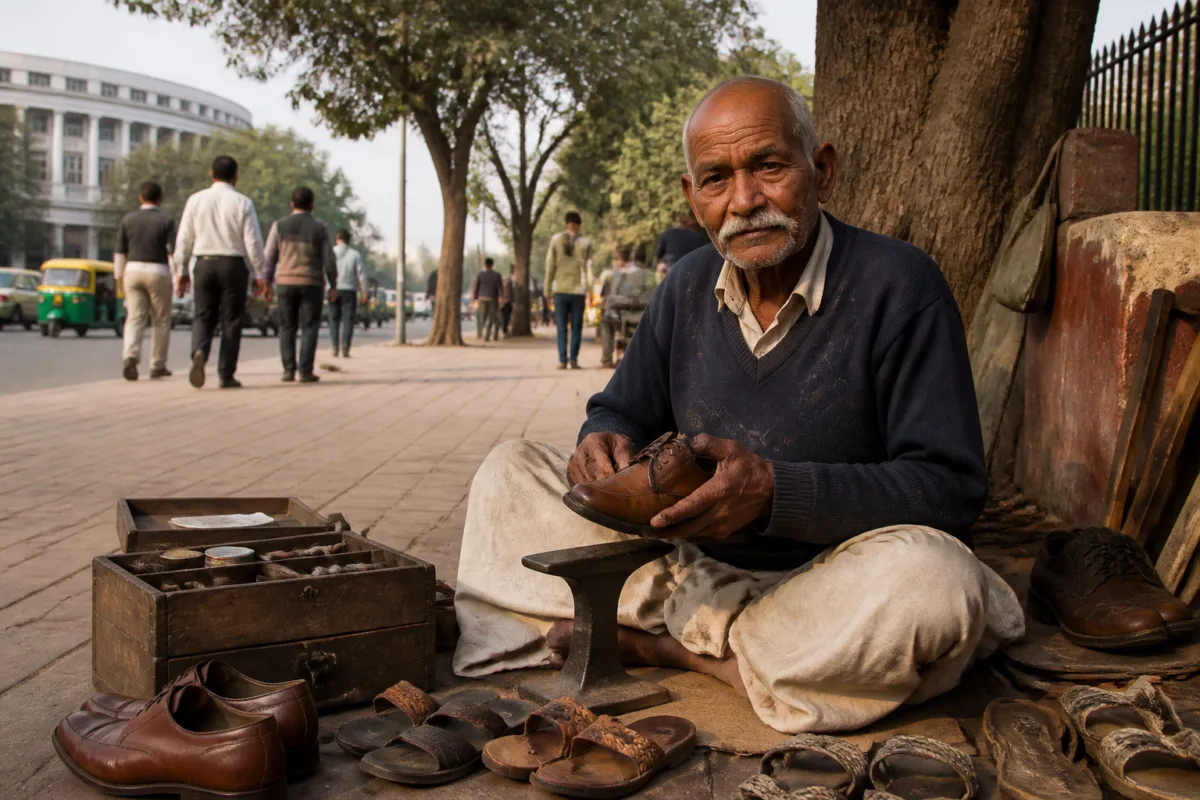
For more than 40 years, Aadhar Singh has repaired shoes beside the post office on Bahadur Shah Zafar Marg, turning a few feet of pavement into a workplace, workshop and archive of Delhi’s changing streets. His story is not only about a cobbler’s craft. It reveals how the capital’s informal workers depend on public space, public transport, weather and the daily rhythm of government offices to earn a living.
Singh works outdoors, close to the main gate of the post office and near the ITO area. His tools, anvil and supplies are packed into a weathered wooden box when the rain arrives. In summer, the fierce heat drives customers indoors. In winter, shorter days reduce his working hours. November, he says, is usually better because the wedding season brings more demand for shoe repairs and related work.
That dependence on the street makes his livelihood closely tied to the way the city uses and manages public space. Singh is not operating from a formal shop with protection from heat, rain or sudden disruption. His workplace is a small, visible piece of pavement whose usefulness comes from its location: near government offices, a post office and a daily stream of people.
Many of his regular customers work in nearby government offices, including the Bureau of Indian Standards and the Comptroller and Auditor General of India, according to the profile. They stop during lunch hours to have shoes repaired, sandals fixed or leather bags mended. The arrangement is simple but important. Workers arrive with worn items, Singh repairs them, and the relationship continues through repeat visits rather than formal contracts or digital platforms.
His craft also operates within a modest local economy of repair and reuse. Singh examines leather, identifies damaged areas and restores shoes and bags that customers are reluctant to discard. He has also begun selling shoes sourced from Agra, most priced below Rs 500. The combination of repair work and low-cost retail allows him to serve customers who may value affordability, familiarity and convenience over replacement.
The profile shows how such livelihoods are shaped by urban time as much as by urban space. Sundays are usually holidays because nearby offices are closed and customer numbers fall. On other days, police closures for parades or visits by VIPs to Rajghat can force Singh to arrive late or take the day off. These interruptions are not described as permanent displacement, but they demonstrate how official activity can temporarily override the routines of workers whose incomes depend on access to the same public area.
For a street-based worker, mobility is also an economic condition. Singh lives in Sunder Nagari in northeast Delhi and travels to work by DTC buses. A journey that once took about 40 minutes now takes nearly two hours, he says. The additional time reduces the hours available for work and extends the daily effort required simply to reach his workplace and return home.
The commute is significant because Singh’s business depends on being physically present. A formal office worker may be able to absorb a longer journey through fixed working hours, leave arrangements or digital communication. Singh’s earnings are tied to the number of customers who pass his spot and the number of hours he can remain there. A lengthy bus ride therefore affects not only personal convenience but also the operating capacity of his livelihood.
His account of the journey also reflects the limits of digital access in the informal economy. Singh does not own a smartphone and uses a keypad phone. An earlier basic Samsung handset was stolen, and he is reluctant to spend more on a mobile phone. The absence of a smartphone is not presented as a personal failing. It is a reminder that many everyday economic relationships still depend on physical proximity, recognition and trust rather than online discovery or digital payments.
Singh’s workplace has remained in a location that has changed considerably around him. He remembers an iron footbridge near Pearey Lal Bhawan being demolished, traffic queues growing longer and metro stations coming into operation. He also recalls the subway in front of The Times of India building being inaugurated by actor Rajesh Khanna and the eventual covering of a foul-smelling open drain near his workplace.
These memories provide a street-level record of infrastructure change. The area has gained or lost structures, altered its traffic patterns and improved one part of its basic environment by covering the drain. Yet the underlying dependence of a worker on a small piece of public space has remained. The city has modernised around Singh, but his livelihood still rests on a pavement, a toolbox and customers who know where to find him.
The contrast is central to understanding informal work in a large city. Urban change is often measured through roads, stations, buildings and traffic capacity. Singh’s experience adds another measure: whether people who work in public spaces can continue earning while these changes take place. The source material does not establish a formal rehabilitation or vending policy connected to his workplace, and it does not indicate that he has been removed. It does, however, show how vulnerable his working hours are to weather, security arrangements, office schedules and transport delays.
His personal history also links the capital’s informal economy to migration. Singh came to Delhi from Chhoti Harda, a village in southern Madhya Pradesh, a few years before Indira Gandhi was assassinated in 1984. He trained under his uncle after choosing city work over agricultural labour alongside his father. He later occupied a space outside the ITO post office after another cobbler left to take a government job.
That route into the city was informal but structured. Training came through a relative, work became available through an existing occupational network, and the location was secured through local knowledge rather than a formal recruitment process. Over four decades, Singh used the income from that work to build a three-storey house in Sunder Nagari. Each floor has one room, giving the house height but little width.
The house is a record of economic progress, but also of the constraints under which it was built. Singh describes himself as better off than when he began. He has raised five daughters and a son, and speaks with pride about a daughter who works from home for a company installing smart meters and earns about Rs 25,000 a month, according to the profile. His family’s trajectory spans several kinds of work, from pavement-based repair to employment linked to newer utility technology.
This intergenerational shift does not erase the importance of Singh’s occupation. His work continues to provide a service in a dense office district and supports a household built gradually from daily earnings. It also illustrates how informal livelihoods can persist alongside newer infrastructure and changing consumption habits. Shoes and bags that might otherwise be replaced are repaired; low-cost footwear is sold; and a recognised worker continues to draw customers through a fixed public location.
Singh’s story therefore raises a broader urban question without requiring a dramatic crisis: whose time, space and convenience are protected when a city is reorganised? The profile documents no single policy failure and does not claim that the authorities have acted unlawfully. Instead, it shows the cumulative pressures that shape a worker’s day—two-hour bus journeys, weather interruptions, closures for official events and reduced customer flow when offices shut.
The evidence confirms that Delhi’s urban economy is sustained not only by formal institutions and large infrastructure projects but also by small, place-dependent occupations. Singh’s pavement workplace has survived decades of physical change because it remains useful to the surrounding district. What remains less visible is how long such work can remain viable when access to public space, transport time and daily footfall are continually altered. For planners and administrators, the story is a reminder that the functioning of a city is also measured through the ordinary livelihoods that operate between its buildings, roads and official schedules.

