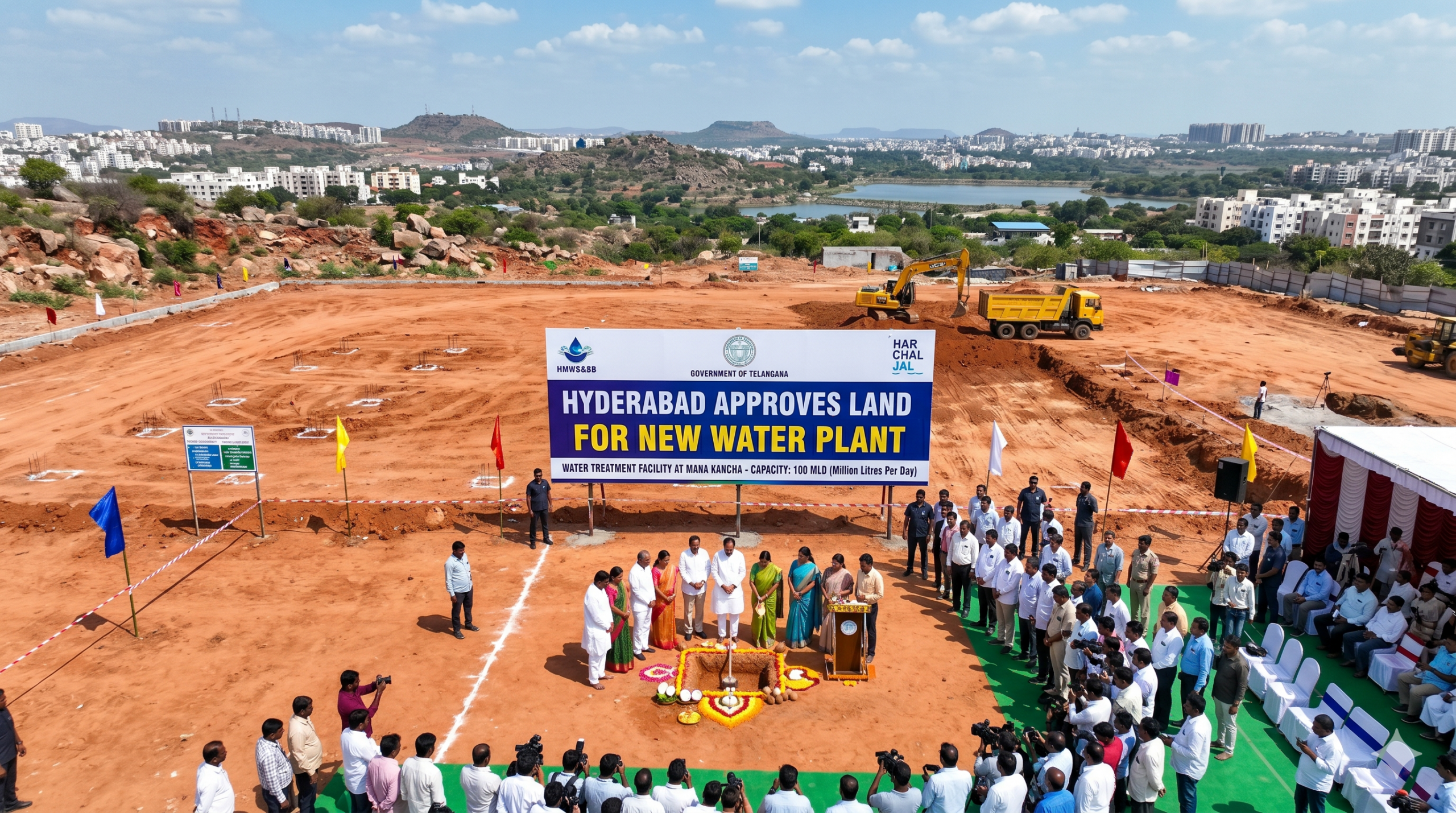
More than 22 acres of government land have been cleared for a new water treatment plant in Qasimabad, as authorities scramble to address the city’s growing water crisis. The proposed 6 million gallon per day rapid gravity filtration plant will serve surrounding localities — but whether it reaches the city’s most parched households remains an open question.
A senior official confirmed the land allotment following a high-level meeting. The site, located in Deh Jamshoro within Village Misri Shaikh, falls under category A-1 — deemed immediately suitable for construction. The Hyderabad municipal corporation had formally requested the allocation under the annual development programme. The plant’s capacity — 6 million gallons daily — sounds substantial. But urban water experts note that Hyderabad’s unplanned expansion has far outpaced infrastructure. Qasimabad and adjoining areas have seen rapid residential growth without proportional increases in piped water supply. Tanker-borne water has filled the gap, at exorbitant costs to households and significant environmental damage from groundwater extraction.
What makes this project notable is its technology choice. A rapid gravity filtration plant uses layered beds of sand and gravel to remove suspended solids — a proven, low-energy method that avoids chemical-intensive treatment. For a city facing both water scarcity and unreliable electricity, gravity-based systems offer climate resilience advantages over pump-dependent alternatives. But technology alone does not deliver water. Distribution networks matter equally. Officials have not detailed how treated water will reach households, nor whether the new supply will prioritise low-income settlements that currently pay the highest prices for private tankers. A water governance researcher not associated with the project noted that treatment plants without equitable last-mile connectivity often end up serving only affluent neighbourhoods.
The state government has simultaneously ordered that 50 percent of all development schemes be dedicated to water supply and drainage, calling potable water a “fundamental public necessity”. Across the province, 1,082 projects are underway, with digital monitoring systems promised to ensure transparency. For Hyderabad’s residents, the real test will be whether the new plant reduces dependence on depleting groundwater and private tankers — or simply adds another underperforming asset to the city’s infrastructure ledger. Execution, transparency, and equitable distribution will determine if this becomes a model for climate-resilient urban water management or another missed opportunity.
Hyderabad Approves Land For New Water Plant