


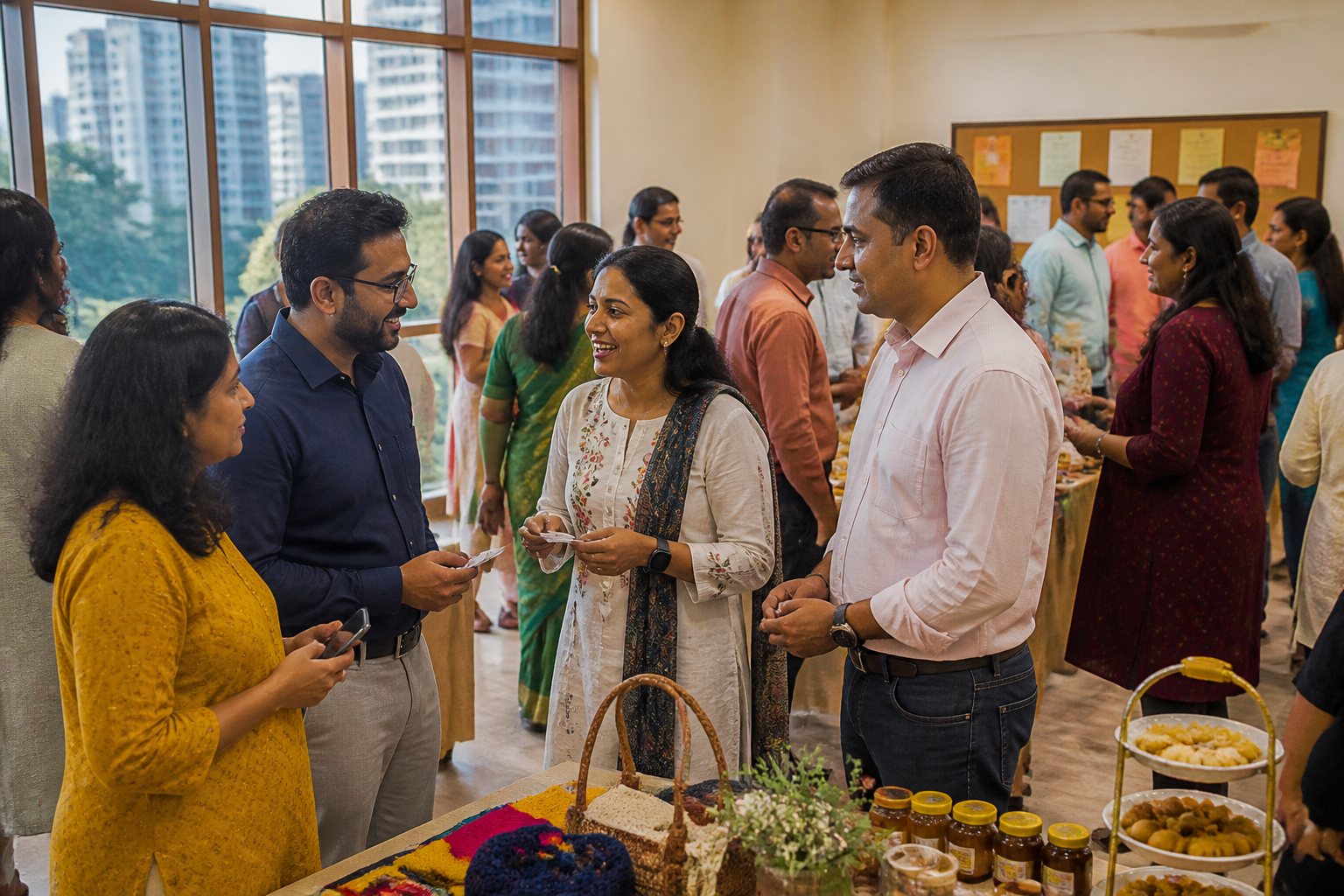
Bengaluru’s Marathi community has grown beyond cultural celebrations into an informal support network that helps newcomers find jobs, housing, business contacts and familiar social spaces. The experience of Bangalore Marathi shows how migrant residents often depend on community infrastructure when the formal city offers limited assistance with the practical difficulties of settling in.
The network’s work is visible in the experiences of residents who arrived in Bengaluru with professional skills but limited local contacts. It is also visible in the scale of the community’s digital presence and in the range of services now connected to it. What began around festivals and cultural gatherings has developed into a parallel system of referrals, recommendations and introductions across the city.
For Harish Bhosale, 43, the network became important after a career interruption. Originally from Solapur, Bhosale put his professional pursuits on hold in 2013 to explore the Western Ghats and Sharavati Valley. After his savings ran out, he returned to the job market, but repeated rejections at the screening stage made it difficult to restart his career. He later connected with Bangalore Marathi, whose members referred him for jobs.
Those referrals helped him secure a role at an Indian service-based company, where he worked for more than a year. He subsequently changed jobs several times, some through referrals, before stabilising at a multinational semiconductor firm. He now supports others through the community’s job forum. His experience illustrates the value of trusted introductions in a large labour market, particularly for people whose career histories do not fit standard recruitment filters.
Bangalore Marathi was established 15 years ago, according to the community. Its activities have expanded from organising Ganesh Chaturthi and haldi-kumkum celebrations to employment assistance, professional networking, matrimony and housing support. Dr Shrutika Itkelwar, a Marathi dentist associated with Motherhood Hospital, joined the community six years ago and describes the organisation as a support system for residents navigating Bengaluru.
At the centre of this expansion is Marathi Connect, a network focused on job referrals and business relationships. Bangalore Marathi co-founder Kapil Ingale says hundreds of entrepreneurs participate in networking events organised by Marathi Connect. The group holds monthly entrepreneur conferences and social meetups for newcomers seeking opportunities in sectors including real estate, finance, hospitality, pharmaceuticals, travel, lifestyle, sports and manufacturing.
The network therefore performs functions that are usually dispersed across employers, professional associations, housing brokers, social groups and local knowledge. It does not replace those institutions, but it helps members access them through personal connections. For people arriving from other cities, the first challenge is often not simply finding an apartment or applying for a job. It is knowing whom to ask, which neighbourhoods to consider and which recommendations to trust.
Housing is one of the clearest examples. Vivek Yawalkar, 51, a commercial artist from Mumbai’s Sir JJ School of Art, said he initially struggled with language and contacts after relocating to Bengaluru. Bangalore Marathi helped him find an affordable home. Community members offered him a serviced one-bedroom apartment in Brookfield for Rs 25,000 a month, he said. He shifts to a larger unit when his family visits.
The example points to the importance of informal housing information in a city where newcomers must make rapid decisions about rent, location and access to work. The account does not establish the overall affordability of Bengaluru’s housing market, but it shows how a community recommendation can reduce the uncertainty involved in finding accommodation. For a resident without an established local network, a personal introduction may be more immediately useful than a generic listing.
Digital groups extend this support beyond formal meetings. WhatsApp and Facebook groups help members locate doctors, plumbers, Marathi food, shared travel and other daily services. A 100-member Marathi business group gave Yawalkar access to professional networking and business opportunities. He said those connections helped him move from struggling during his first year in the city to building a more stable life in Bengaluru.
The community’s role also extends to entrepreneurship. Ingale, an engineering graduate from Nagpur, moved to Bengaluru at the age of 23. After working at Cognizant, he entered the hospitality sector through Home Awaits, which offers accommodation across the city. He says the community complements his business, with about half his guests coming from the Marathi community. Properties also host celebrities and crews visiting Bengaluru for cultural and theatre events, increasing their visibility.
For Varsha Barde, who moved from Pune and spent two decades in information technology before entering wellness and entrepreneurship, Marathi Connect has provided referrals and helped build trust in her beauty and wellness brand. She described the network’s monthly meetings, social events and business meetups as an important platform for making contacts and receiving community backing.
These accounts show that the network is not limited to people seeking salaried employment. It also links business owners, service providers, artists, hospitality operators and consumers. Community identity becomes a route through which economic relationships are formed. That does not mean every member receives the same benefit, or that informal networks can substitute for transparent employment and housing systems. But it does show how social trust can influence access to urban opportunities.
Bangalore Marathi’s reported reach is substantial. Ingale says more than 1,13,000 people follow the community on Instagram and more than 20,000 are members of its Telegram network. He also says over four lakh Marathi-speaking people are connected through Bangalore Marathi, including through multiple sub-groups. The supplied account does not independently verify these figures, but they indicate the scale claimed by the organisation and the extent to which its activities have moved into digital platforms.
The network’s cultural activities also have an economic dimension. Its social media presence promotes Marathi-owned homestays, food suppliers and home cooks when theatre companies arrive in Bengaluru. Artisans, including Ganesh idol makers, receive promotional support. During Sankranti, the group organised a haldi-kumkum programme in HSR Layout attended by about 1,000 married women, according to Itkelwar.
This combination of cultural, commercial and practical support is significant because migration to a city is not only a movement between jobs and addresses. It is also a process of rebuilding everyday systems: finding healthcare, arranging repairs, locating food, forming friendships and creating a sense of security. Large cities bring people together through employment, but they do not automatically provide the social relationships needed to navigate urban life.
Language is part of that transition. Ingale says settling in Bengaluru as a Marathi person initially involved language challenges, although those difficulties faded over time. After nearly two decades, he considers Bengaluru home. The existence of a BM Learn Kannada group within the wider community suggests that cultural networks can also support adaptation to the host city rather than simply reproduce a separate enclave.
For Ragini Satish Naik, 43, who moved from Gokak to Bengaluru to look after her daughters Swara and Shambavi, the need was more personal. She missed familiar faces and a sense of community. A conversation at a Marathi film screening introduced her to Bengaluru’s Marathi network. Later, a chance meeting with a Maharashtrian resident named Jayanti helped her find accommodation. Her husband, Satish, remains in their hometown and visits twice a month. In his absence, Naik says, the community has become an extended family for her and her daughters.
Her experience highlights a dimension of urban support that is difficult to capture through conventional infrastructure measures. Roads, housing projects, workplaces and public transport determine how a city functions physically. But belonging, trust and mutual assistance also affect whether people can remain in the city and build stable lives. For families separated by work or caregiving responsibilities, community networks can provide practical and emotional support that formal institutions may not offer.
Bengaluru’s Marathi network is part of a wider pattern in which migrant communities create their own channels for information and assistance. The available accounts do not establish how these networks compare with other linguistic or regional communities, nor do they measure their impact on employment outcomes or housing costs. They do, however, demonstrate the range of urban functions being performed informally: job matching, rental referrals, service discovery, business promotion, cultural programming and newcomer orientation.
The institutional question is what this reveals about the city’s settlement systems. Bengaluru attracts workers, entrepreneurs, students, artists and families from across India, yet newcomers often arrive without a single public-facing system that connects them to reliable housing information, local services, employment networks and language support. Community organisations fill some of that gap because they already possess trust and a shared identity.
That arrangement has strengths and limits. Personal referrals can reduce friction and help people recover from professional setbacks or relocation difficulties. At the same time, access depends on knowing that a group exists and being able to participate in it. The supplied material does not provide evidence on who remains outside these networks, how disputes are handled or whether the support reaches residents from other backgrounds.
What the evidence confirms is narrower but important: in Bengaluru, Bangalore Marathi has developed from a cultural association into a multi-purpose community platform. Its reported membership and social media reach, along with the experiences of Bhosale, Yawalkar, Barde and Naik, show how a migrant network can support both social belonging and economic activity.
The larger urban question is whether cities such as Bengaluru can build formal systems that recognise the practical needs of a highly mobile population, while communities continue to provide the trust that public systems often lack. For now, the Marathi network’s growth shows that urban integration is being managed not only through institutions and infrastructure, but also through relationships built between residents themselves.
