


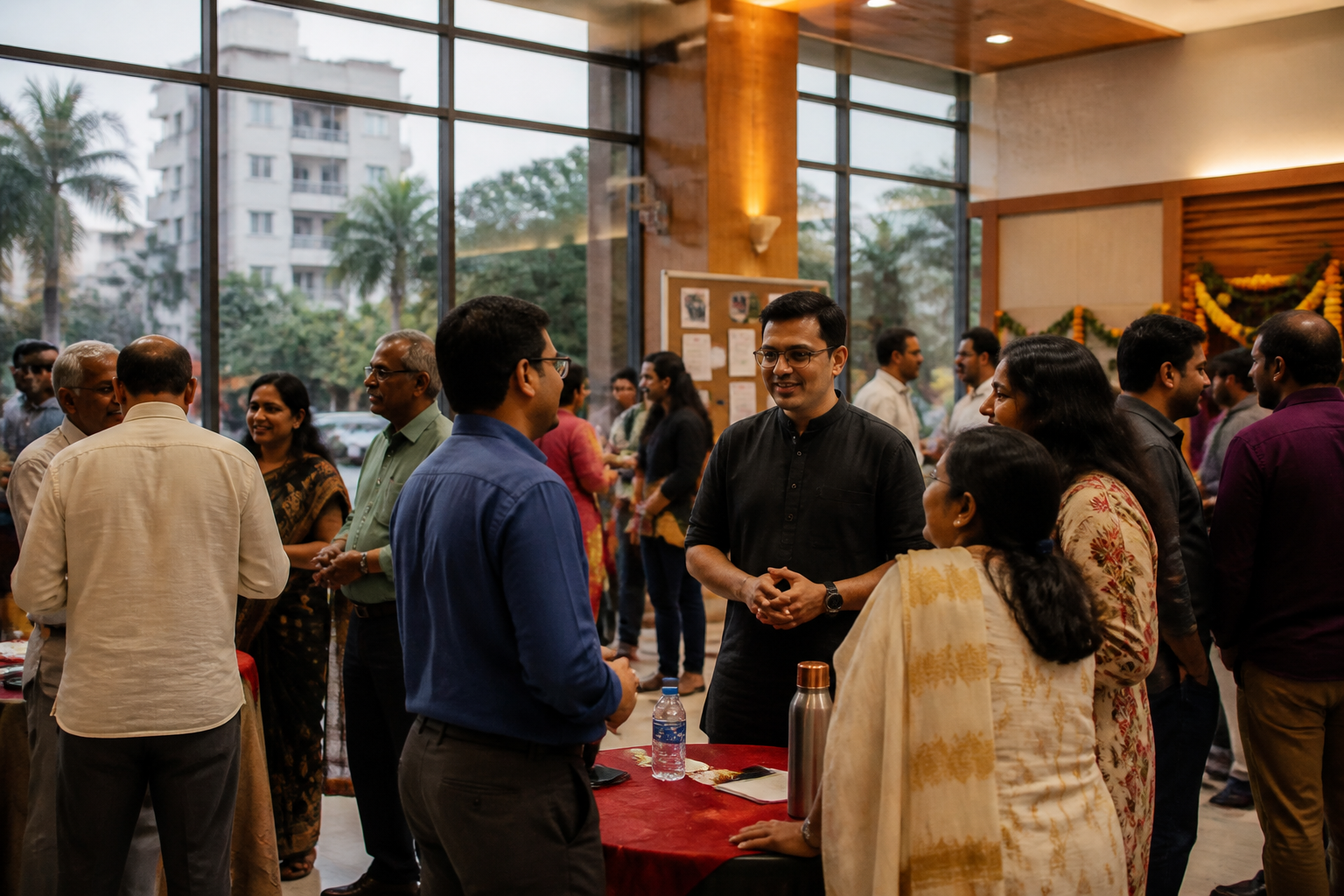
Bangalore Marathi’s expansion from a cultural association into a network for jobs, housing, business referrals and everyday assistance reveals a less visible layer of how migrants settle in Bengaluru. For Marathi-speaking residents, the network is not only preserving language and festivals; it is helping people navigate the city’s labour market, rental housing, services and social isolation.
The community, which began about 15 years ago by organising events such as Ganesh Chaturthi and haldi-kumkum gatherings, now connects more than four lakh Marathi-speaking people, according to co-founder Kapil Ingale. Its reach includes more than 1,13,000 Instagram followers and over 20,000 Telegram members, the report says. Alongside the main network are smaller groups such as Amhi Marathi, Mitramandal Bengaluru Parivar and BM Learn Kannada.
That evolution matters because moving to a large city involves more than finding a job. New residents need reliable information about neighbourhoods, landlords, doctors, food suppliers, transport, household services and social relationships. Formal institutions rarely provide all of these connections in one place. In the cases described in the report, community groups are filling that gap through referrals and informal trust.
The most direct example is employment. Harish Bhosale, who moved from Solapur and took a career break to explore the Western Ghats and Sharavati Valley, faced repeated rejections when he tried to return to work in 2013. After connecting with Bangalore Marathi, members referred him for jobs. He eventually joined an Indian service-based company, changed jobs through further referrals and later stabilised at a multinational semiconductor firm. He now assists others through the network’s job forum.
Bhosale’s experience shows how recruitment can operate outside formal applications. A career break may be difficult to explain through standard screening systems, while a referral gives an employer a personal recommendation and gives the applicant access to openings that might otherwise remain invisible. The community therefore functions as an informal labour-market intermediary, connecting professional experience with local opportunity.
Marathi Connect is the main employment and business platform described in the report. Ingale says hundreds of entrepreneurs take part in its networking events. Monthly conferences and social meetings bring together people seeking or offering work in real estate, finance, hospitality, pharmaceuticals, travel, lifestyle, sports and manufacturing. The network also provides a route for entrepreneurs to build credibility among potential customers who already share a social connection.
Varsha Barde’s experience illustrates that role. After two decades in information technology, she moved towards wellness and entrepreneurship. Her beauty and wellness brand receives referrals and what she describes as community backing through Marathi Connect. The network’s value, in this case, is not simply advertising. It creates repeated contact through monthly meetings, social events and business meetups, allowing trust to develop among people who may otherwise be unfamiliar with a new brand.
The same mechanism extends into housing. Vivek Yawalkar, a commercial artist from Mumbai’s Sir JJ School of Art, initially struggled with language and contacts after relocating to Bengaluru. Through Bangalore Marathi, he found a serviced one-bedroom apartment in Brookfield for Rs 25,000 a month. He later shifted to a larger unit when his family visited.
The account does not establish that the network has solved Bengaluru’s affordability problem. It does show how social connections can reduce the search costs and uncertainty involved in renting. A newcomer may not know which landlords are reliable, how much a particular neighbourhood costs or how to locate a short-term home. A recommendation from a known community member can make that process faster, particularly for people arriving without an established local network.
Housing assistance also reflects the uneven nature of access to the city. Bengaluru’s neighbourhoods are often experienced through personal contacts: a colleague recommends a locality, a friend identifies a rental, or a community group connects a newcomer to a service provider. These channels can determine how quickly a resident finds a home and how safely they manage the transition. They sit alongside, rather than replace, the formal rental market.
For families and individuals living away from their hometowns, the social function may be equally important. Ragini Satish Naik, who moved to Bengaluru to look after her daughters, initially missed familiar faces and a sense of community. A Marathi film screening introduced her to the network, and a later meeting with another Maharashtrian resident helped her find accommodation. With her husband living in their hometown and visiting twice a month, the community became an extended support system for Naik and her daughters.
This is a form of urban infrastructure that does not appear on a master plan. It is built through repeated interaction, shared language, cultural events and digital communication. WhatsApp and Facebook groups help members locate doctors, plumbers, Marathi food, shared travel and other daily services. The result is a parallel information system that translates a large and unfamiliar city into a set of trusted contacts.
The network’s cultural activities remain central to that system. A haldi-kumkum programme in HSR Layout drew about 1,000 married women during Sankranti, according to Dr Shrutika Itkelwar, a dentist and community member. Marathi film screenings, handicraft workshops and sessions on making ukadiche modak create meeting points that can lead to practical assistance. Cultural participation becomes an entry route into employment, housing and social support rather than an activity separate from urban settlement.
The community also supports businesses linked to cultural production. The report says Marathi-owned homestays, food suppliers and home cooks receive promotion when theatre companies visit Bengaluru. Artisans, including Ganesh idol makers, also gain visibility. This indicates that the network is not only connecting residents to existing jobs; it is helping create demand for services associated with language and cultural identity.
Ingale’s own career reflects the city’s changing economic pathways. After moving from Nagpur to Bengaluru at the age of 23 and working at Cognizant, he entered hospitality through Home Awaits, which provides accommodation across the city. He says about half of the guests at his properties come from the Marathi community. Cultural events and theatre-related stays also contribute to the properties’ visibility.
Such links show how migration, entrepreneurship and cultural activity can reinforce one another. A resident may arrive as a job seeker, become a service provider, then use the same network to find customers or employees. The boundary between community association and economic platform becomes less distinct as members build businesses around the needs of a mobile population.
The network also appears to be adapting to the practical demands of integration. BM Learn Kannada is identified as one of its sub-groups, suggesting that maintaining a linguistic identity does not necessarily mean remaining separate from Bengaluru’s wider civic and social environment. It can also mean acquiring the language and contacts needed to function more effectively in the city.
The report does not provide audited membership data, information on the number of job placements or a comparison with other migrant networks. Its account is based on community representatives and individual members, so the scale and outcomes of the network cannot be independently quantified from the supplied material. The reported figure of more than four lakh connected people also does not clarify whether it refers to unique individuals, followers across platforms or members of multiple sub-groups.
Even with those limits, the cases point to a wider urban question: how much of a city’s accessibility depends on institutions that are neither government services nor commercial platforms? In Bengaluru, the examples described here suggest that community networks help residents navigate employment, housing and daily life by reducing isolation and circulating trusted information.
The significance of Bangalore Marathi lies in this movement beyond cultural programming. Festivals and language-based gatherings remain the visible face of the organisation, but the deeper function is connective. It links newcomers to homes, workers to employers, entrepreneurs to customers and families to social support. As Bengaluru continues to attract people from across India, these informal systems are becoming part of how the city is actually inhabited. What remains to be established is how consistently such networks deliver outcomes at scale, and how their role compares with the formal institutions responsible for housing, employment access and urban integration.

