


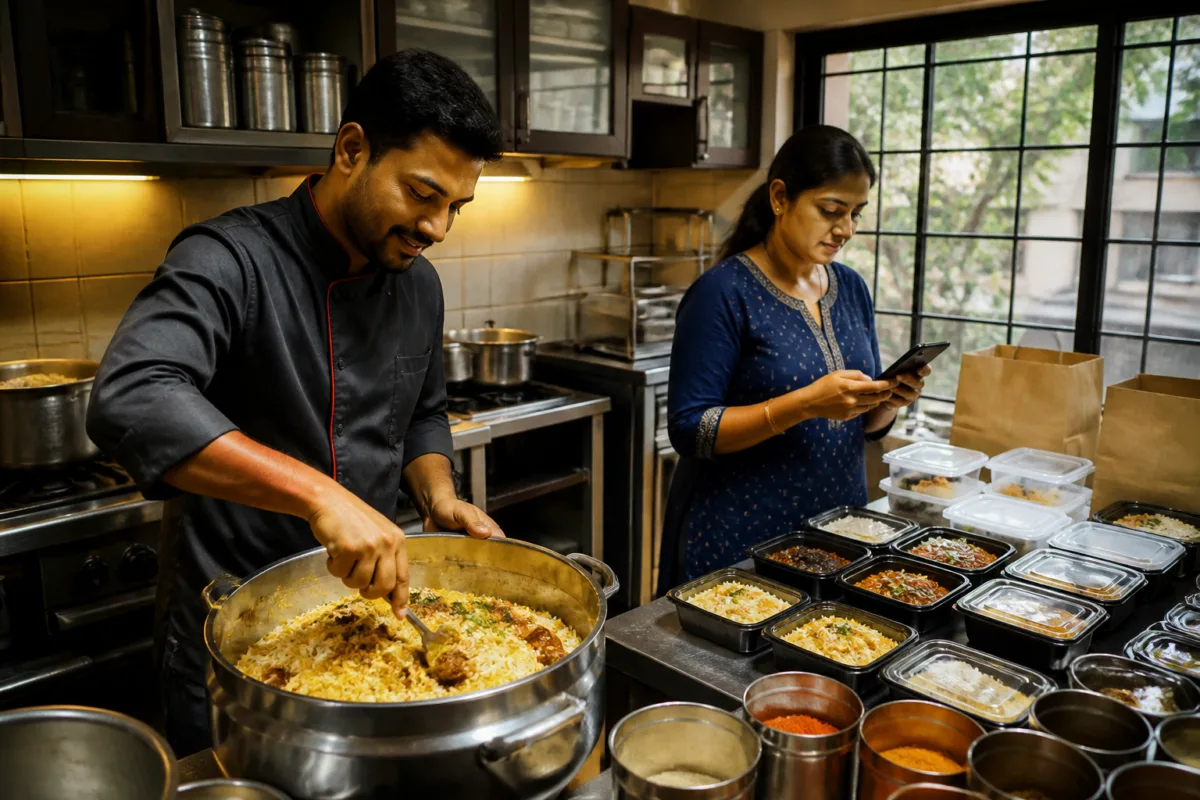
A Bengaluru cloud kitchen run from a JP Nagar home shows how urban entrepreneurship is increasingly being built around existing household assets rather than expensive commercial premises. Rakesh and Yamini, who started Raku’s Kitchen after an earlier hotel venture failed, now operate through pre-orders, social media and delivery services, preparing food only after customers confirm and pay.
Their story is not simply about a couple finding a new source of income. It also illustrates how the city’s food economy is being reorganised around small, flexible and digitally mediated businesses. Instead of maintaining a dining room, a large kitchen or a permanent workforce, the couple use their home kitchen, online communication and delivery platforms to serve individual customers, family functions and corporate orders.
That model changes the economics of entering the food business. A conventional restaurant requires a customer-facing location, interiors, staff and the capacity to absorb the cost of unsold food. Raku’s Kitchen began with the equipment already available at home. The couple used their existing stove and large vessels before purchasing a commercial stove and additional utensils as demand increased.
The approach, as described by the couple to Prajavani, was to avoid committing substantial capital before the business had demonstrated demand. Their advice to prospective cloud-kitchen operators is to start with available household equipment and expand only when orders justify further investment. This is a gradual growth model, where capacity follows confirmed demand rather than preceding it.
The business was started after Rakesh’s earlier experience in the hospitality sector. A trained chef and hotel-management graduate, he had completed a postgraduate degree in Britain and worked in large five-star hotels. He later returned to Bengaluru with the aim of running a hotel in his home country. Together with friends, he opened three hotels in Bengaluru, Magadi and Chikkaballapur, according to the report. Disagreements among the partners eventually brought that venture to an end.
Raku’s Kitchen became the couple’s attempt to continue in the food business without repeating the same operating structure. Rakesh handles the cooking, while Yamini assists with packing and promotion. They currently do not employ separate kitchen workers and manage preparation, packing and delivery coordination themselves. Yamini, who works as a social-media influencer, promotes the business on YouTube and Instagram, while customer communication takes place largely through WhatsApp.
This division of labour is central to the enterprise. The kitchen is not only a place where food is cooked; it is also the production unit, order-management centre and starting point for customer service. The couple personally purchase ingredients and prepare their own spice mixes. Yamini told Prajavani that they do not use ready-made masalas and currently focus on a country-style menu. Meat is purchased from a specified shop, with quality presented as a priority.
The menu includes biryani, fried dishes, sambar and keema, along with chicken, mutton and seafood preparations. Orders come from households and companies. The couple said they have received food orders for birthdays, baby showers and other family functions, as well as larger orders from companies including Starbucks and Croma for their employees. They also offer customised preparations for larger orders and provide catering services that include serving food and cleaning up after an event.
The operating model is built around advance planning. Customers generally place orders a day in advance, allowing the couple to prepare the required quantity rather than cook for uncertain demand. The business does not promise immediate delivery for sudden orders. It takes orders for lunch and dinner, prepares the food roughly one to one-and-a-half hours before the meal time and sends it through available delivery applications.
This pre-order system is significant because it connects the size of production to the size of confirmed demand. The couple said they do not cook even a small additional quantity beyond what has been ordered. In their account, this reduces the possibility of food remaining unsold, while allowing customers to receive freshly prepared meals. Orders are accepted and confirmed after payment, with WhatsApp used for communication from the initial request through delivery.
The arrangement also makes the business more dependent on reliability than on spontaneous footfall. A restaurant can attract passing customers, but a home-based kitchen has to be discovered through recommendations, social-media promotion or direct communication. Repeat orders therefore become especially important. Yamini said customers return because of the food’s taste, cleanliness and quantity, but the report does not provide figures for the number of orders, revenue, delivery area or monthly growth.
That absence of operating data is important. The account establishes that Raku’s Kitchen has received household, corporate and catering orders, but it does not establish the size or profitability of the business. Nor does it indicate how many similar kitchens operate in Bengaluru, what proportion survive beyond their initial months or how much income the couple currently derives from the venture. The story is therefore best understood as a documented example of a business model, not as evidence that every home-based food enterprise will achieve the same results.
The model also places multiple responsibilities on the founders. Rakesh’s culinary experience provides the production skill, but the couple must also source ingredients, maintain consistency, manage customer communication, collect payments, pack food, coordinate delivery and promote the brand. In a conventional restaurant, these functions may be distributed among chefs, service staff, managers and delivery personnel. In this kitchen, they remain concentrated within a two-person household enterprise.
That concentration can lower initial costs, but it also ties the business closely to the couple’s own time and capacity. The supplied report does not establish how they manage unusually large orders, illness, equipment failure or simultaneous catering commitments. It does show that the business has responded to increasing demand by investing in a commercial stove and more utensils rather than immediately shifting to a separate premises or hiring staff.
The cloud-kitchen format also changes the relationship between food businesses and urban space. A restaurant’s location is visible through signage, seating and street activity. A home-based kitchen may have little or no public-facing presence, yet it can serve customers across a wider area through delivery networks. The commercial value of the enterprise is therefore created partly inside the home and partly through digital channels that connect the kitchen to customers beyond the immediate neighbourhood.
For cities such as Bengaluru, this raises a broader question about how household space is being used for economic activity. The source does not provide details about zoning, licensing or regulatory approvals, so no conclusion can be drawn here about the legal framework governing this particular kitchen. The couple said they follow food-safety rules strictly, but the report does not identify the specific registrations, inspections or compliance documents involved.
What the account does make clear is that digital communication has reduced the need for a conventional storefront at the earliest stage of a food business. Menus can be circulated through WhatsApp and Instagram, orders can be confirmed after payment, and delivery can be arranged through existing applications. This does not eliminate the operational demands of food production, but it changes how customers find the business and how the enterprise manages demand.
The story also highlights the role of prior professional experience in shaping small urban enterprises. Rakesh did not enter the business without hospitality knowledge. His training, international postgraduate education and experience in five-star hotels provided a foundation for the menu and kitchen operations. At the same time, the business was rebuilt at a smaller scale after a partnership-based hotel venture failed. The result is a shift from a capital-intensive and jointly owned format to a household-led operation.
Yamini’s role shows that the business depends on more than cooking. Social-media promotion, customer communication and packaging are part of the service being offered. The couple’s emphasis on taste, hygiene, quantity and customised orders is also a way of differentiating a home-based kitchen from other food options available to urban consumers. The supplied material, however, does not include independent customer reviews or comparative information on pricing and delivery performance.
Raku’s Kitchen plans to launch a website and expand its operations, while continuing its catering service. Those are stated intentions rather than completed developments. Whether the business can grow beyond a two-person operation will depend on factors not covered in the report, including order volumes, kitchen capacity, delivery reach and the cost of adding workers or moving into a larger facility.
The larger urban lesson is that entrepreneurship does not always begin with a new commercial property or a large investment. In this case, a home kitchen, professional skills, social-media reach and pre-paid orders have been combined into a small food enterprise. The evidence supports that narrower conclusion. It shows how one Bengaluru couple converted domestic space into a production and service base after a failed hotel partnership, while the questions of scale, regulation, profitability and long-term sustainability remain open.

