


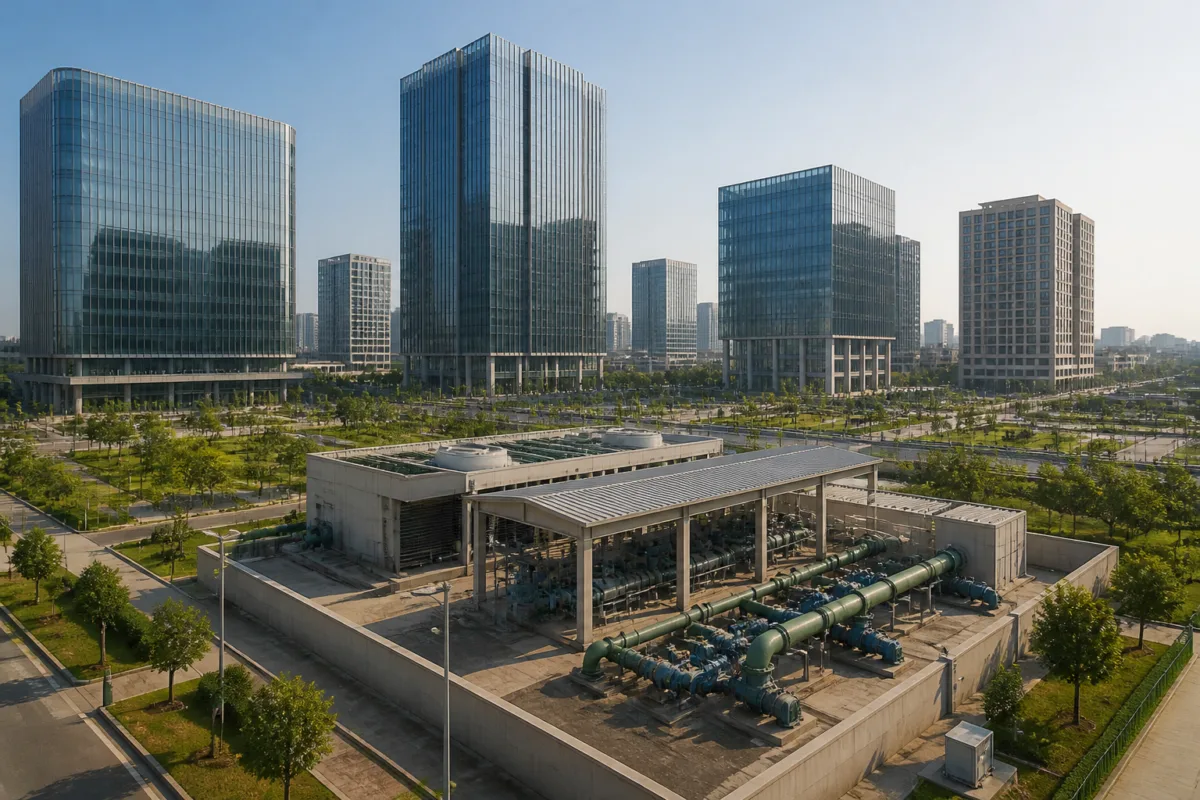
District cooling is emerging as a potential way for India’s planned urban developments to manage rising cooling demand, with Grundfos estimating that centralised systems could reduce energy and water consumption by 30-40 per cent compared with conventional building-level systems. The opportunity is being discussed as India expands commercial districts, infrastructure networks, data centres and large mixed-use developments, but the technology remains at an early stage in the country.
The central distinction is between cooling systems designed for individual buildings and a district-scale arrangement that serves several buildings from a shared system. Saravanan Panneerselvam, Senior Regional Director for Commercial Building Services in IMEA at Grundfos, told The Hindu BusinessLine that a centralised solution could reduce the need for every building to calculate its own peak load and separately design its electricity and water consumption around that demand.
His example was of an area containing 10 towers. Under a conventional model, each tower would plan for its own peak requirement. A district cooling system can aggregate that demand and supply the buildings through a central arrangement, potentially reducing the combined resources required. Grundfos estimates that this approach could result in approximately 30-40 per cent lower energy and water consumption, although the estimate is the company’s assessment rather than an independently verified national benchmark.
That distinction matters because cooling is not only a building-services issue. It affects the design of power infrastructure, water systems, plant rooms, construction sequencing and the operating costs of large urban developments. When cooling is planned separately for each building, the resulting infrastructure is distributed across multiple sites. A centralised system changes where equipment is located, how capacity is planned and how buildings connect to the service.
The company’s argument is strongest where several large buildings are planned together. Planned urban developments, commercial complexes and infrastructure projects offer an opportunity to integrate a shared cooling network during the design stage. Retrofitting such a system after buildings have been completed is more difficult because the internal mechanical systems, building layouts and utility connections have already been established.
This makes district cooling partly a question of urban timing. The technology cannot be considered only as equipment that a building owner may purchase later. Its feasibility depends on decisions made before construction: how the site is planned, how buildings are grouped, how cooling demand is calculated, where central plants can be located and how the network is connected to individual properties. The company’s comments point to a broader planning challenge in India, where infrastructure systems are often considered separately even when they serve the same urban district.
India’s adoption of district cooling is still limited. Grundfos said the system has been widely adopted in parts of the Middle East, while most commercial buildings in India continue to rely on standalone cooling systems. The company has executed what it describes as India’s first district cooling project at Gujarat International Finance Tec-City, or GIFT City, as a greenfield project. It has also carried out campus cooling projects in India, which are smaller versions of district cooling, with capacities ranging from 500 to 10,000 tons of refrigeration.
The experience of GIFT City is relevant because a greenfield development offers conditions that established urban areas often do not. New districts can reserve space, coordinate utility corridors and align multiple buildings before construction is complete. Existing commercial areas, by contrast, may have to work around occupied buildings, fragmented ownership, limited rights of way and cooling systems that were designed independently.
The difference between a district cooling system and a campus cooling project also indicates that adoption need not begin at the scale of an entire city. A university, business park, hospital cluster, financial district or large commercial development can function as a smaller test case. Grundfos’s reported project capacities suggest that the approach can cover a range of development sizes, although the supplied report does not establish how many such systems are operational or how their actual performance compares with conventional cooling.
The potential resource savings are particularly relevant in sectors that combine high energy demand with intensive cooling requirements. Grundfos identified data centres as an opportunity for efficient pumping systems, water treatment and water reuse. It also pointed to transport infrastructure, including airports, railway networks and metro projects, as well as the hospitality sector.
These sectors do not all have the same operating model. A data centre requires continuous environmental control and has concentrated technical loads. An airport or railway network contains multiple buildings and operational zones with different patterns of use. Hotels and hospitality developments have changing occupancy levels and varied cooling demand. A district-scale approach could therefore be applied differently across each sector, with the design depending on the concentration and timing of demand.
The reference to water is also important. Cooling systems are commonly discussed through electricity consumption, but water use can become a parallel constraint in large developments. Grundfos’s stated opportunity includes water treatment and reuse, particularly for data centres. The report does not provide project-level water consumption figures or specify the technologies that would deliver the estimated savings in each application. It does, however, place water management alongside energy efficiency rather than treating them as separate infrastructure questions.
For urban authorities and project developers, this raises an institutional issue: who plans and governs a shared cooling network? A standalone air-conditioning system can generally be specified by an individual building project. A district system requires coordination across the master plan, building owners, utility providers and the entity responsible for operating the central plant and distribution network. The supplied report does not identify a common regulatory framework or a standard ownership model for district cooling in India.
That gap is significant because technical feasibility alone does not establish whether a system will be adopted. A shared network must be incorporated into development approvals and building designs, while its costs and responsibilities must be allocated among participating properties. Buildings also need to connect at the correct stage. If one project proceeds without provision for the network, later connections may become more expensive or technically difficult.
Grundfos’s wider India strategy provides another part of the context. The company described India as its biggest growth-potential market within its broader India-Middle East-Africa and Asia-Pacific businesses. It reported double-digit growth in India and said around 60-65 per cent of its India business is locally sourced, produced and assembled. This local capability has helped insulate its India operations from logistics disruptions affecting the Middle East, according to Panneerselvam.
The company said shipments from Europe to the Middle East now take nearly 85 days, compared with roughly three weeks earlier, because of disruption linked to the ongoing geopolitical conflict. It expects its overall IMEA business to remain flat this year, after five years of double-digit growth. These details are not directly about district cooling, but they show why the company is placing greater emphasis on India as a market for pumping, water and building-services equipment.
They also underline the supply-chain dimension of urban infrastructure. District cooling depends on pumps, controls, treatment systems and other specialised equipment, in addition to civil and mechanical works. Greater local sourcing may support project delivery, but the report does not establish whether Indian cities currently have enough operators, standards or procurement models to scale the technology beyond individual developments.
The evidence currently supports a cautious conclusion. District cooling can offer a way to coordinate cooling demand across multiple buildings, and Grundfos sees a 30-40 per cent potential reduction in energy and water consumption compared with conventional systems. India has at least one greenfield district cooling project at GIFT City and a number of campus cooling projects. Yet the technology remains nascent, most commercial buildings still use standalone systems, and the available report does not provide independent performance data or a national adoption figure.
The larger urban question is whether cooling will be treated as a building-by-building service or as shared infrastructure in the districts now being planned. The answer will influence how cities allocate space, electricity and water as commercial and infrastructure development expands. The next evidence to watch is whether more new districts, data centres, transport hubs and large campuses integrate centralised cooling at the design stage, and whether those projects publish verifiable operating results against the savings estimates now being advanced.

