


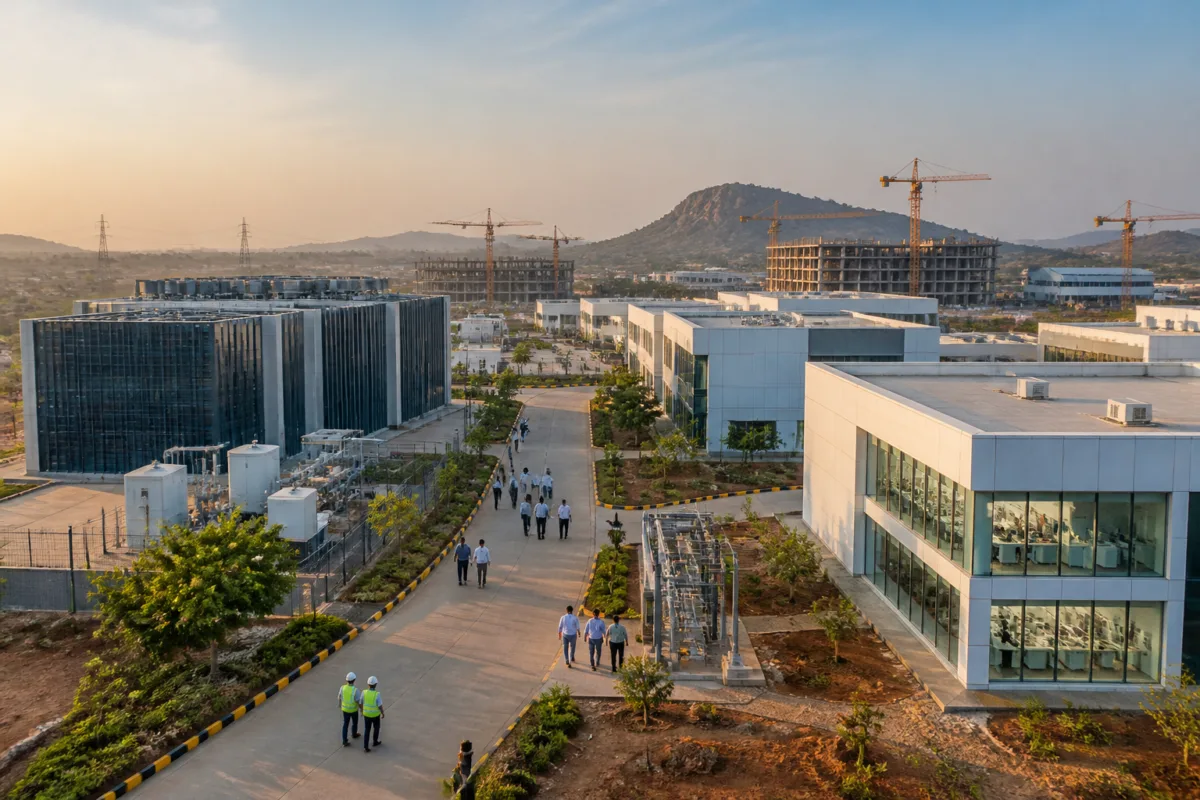
Telangana’s technology expansion is moving into a more demanding phase. The state has already demonstrated that a concentrated ecosystem can attract companies, talent and investment around Hyderabad’s HITEC City and Genome Valley. Its next challenge is to determine whether that model can be adapted for multiple locations, each built around the infrastructure, skills, research capacity and supplier networks required by a specific industry.
The distinction matters because a technology hub is not created merely by allocating land or announcing investment. The supplied report points to a wider state ambition covering life sciences, data centres, electronics, semiconductors, electric mobility, advanced manufacturing, space technology and other high-value sectors. These industries do not share identical operating requirements. Their success outside Hyderabad will depend on whether Telangana can build complete ecosystems rather than isolated industrial sites.
Genome Valley provides the clearest example of how such an ecosystem can mature. Established in 1999, it now houses more than 200 companies and a scientific workforce of around 15,000 professionals, according to the report. Pharmaceutical and biotechnology firms, vaccine manufacturers and research facilities operate within the cluster. This concentration gives companies access not only to premises, but also to specialised laboratories, scientific talent and sector-specific expertise.
That accumulated capability is difficult to reproduce quickly. A company considering a location evaluates more than the availability of buildings or fiscal incentives. It also needs access to workers who understand its processes, suppliers who can meet technical requirements, institutions that can support research and services that can maintain production. When firms in the same sector operate near one another, they create a common labour market and a network through which knowledge, vendors and specialised services circulate.
The report says Telangana’s life sciences sector has grown to more than 2,000 companies and accounts for about a third of global vaccine production. These figures are presented in the source article and are not independently examined in the supplied material, but they illustrate the scale of the ecosystem that Telangana is seeking to extend into other sectors. The relevant lesson is not simply that a large number of companies can be assembled in one place. It is that long-term investment in connected capabilities can make a location commercially useful to an entire industry.
The requirements of newer sectors reveal why a single template will not work across the state. Data centres require reliable electricity, fibre connectivity and cooling infrastructure. Electronics and semiconductor manufacturing need technical workers, testing facilities and specialised suppliers. Battery and electric vehicle production depends on component manufacturers and engineering capabilities. A location that is suitable for one activity may not offer the infrastructure or workforce needed for another.
Data centres illustrate the difference between investment scale and employment impact. The report cites around 200 MW of live IT capacity in the state, with another 4.7 GW in the committed or early-stage pipeline. It also identifies Chandanvelly and Bharat Future City as locations being considered for data-centre development. If these projects proceed, they could substantially increase Telangana’s data-centre capacity. However, the source also notes that operational data centres employ far fewer people than their construction phase requires.
This makes the wider economic effect dependent on the connections around the facilities. Data-centre projects could generate continuing demand for engineering services, equipment suppliers and technical maintenance firms, but the scale and durability of those linkages will determine whether they become local economic anchors or remain capital-intensive enclaves. The distinction is important for a state seeking employment and regional diversification rather than only a higher investment total.
The same issue applies to space technology and deep tech. Hyderabad is home to companies including Skyroot Aerospace, which is developing launch vehicles, and Dhruva Space, which builds satellite systems, according to the report. Their presence suggests that Telangana has an existing base of engineering and entrepreneurial capability on which a broader private space ecosystem could be built. But the expansion of such sectors would require connections between companies, research institutions, testing facilities, manufacturers and investors.
Semiconductors present a similar opportunity and constraint. The report says Telangana has an established base in chip design and research and is looking to expand into semiconductor manufacturing and advanced packaging. Moving from design expertise towards manufacturing involves a different level of infrastructure, specialised suppliers, technical training and quality-control capability. The source does not establish the status or scale of specific manufacturing projects, but the policy direction demonstrates the state’s attempt to move up the technology value chain.
Skills are therefore not a supporting issue; they are part of the infrastructure of a technology hub. The report cites T-Works as an example of a facility that provides electronics testing, printed circuit board fabrication and prototyping support. Such shared facilities can reduce the upfront burden on start-ups and smaller manufacturers that cannot independently purchase every piece of equipment needed to develop and test products.
It also refers to a partnership between TASK and Dell Technologies, announced in September 2026, to train 5,500 students across 25 centres in artificial intelligence, cloud computing and electronics manufacturing. Extending similar training and prototyping capacity to emerging industrial locations could help companies recruit locally. It could also reduce the dependence of every new cluster on workers already concentrated in Hyderabad.
The institutional question is how knowledge moves between the established metropolitan core and newer locations. The Research and Innovation Circle of Hyderabad, or RICH, is described as connecting research institutions with companies and start-ups, including medical-device and diagnostics businesses seeking to test products and move towards commercialisation. A comparable network linking researchers, manufacturers and entrepreneurs could help firms outside Hyderabad solve technical problems and bring products to market.
This is a different model from simply decentralising offices. A technology cluster becomes more resilient when its companies share specialised capabilities, develop suppliers and create pathways from research to commercial production. Telangana’s established institutions could support that process across the state, but the supplied material does not specify the administrative arrangements, funding commitments or delivery timelines for extending these networks to new locations.
The state’s broader planning challenge is to match sectoral ambition with infrastructure sequencing. Power, connectivity, transport access, industrial land, laboratories, testing centres and training institutions must arrive in a usable combination. For data centres, power and cooling are critical. For advanced manufacturing, testing and supplier networks may be more decisive. For life sciences, laboratories and scientific talent are central. This means the state’s emerging hubs will need differentiated planning rather than a uniform industrial-estate model.
The experience of HITEC City and Genome Valley also shows why time matters. Genome Valley’s development began in 1999 and has produced a cluster with more than 200 companies and around 15,000 scientific professionals. The report uses this history to suggest that ecosystems develop through sustained investment rather than through a single project announcement. New locations may therefore require a long period of institution-building before their full economic role becomes visible.
For citizens, the regional question is whether technology-led growth can create opportunities beyond Hyderabad’s established corridors. More distributed employment could reduce the concentration of high-value activity in the capital region and create new roles for technical professionals, suppliers and service firms elsewhere in Telangana. However, the evidence supplied does not establish how many jobs the proposed sectors will create, where those jobs will be located or whether local workers will have access to them.
The evidence currently confirms that Telangana has a strong base from which to pursue a multi-centre technology strategy. It also shows that the state’s sectors vary widely in their infrastructure and workforce needs. What remains uncertain is whether planned investments will generate durable local networks rather than standalone facilities, and whether training, research and supplier development will keep pace with physical expansion. The next important indicators will be the implementation of projects in identified locations, the extension of shared technical facilities and the formation of measurable links between companies, institutions and local talent.

