


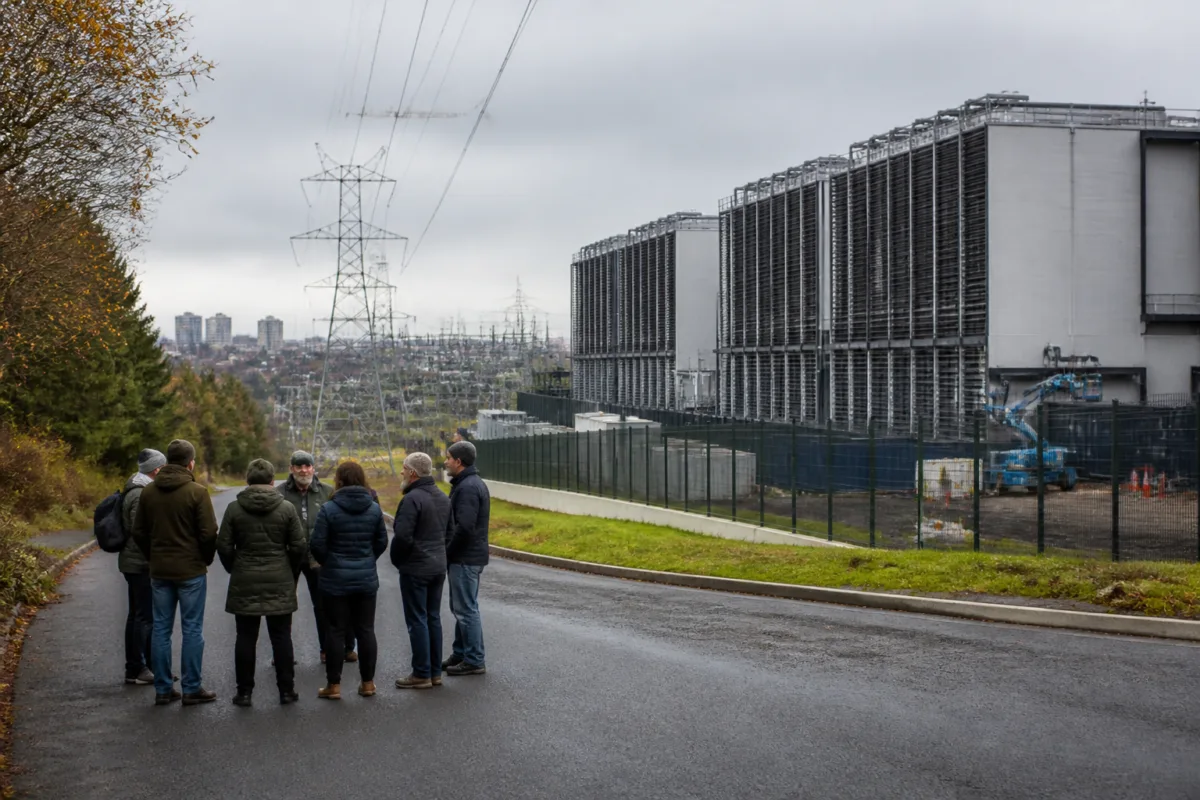
Data centres are becoming a new urban infrastructure battleground in Europe, where citizens are challenging the land, electricity and environmental costs of artificial-intelligence expansion. Demonstrations in Dublin, Helsinki and smaller Finnish towns show that opposition is no longer limited to technology policy: it is increasingly about who controls local resources and who benefits from infrastructure built for global companies.
According to a report carried by Deccan Chronicle and attributed to Bloomberg, about 2,000 people marched in Dublin and approximately 1,300 gathered in Helsinki on Saturday. Demonstrations were also held in smaller Finnish towns. The protests were organised amid a rapid global build-out of facilities required to run and train artificial-intelligence systems.
The immediate political demand from campaign groups is a moratorium on new data-centre construction until communities can decide what infrastructure is needed and how it should serve the public. Representatives of Stop Dirty Data Centres, a coalition of local democracy and climate protest groups, said they wanted to halt what they described as the unchecked expansion of AI data centres.
The wording of that demand is significant. It frames data centres not simply as private technology projects, but as large-scale urban and regional infrastructure whose consequences are distributed across public systems. Land is allocated to server farms, electricity networks are expanded to serve them, roads and construction activity reshape local areas, and residents are asked to accept environmental and cost pressures that may not be matched by visible local gains.
Ireland illustrates the scale of the issue. The country attracted substantial investment from US technology companies including Microsoft, Amazon and Google, becoming one of Europe’s largest data-centre hubs. Official statistics cited in the report show that data centres accounted for 23 per cent of Ireland’s total metered electricity consumption in 2025.
That figure changes the nature of the planning question. Electricity demand is no longer a background technical matter for grid operators. It becomes a central issue in deciding where new development can take place, how much capacity should be reserved for industrial users, and how the costs of expanding or reinforcing networks should be distributed. When a single infrastructure category accounts for nearly a quarter of metered electricity consumption, its relationship with housing, industry, transport and household energy use becomes a matter of public administration.
The Irish experience also shows why the debate cannot be reduced to a simple choice between technology investment and environmental opposition. Data centres can bring large capital commitments and support a country’s position in the digital economy. At the same time, their electricity requirements can create pressure on energy systems and raise questions about whether communities hosting them receive sufficient economic benefit. The report says communities are concerned about land demand, energy costs and whether they will see meaningful returns from the expansion.
Finland provides a second example of this tension. Google announced its largest-ever European investment in September, valued at €13 billion, to expand an existing data centre and build two new facilities. Separately, about €80 billion worth of server farms were in various stages of planning and construction in Finland, according to the Confederation of Finnish Industries.
The scale of the proposed pipeline matters because planning authorities are not assessing one isolated building. They are dealing with a cumulative infrastructure programme involving land, power, roads, construction materials and environmental review. A series of individually approved projects can collectively alter the demand profile of a region. The public debate in Finland indicates that residents are beginning to judge these projects as a connected development pattern rather than as separate corporate investments.
That shift is visible in the controversy over a Finnish site linked to Google. Citizens became increasingly opposed to data centres after reports that Google representatives had cleared woodland, removed topsoil and built roads before an environmental impact assessment had been completed. The company building the site is facing a criminal inquiry, according to the report, while the Finnish government is introducing legislation intended to rein in AI expansion.
The allegation and the investigation are important because environmental approval is not a procedural detail added after a project has effectively begun. It is intended to establish the likely effects of development before irreversible changes are made. Clearing woodland, stripping soil and building access roads can transform the baseline against which environmental impacts are assessed. The episode therefore places the sequencing of construction and environmental review at the centre of the governance debate.
It also exposes a wider weakness in infrastructure decision-making: local communities often encounter a project only after its economic logic and technical requirements have already been established. By then, the public discussion is frequently focused on mitigation rather than on whether the location, scale and timing of development are appropriate. The Finnish controversy suggests that citizens are questioning not only the outcomes of data-centre projects but also the process by which those projects receive permission to proceed.
The protests in Helsinki were directed towards Google’s offices and the parliament in the city centre. That choice of location linked corporate decision-making with national policy. Data-centre development may occur in specific municipalities, but the regulatory framework, energy strategy and industrial incentives that make it possible are often determined at a higher level. Local authorities face the physical effects, while central governments may control the rules governing investment, land use and environmental safeguards.
This division of responsibility can produce an accountability gap. A municipality may approve or host a project, an energy operator may manage grid connections, a national government may offer policy support, and a global technology company may control investment decisions. Residents experience the combined effect, but no single institution necessarily answers for the complete urban and environmental impact.
The demand for a moratorium is therefore also a demand for institutional coordination. Campaigners from Scotland, Spain, France and Denmark joined the action, calling for construction to pause until democratic decisions are made about what is needed. Their position reflects concern that project-by-project approvals are moving faster than public systems can assess the cumulative implications.
The protests followed a demonstration in Amsterdam on Friday, where hundreds of people clashed with police at a Microsoft data centre and one person was arrested. That incident shows how quickly disputes over digital infrastructure can become conflicts over physical access, policing and public order. It also demonstrates that opposition is not confined to one country’s energy mix or planning system.
The American comparison cited in the report strengthens that conclusion. Data-centre proliferation became a key factor in midterm elections in the United States, where voters in several states selected local officials who had pledged to stop or pause construction. Local political campaigns are thus absorbing a debate that was once largely handled through corporate investment announcements and specialised energy planning.
For cities and regions, the central question is not whether data centres are technologically important. Their role in artificial-intelligence systems is driving investment at a scale described in the report as hundreds of billions of dollars globally. The harder question is whether governance systems can evaluate this growth with the same speed and seriousness as the companies building the facilities.
The available evidence establishes several pressures: electricity consumption is already substantial in Ireland; Finland is considering a very large pipeline of server farms; environmental compliance has become contentious; and residents across multiple European countries are demanding pauses or stronger democratic control. It does not establish that every data-centre project produces the same impacts, nor does it quantify the economic benefits received by each host community. Those distinctions matter because public decisions require project-level evidence as well as regional planning.
What is changing is the political status of the data centre. It is no longer invisible digital infrastructure operating somewhere outside the urban imagination. It is a physical land use, an electricity consumer, a construction site and a long-term claim on public capacity. As AI investment expands, planning authorities will have to address these facilities alongside other major infrastructure demands rather than treating them as exceptional corporate developments.
The European protests do not settle whether construction should stop or continue. They establish that the existing expansion is facing a legitimacy test. The developments to monitor are Finland’s proposed legislation, the criminal inquiry linked to the disputed site, the treatment of environmental assessments, and how Ireland and other European jurisdictions respond to data centres’ growing share of electricity demand. The evidence so far points to a widening gap between the speed of AI infrastructure investment and the public processes required to govern its urban consequences.

