


Engineering graduates taking teaching jobs across Karnataka are not simply changing careers; they are revealing how uneven employment opportunities have become between professional education, urban labour markets and smaller-town economies. School authorities and education-sector organisations cited by the Times of India say more engineers, MBA, BCA and other graduates are applying for teaching and administrative roles because jobs in their original fields are uncertain, poorly paid or unavailable.
The shift is significant because teaching was earlier seen by many engineers as a profession chosen for personal interest, social contribution or a better work-life balance. School leaders now describe a different motivation. For some graduates, particularly those unable to find work after completing engineering degrees, teaching has become a route to immediate income and relative stability.
Vikram Narvekar, principal of Sri BM Patil Public School in Vijayapura, said the change had become a matter of survival for some engineering graduates. Graduates from other districts, he said, often find that the cost of living in cities such as Bengaluru is too high relative to entry-level salaries. Some continue to depend on family support, while others return to their hometowns and join schools where they can earn an income without taking on the cost of relocating to a larger city.
That movement from cities back to smaller towns points to a deeper problem in Karnataka’s employment geography. Professional education has expanded the number of graduates seeking formal-sector work, but employment opportunities have not expanded evenly across districts or disciplines. Bengaluru remains the state’s dominant employment centre, yet the salaries available to fresh graduates may not be sufficient to cover rent, transport and other daily costs. Moving to the city therefore does not automatically translate into economic mobility.
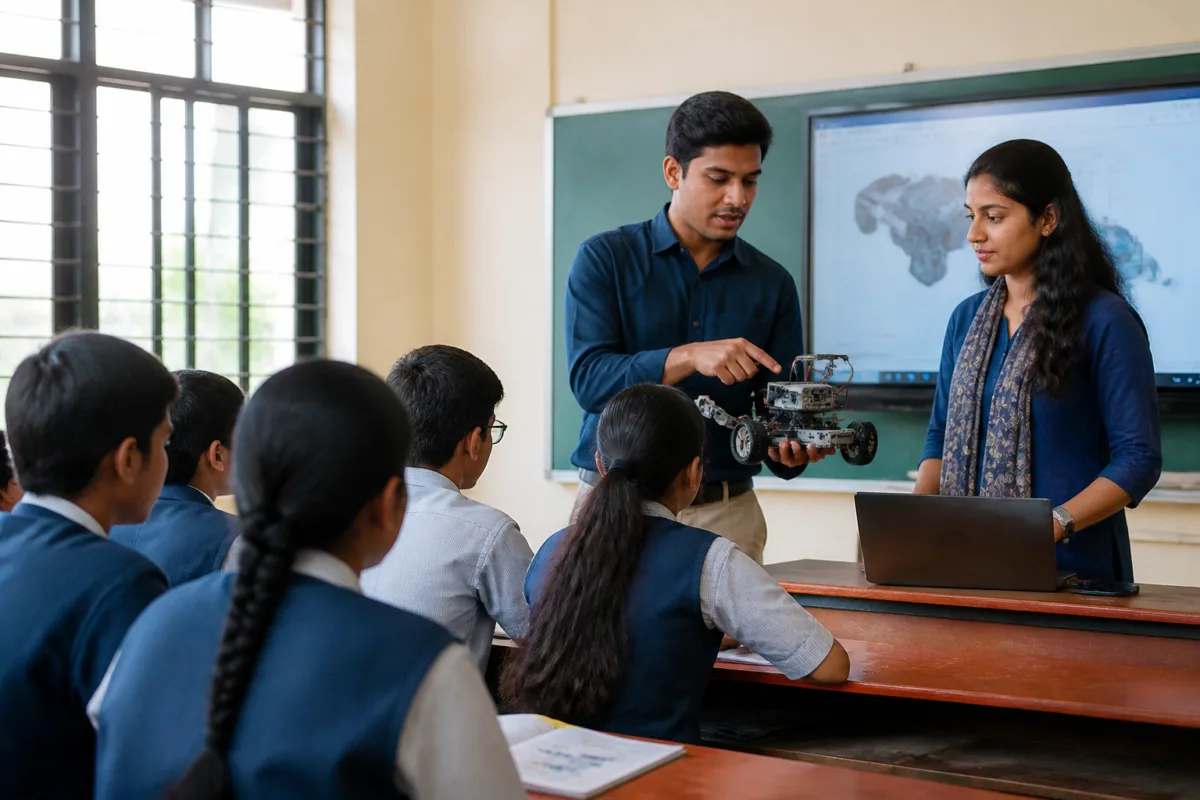
Teaching offers an alternative because schools require subject knowledge, communication skills and basic digital familiarity. Several private schools are willing to hire graduates without the qualifications required for regular government teaching posts. These candidates may be appointed as additional or guest teachers, or assigned subjects such as computer science, robotics and artificial intelligence.
This distinction between government and private schools is important. A Bachelor of Education qualification and eligibility tests are mandatory for teaching posts in government schools, according to the report. Private schools, however, have greater flexibility in recruiting graduates for specific functions. That flexibility allows schools to fill subject-level requirements quickly, but it also creates a training and quality challenge: subject expertise does not automatically provide classroom-management skills, assessment capabilities or an understanding of child development.
Maya Menon, founder director of Teacher Foundation, said engineers and other professionals were increasingly joining coaching institutes and schools because these roles offered relatively steady incomes and the satisfaction of working with young people. D Shashi Kumar, secretary of the Associated Managements of Primary and Secondary Schools of Karnataka, said schools were receiving applications from graduates in engineering, BBA, MBA and BCA, including candidates seeking administrative roles.
Kumar said many applicants viewed teaching as a respectable profession involving seven to eight hours of work a day. The report says several private schools are willing to offer salaries of Rs 25,000 and above, while some applicants are also drawn by the use of artificial intelligence tools and apps that can make tasks such as preparing lesson plans easier. The salary figure is not presented as a statewide standard, but as an indication of what some private schools are prepared to offer for these roles.
The comparison with other entry-level employment is central to understanding the trend. Marjeena M Chittargi, a civil engineer who worked as a teacher in Bagalkot, said some of her friends earned only Rs 10,000-Rs 12,000 and had to change jobs repeatedly to obtain better salaries. She said limited opportunities in neighbouring districts and the difficulty of moving to Bengaluru, particularly for women, made teaching a more attractive option.
Chittargi’s account also shows that the trend cannot be explained only through a preference for teaching. In her school, four engineers from different disciplines—electrical, civil, electronics and communication, and computer science—were working as teachers. She taught social sciences, while the others handled mathematics. Their engineering background gave them experience with projects and presentations, but their actual classroom roles were not limited to their degree subjects.
That flexibility can help schools address staffing needs, especially in mathematics, computing and emerging technology subjects. It also shows how graduates are adapting their qualifications to a labour market that does not necessarily offer a direct professional pathway. An engineering degree may lead to teaching mathematics or social sciences, an administrative role or an allied education-sector job rather than a conventional engineering position.
MN Natesh Kumar, principal of Gurukula International School in Bengaluru, said applications from fresh graduates for teaching posts had doubled or tripled in recent years because of the shortage of jobs in other sectors. He also said people who had quit or lost jobs were approaching schools after failing to find alternative employment. The account links two groups that are often treated separately: new graduates entering the workforce and experienced employees displaced from other industries.
The growing role of technology in schools adds another layer to the transition. Graduates are being assigned computer science, robotics and artificial intelligence, while schools are using digital tools to support lesson preparation. These developments may make technical graduates useful in classrooms, but they do not remove the need for structured training. The ability to use technology or explain a technical concept is different from the ability to teach it effectively to students with varying levels of understanding.
Ramya Venkataraman, founder and CEO of CENTA, said engineers and graduates from fields such as BSc, BCom and BBA were showing greater interest in teaching because of its relatively stable employment prospects. She said domestic school recruitment was partly constrained by the regulatory requirement of a BEd qualification, but opportunities existed in allied areas such as content creation and in schools abroad.
Venkataraman also said her organisation was helping one of the states in the United States with global recruitment and that almost 50% of applicants were from such educational backgrounds. The figure applies to that recruitment effort, not to the wider Indian labour market. Its relevance is that graduates who cannot enter domestic classrooms through conventional routes may still find education-related opportunities through international recruitment, content work or teacher-support services.
The reported shift therefore has two institutional consequences. Schools gain access to graduates with technical knowledge, communication skills and experience of projects and presentations. At the same time, they must assess what these candidates do not yet know about pedagogy. Venkataraman said schools may not always have the infrastructure to provide the in-depth training required, and suggested that standardised assessments and intensive training could help bridge skill gaps.
This raises a question about how private schools are functioning as labour-market absorbers. They are not only education providers; in some districts, they are becoming fallback employers for graduates who cannot find work in their trained fields. Their ability to offer salaries, however, depends on fee structures, staffing needs and the market position of individual institutions. The report does not establish whether the current recruitment trend will produce long-term teaching careers or remain a temporary response to weak employment conditions.
The evidence also does not show how many engineering graduates have moved into teaching across Karnataka, how long they remain in the profession or whether their pay and working conditions improve over time. Nor does it establish whether the rise in applications reflects a shortage of teachers, an expansion of school staffing, or simply a larger pool of unemployed graduates seeking any stable job. Those unanswered questions matter because a rise in recruitment is not the same as a durable employment pathway.
What is clear is that the boundary between professional education and urban employment is under pressure. Engineering colleges continue to produce graduates with specialised qualifications, while schools are absorbing some of them into roles that range from classroom teaching to administration, content creation and technology instruction. Bengaluru’s high living costs make relocation difficult for many, while smaller towns offer fewer opportunities in engineering and related sectors. Teaching sits at the intersection of these pressures because it is available in both urban and non-urban locations and is widely regarded as respectable and relatively stable.
For Karnataka’s cities and towns, the development is a labour-market signal rather than only an education-sector trend. It shows graduates recalculating the value of location, salary, stability and professional identity. It also places greater responsibility on private schools and training organisations to ensure that technical competence is matched by teaching capability. The next questions are whether these graduates remain in classrooms, whether schools invest in their preparation, and whether employment opportunities in engineering and other sectors improve enough to reduce the need for such career shifts.

