


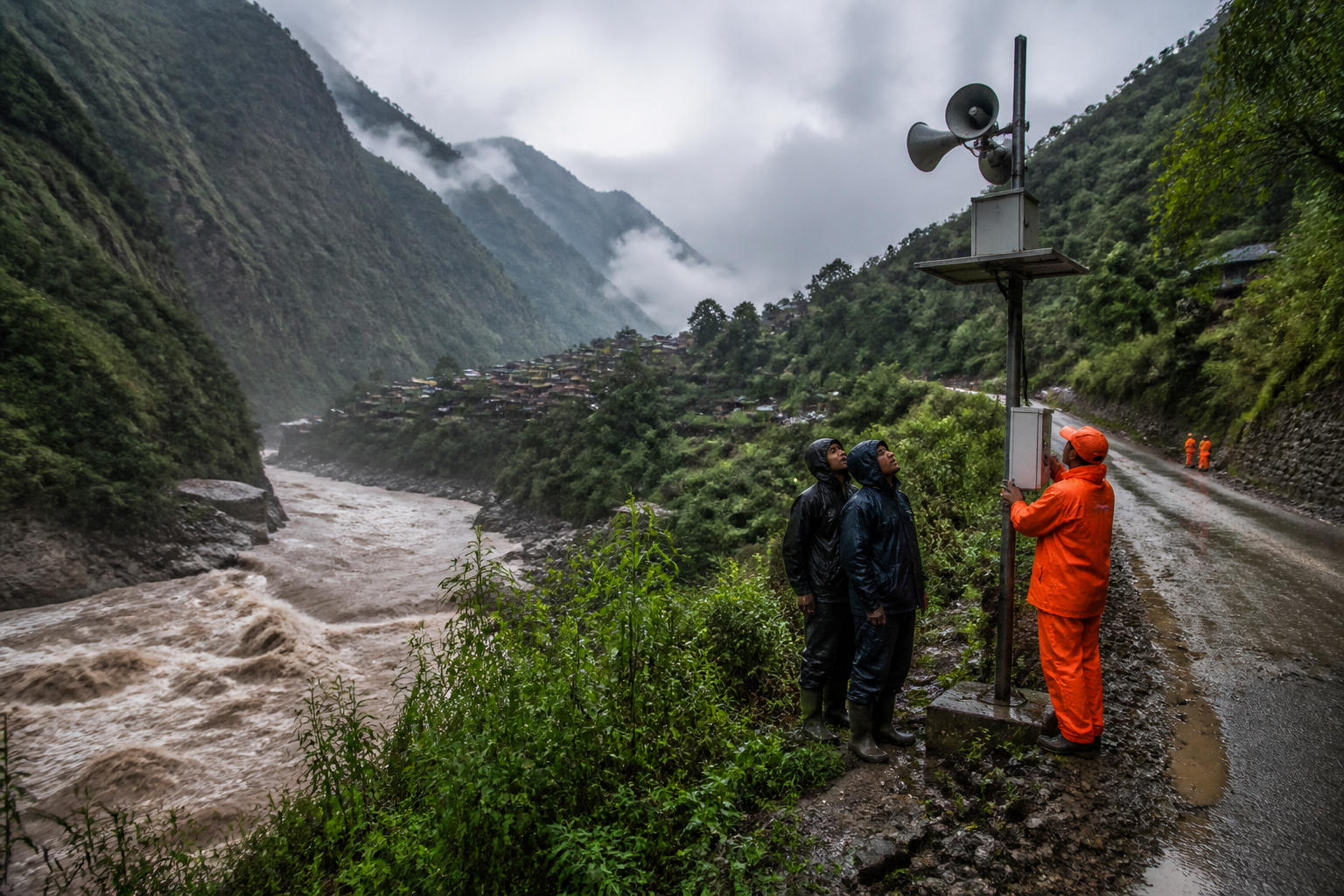
A Hyderabad webinar on Himalayan disasters has placed a fundamental governance question before South Asia: can communities facing floods and other mountain hazards receive warnings early enough, and through systems designed around how they actually live? The experts and youth leaders who participated in the discussion argued that mountain hazards cannot be eliminated, but their consequences can be reduced through community-centred early warning systems and sustained cooperation among neighbouring countries.
The discussion, titled ‘Himalayan Glacial Disaster: Wake-up Call for South Asia’, was organised by the Doyens of Peace of South Asia in collaboration with Hyderabad-based COVA Peace Network. Its immediate backdrop was the recent flooding in Nepal, including the Rasuwa floods discussed by Nepal Environment Society General Secretary Samir Thapa. The event brought together speakers from across South Asia, making it less a discussion of one disaster than an examination of how the region manages shared environmental risks.
That distinction is important. The Himalayas cross national boundaries, while the effects of hazards do not stop at them. A disaster in a mountain area can become a question of communications, transport access, emergency response and public administration for communities that may already be difficult to reach. The supplied account does not establish the scale of the recent Nepal floods or identify specific infrastructure failures. It does, however, show that the participating experts viewed early warning and regional coordination as central to reducing the human consequences of recurring calamities.
The webinar’s strongest intervention was its emphasis on community-centred warning systems. Early warning is often discussed as a technical function: detecting a hazard, issuing an alert and transmitting it through an official channel. The speakers’ framing points to a wider chain of responsibility. A warning has value only when it reaches people in time, is understood locally, is trusted, and is connected to a practical response. The report does not specify the technologies, agencies or protocols proposed by the panellists. It does indicate that the organisers and speakers considered communities to be active parts of disaster preparedness rather than passive recipients of government messages.
This is a significant shift in how urban and regional resilience is understood. Disaster management is not limited to the location where a hazard begins. It also involves the condition of roads, communication networks, public buildings, evacuation routes and local administrative capacity. In mountain regions, those systems operate across difficult terrain and multiple jurisdictions. The webinar’s call for sustained regional collaboration therefore has an institutional dimension: neighbouring countries would need to share information, coordinate warnings and maintain channels of communication before an emergency occurs, not attempt to build cooperation during one.
The discussion also connected disaster risk to responsibility among South Asian nations. Anmol Ohri, Founder-Director of Climate Front India, spoke about the broader responsibilities of countries facing climate disasters. The source account does not attribute a specific policy proposal or climate statistic to Ohri, so the claim should be read as a normative concern raised at the webinar rather than as a documented regional plan. Even so, the presence of that argument alongside the discussion of Nepal’s floods reveals the organisers’ wider focus: disasters are being treated as a shared regional governance problem rather than as isolated national emergencies.
The panel’s composition reinforced this regional framing. Dr Sher Muhammad of ICIMOD, identified in the report with Nepal and Pakistan, addressed recurring Himalayan calamities and their underlying causes. Thapa examined the Rasuwa floods. Ohri addressed South Asian responsibilities. Other participants included speakers from India, Nepal, Bangladesh, Afghanistan, Pakistan and Bhutan. The event therefore brought together perspectives from countries with different administrative systems and different geographic relationships with the Himalayas, although the report does not describe a common institutional mechanism adopted by them.
That limitation matters. A call for regional action is not the same as a regional action plan. The supplied report records agreement around early warning, cooperation and responsibility, but it does not mention a new treaty, funding commitment, cross-border protocol, emergency command structure or implementation timeline. Nor does it provide data comparing warning coverage, response times or disaster losses across the countries represented. The webinar is consequently best understood as a public intervention and agenda-setting discussion, not evidence that a new regional system has been created.
The institutional challenge is particularly visible in the gap between national responsibility and local exposure. National governments may control disaster policy, international coordination and large-scale infrastructure. Local communities, however, are the first to interpret warnings, decide whether to move, assist vulnerable residents and cope with disrupted access. A community-centred model would require these levels of governance to be connected. The report does not establish how that connection currently works in the Himalayan region, but the speakers’ emphasis suggests that technical alerts alone are viewed as insufficient.
The same issue applies to the relationship between hazard information and public infrastructure. A warning system cannot by itself keep roads open, ensure communication after a flood or provide safe places for evacuation. Yet the supplied material does not identify particular roads, bridges, shelters, telecommunications systems or municipal agencies affected by the Nepal floods. It would therefore be inaccurate to infer specific infrastructure failures from the webinar. What can be established is that disaster preparedness was discussed as a community and regional responsibility, with early warning as a key means of reducing consequences.
The event also illustrates how youth participation is entering debates on climate and disaster governance. Three youth panellists were central to the discussion, including representatives associated with ICIMOD, the Nepal Environment Society and Climate Front India. Their participation did not produce a separate youth policy in the reported proceedings, but it gave the conversation a cross-generational dimension. The issues under discussion—recurring calamities, climate risks and national responsibility—require institutions to maintain preparedness over time rather than respond only after each emergency.
For cities and towns across South Asia, the relevance extends beyond the immediate mountain zone. Urban areas often function as administrative, transport and service centres during disasters. They may receive displaced populations, coordinate relief or experience interruptions in supplies and connectivity. The source material does not report such effects from the recent Nepal floods, and no specific urban impact should be assumed. The broader point supported by the webinar is that disaster risk management must connect remote communities with the wider systems on which response depends.
The policy landscape emerging from the discussion has three identifiable layers. The first is local: warnings and response arrangements must be usable by communities. The second is national: governments must support disaster institutions and clarify responsibility. The third is regional: countries must cooperate around hazards that affect a shared mountain system. The report does not say whether these layers currently operate through a formal framework. It does show that speakers from several South Asian countries considered regional collaboration necessary.
The data story is thinner than the policy question. The report names the recent Nepal floods and the Rasuwa floods but provides no casualty figures, damage estimates, hazard frequency, warning times or infrastructure statistics. It also does not quantify the number of communities at risk or compare disaster preparedness between countries. That absence limits what can be concluded about the scale of the regional problem from this event alone. It also highlights why future public discussions would benefit from placing calls for cooperation alongside measurable information on warnings, evacuations, response capacity and recovery.
What the webinar does establish is the direction of concern. Experts and youth leaders from across South Asia described Himalayan disasters as recurring hazards whose consequences can be mitigated, even if the hazards themselves cannot be entirely prevented. They placed community-centred early warning systems and sustained regional collaboration at the centre of that mitigation effort. Those ideas shift attention from disaster response after impact to preparedness before impact, without claiming that a functioning regional mechanism already exists.
The larger urban question is whether South Asian governance can connect local knowledge and action with national systems and cross-border cooperation. The Hyderabad discussion advances that question, but it does not resolve it. The next developments to monitor are whether the organisations and governments represented translate the call into documented protocols, shared warning arrangements, funded preparedness measures or other concrete forms of cooperation. Until then, the webinar remains a significant regional warning about the institutional consequences of treating Himalayan disasters as isolated events.
