


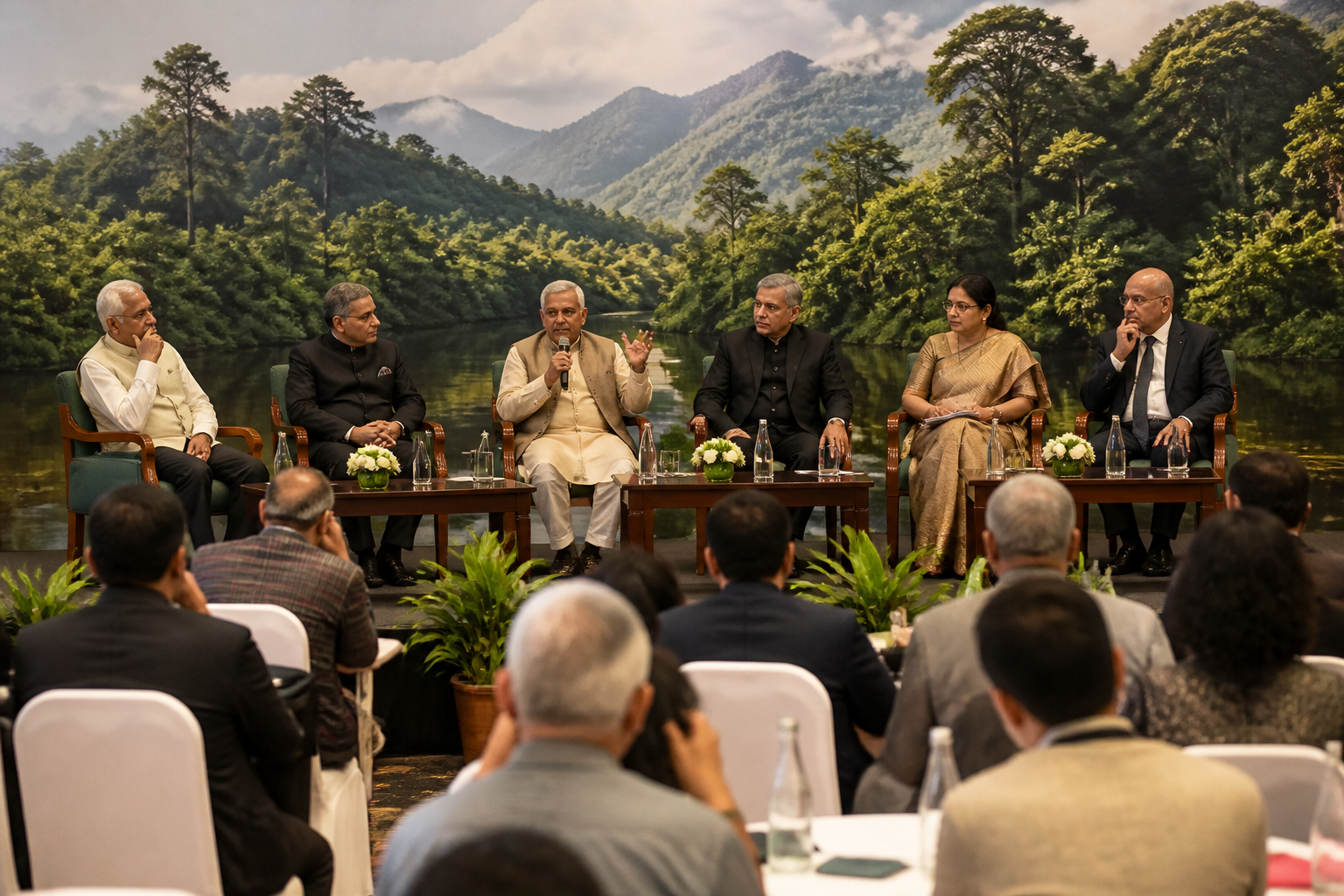
India’s climate policy must combine development with community-led adaptation, biodiversity protection and stronger resilience for vulnerable populations, President Droupadi Murmu said at a National Green Tribunal conference in New Delhi on Sunday.
Addressing the valedictory session of the two-day international conference on ‘The Future of Environment and Climate Dynamics’, Murmu said climate change was affecting food security, health and livelihoods. She said biodiversity loss, water stress and land degradation were interconnected challenges requiring a coordinated policy response.
The President called for a structured framework of policies and actions involving governments, legal experts and communities directly affected by climate change. She said rural and forest-dwelling communities, small farmers, women and other vulnerable groups needed particular attention because they faced the greatest impact from natural disasters.
Murmu also stressed the role of traditional knowledge and local experience in strengthening climate adaptation. She said people-centric and community-based approaches could improve resilience when they were rooted in the practices of local communities.
On afforestation, the President said the objective should extend beyond planting trees. She described sustainable afforestation as the restoration of healthy, self-sustaining ecosystems, with biodiversity and local conditions guiding efforts. The emphasis places ecological restoration alongside tree-planting targets in the official discussion on climate action.
Murmu said developing countries needed to improve resilience while maintaining economic development. Climate commitments, she said, should be aligned with national development needs and economic aspirations and should also be technically feasible.
Union minister Manohar Lal, who also addressed the event, highlighted India’s progress in expanding non-fossil power capacity. He said non-fossil sources accounted for nearly 55% of installed generation capacity and that India had achieved its 50% non-fossil capacity target five years ahead of schedule.
National Green Tribunal chairperson Justice Prakash Shrivastava said climate action needed to be inclusive and equitable, with attention to vulnerable communities and future generations. He said environmental law had to remain responsive and forward-looking while accommodating technology, innovation, sustainable finance and a just transition.
The conference placed climate resilience within a wider governance framework linking environmental law, energy transition, biodiversity, local participation and development planning. The official discussions did not announce a new scheme or implementation deadline, but set out the policy priorities presented by the President, the Union minister and the NGT chairperson.
