


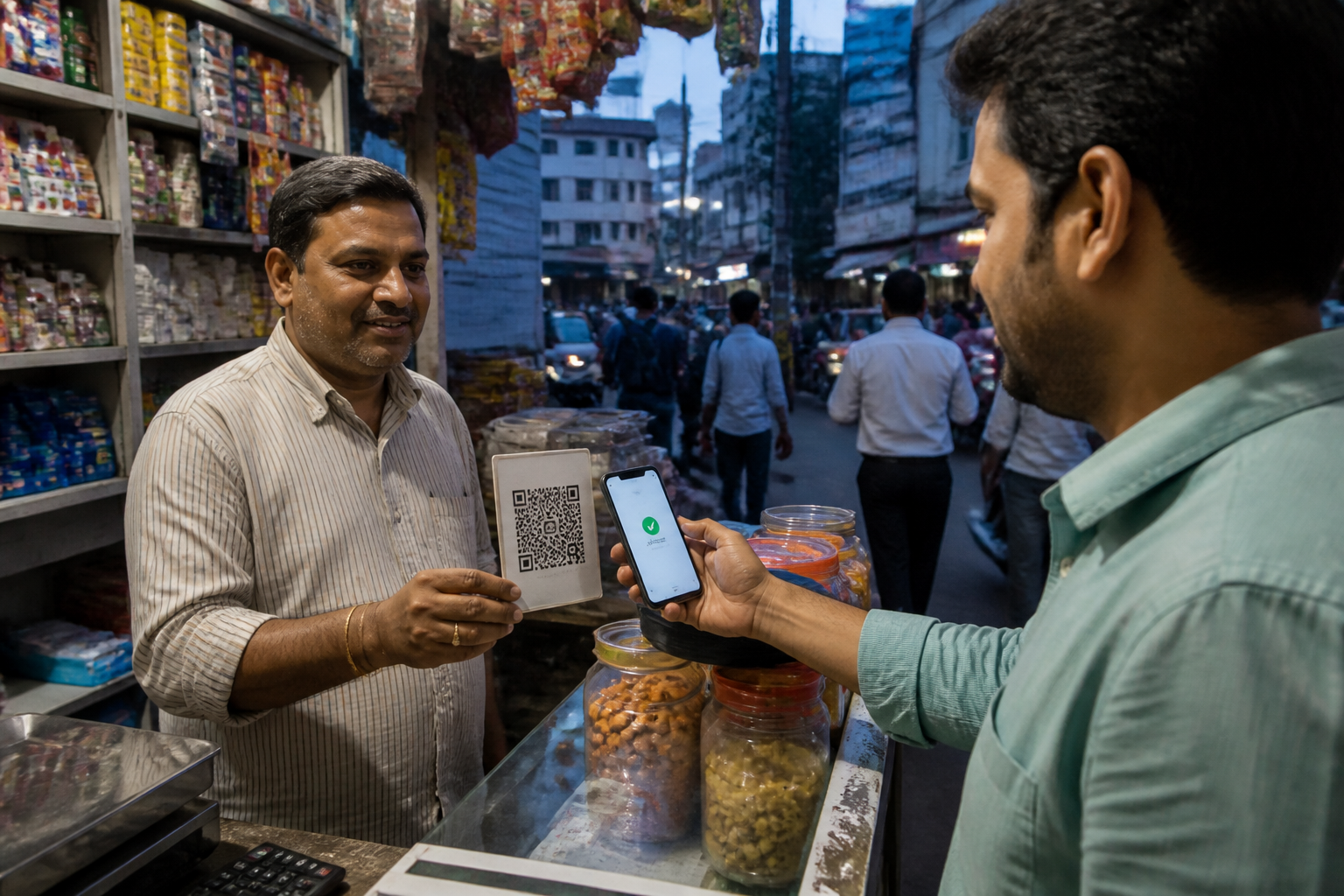
The debate over GST on UPI Merchant Discount Rate (MDR) is less about taxing every digital payment and more about how India’s payment infrastructure separates transaction value from the service fee charged for processing it. NPCI has said that GST will apply to the MDR paid on certain merchant transactions, not to the full value of a UPI payment. That distinction will determine which businesses face an additional cost and which continue to use UPI without paying MDR.
The clarification comes ahead of a proposed change from 15 October. For person-to-merchant, or P2M, UPI transactions above ₹2,000, an MDR of 0.4% will apply, subject to a maximum of ₹300. NPCI has said that GST at 18% will be charged on this MDR. In categories including railway services, telecom services, insurance and fuel, a concessional MDR of ₹5 will apply to transactions above ₹2,000.
The immediate public concern has been that GST on MDR could make UPI payments more expensive for small shops and other businesses that have come to depend on digital payments. NPCI has rejected that broad interpretation. According to the clarification reported by Aaj Tak Business, transactions up to ₹2,000 will continue to have zero MDR. Merchants receiving up to ₹1 lakh a month through UPI will also not be required to pay MDR, according to NPCI.
That means the proposed structure does not impose a charge on every UPI transaction. It creates a differentiated system in which the value of a payment, the merchant’s monthly receipts, the category of service and the merchant’s GST status all affect the final cost.
The difference between a UPI payment and MDR
MDR is a service fee connected with payment processing and settlement. It is not the price of the goods or services purchased by the customer. NPCI’s explanation is built around this distinction: GST applies to the service fee, rather than to the value of the underlying UPI transaction.
For example, if a customer makes a ₹10,000 merchant payment and the applicable MDR is 0.4%, the MDR would be ₹40. GST at 18% would then be calculated on ₹40, producing a tax of ₹7.20. GST would not be calculated on the full ₹10,000 payment.
This structure matters because a tax on the complete transaction value would have created a substantially different cost for merchants and consumers. The NPCI clarification says that the tax is limited to the payment service charge. It also says that reports describing the change as a broad increase in the cost of digital payments for small businesses are incorrect.
However, the distinction does not mean that every affected merchant will experience the policy in the same way. The cost depends on whether the merchant crosses the relevant thresholds, whether the transaction falls into a category with concessional pricing and whether the business can use input tax credit.
Why most UPI transactions may remain outside the charge
NPCI has said that more than 96% of UPI merchant transactions are valued at ₹2,000 or below. Since these payments will continue to have zero MDR, they will also not generate GST on MDR under the structure described in the report.
This is the main reason NPCI has argued that the change should not be interpreted as a general levy on the country’s everyday digital payments. Small-value purchases, which are common in neighbourhood retail and routine consumer transactions, remain outside the MDR threshold stated by NPCI.
The monthly income threshold is another part of the protection for smaller merchants. NPCI has said that businesses receiving up to ₹1 lakh a month through UPI will not need to pay MDR. The practical effect is that a large number of small merchants may continue to accept UPI without bearing the service fee or GST associated with it.
The available figures nevertheless show that the higher-value segment is becoming more important. Transactions above ₹2,000 accounted for 15.1% of total P2M transaction volume in financial year 2023, according to the information cited in the report. That share increased to 20.1% in the June quarter of financial year 2027.
The trend does not establish that small merchants will face a universal cost increase. It does show that the segment exposed to MDR is expanding. As more transactions move into the higher-value category, the distinction between zero-cost everyday payments and chargeable merchant payments will become more significant for businesses and payment operators.
Input tax credit creates a second layer of differentiation
For GST-registered merchants with an output GST liability, the tax paid on MDR may not become a permanent cost. A tax expert cited in the report said such businesses could claim input tax credit on the GST charged on MDR and use it against their output GST liability.
This means the effective burden may depend not only on the size of the MDR but also on the tax treatment of the merchant’s business. A registered merchant selling taxable goods or services may be able to offset the GST paid on the payment service against its own tax liability.
The position is different for businesses dealing in tax-free goods or services. According to the report, such businesses may not be able to claim the credit and could therefore have to absorb the GST on MDR as a cost. The same MDR rule can consequently produce different financial outcomes for different types of merchants.
This is an important institutional feature of the policy. The question is not simply whether GST exists on MDR. It is also whether the business is registered, whether it has an output tax liability and whether the transaction belongs to an eligible category. The payment system may look identical to the customer, while its accounting consequences differ for the merchant.
The revenue question behind the policy
The proposed change also has a wider fiscal dimension. Tax experts cited in the report have estimated that GST collections from MDR could reach several thousand crore rupees annually. One estimate places the potential annual collection at about ₹5,184 crore, based on monthly merchant payments above ₹2,000 and a uniform MDR of 0.4%.
That figure is presented as a potential estimate rather than a confirmed revenue outcome. The actual net revenue would depend on discounts, concessional MDR rates, transaction limits and input tax credit claims made by eligible businesses. The ₹5,184 crore estimate therefore represents the scale of the tax base under stated assumptions, not necessarily the final amount collected.
The fiscal calculation also illustrates why the details of the payment system matter. A large digital transaction volume does not automatically translate into an equally large taxable base. Only transactions within the relevant threshold, categories and merchant arrangements would contribute to MDR. The tax is then applied to the service fee rather than to the payment value.
What the change reveals about digital payment infrastructure
India’s UPI system is often experienced as a simple consumer service: a customer scans a QR code, authorises a payment and receives confirmation. Behind that transaction is a network of payment processing, settlement and merchant arrangements. MDR is one of the mechanisms through which those services can be priced.
The dispute over GST shows how policy changes at the settlement layer can become a concern at street level. A neighbourhood retailer may not use the language of payment infrastructure, but the business can still be affected by the cost of accepting digital payments. Whether that cost is passed on, absorbed or offset through tax credit depends on the merchant’s scale and regulatory status.
The thresholds described by NPCI attempt to preserve zero-cost access for small-value payments while introducing a charge for selected higher-value merchant transactions. That design creates a buffer for routine low-value commerce, but it also makes monitoring important as transaction values change. The report’s figures show that payments above ₹2,000 are already forming a larger share of P2M activity.
The policy also places greater importance on clear communication. Confusion between GST on a service fee and GST on the complete transaction value can produce an exaggerated understanding of the likely impact. At the same time, describing the change as harmless for every merchant would ignore businesses that cannot claim input tax credit or that fall outside the stated exemptions.
For now, the evidence supplied by NPCI indicates that most UPI merchant transactions and many small merchants will remain outside the MDR charge. The central uncertainty is how the rules will operate across merchant categories, payment arrangements and tax statuses once the proposed 15 October implementation takes effect. The next stage will be to observe whether the thresholds, concessional rates and input tax credit provisions work in practice as described.

