


The contest over Rajasthan’s proposed Haldighati tourism circuit is not only about where to place a statue or museum. It is about whether a publicly funded heritage project will treat the battlefield as a connected landscape or reduce it to a collection of attractions located away from the places where the 1576 battle unfolded.
Civil society groups in Rajsamand have urged the Rajasthan government to locate a proposed Maharana Pratap statue at the original Haldighati pass and develop a museum at Rakt Talai, described in their memorandum as the site of the fiercest phase of the battle. Their demand comes as the state considers a Rs 275.68-crore detailed project report for tourism development and an MoU worth around Rs 168 crore.
The Haldighati Tourism Committee and Haldighati Press Club submitted a memorandum on Friday and also filed a complaint on the Rajasthan Sampark portal. They have asked the government to protect the original battlefield and its historical monuments, particularly in Khamnor. The groups say repeated representations to the royal family in Udaipur, the government in Jaipur, the Union culture ministry and the state government have not resulted in restoration or protection work.
The immediate dispute reflects a familiar challenge in heritage-led urban and regional development: the difference between building a destination and conserving a place. A statue, museum, access road or visitor facility can be delivered as an individual project. A battlefield, however, is understood through its geography, movement corridors, landmarks and relationship with surrounding settlements. Relocating the main interpretive elements could make the site easier to package for tourism, but it may also weaken the connection between the visitor experience and the historical landscape identified by the groups.
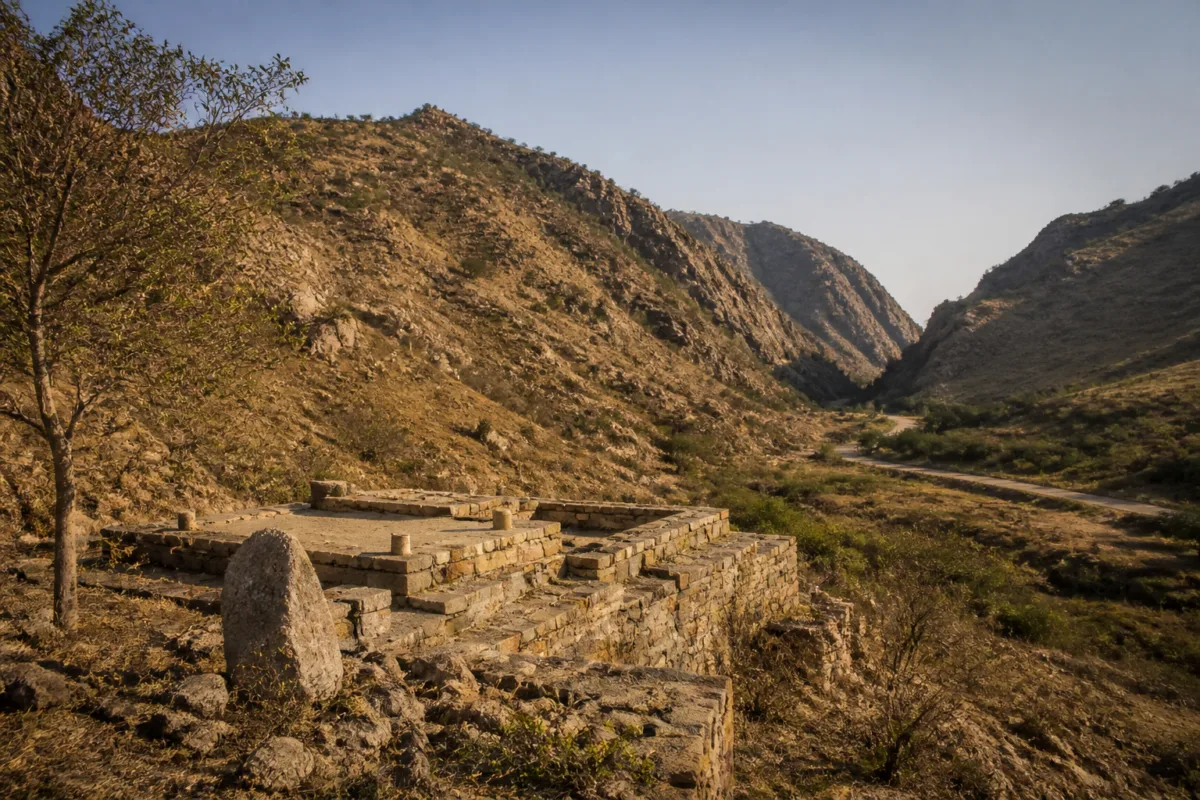
The organisations have maintained that the Battle of Haldighati began on June 18, 1576, at the narrow pass between Khamnor and Balicha and extended through Rakt Talai towards the Banas river and Molela. They cite historical accounts, including that of Mughal court historian Abul Fazl, to support their position that Khamnor was the main battlefield and Rakt Talai witnessed the fiercest fighting.
These locations matter because the proposed development is being debated as a tourism circuit rather than as a single isolated monument. A circuit implies a relationship between multiple sites, routes and points of interpretation. In the Haldighati case, the groups are asking the government to prioritise the Khamnor-Rakt Talai stretch under the proposed circuit and the third phase of the Mewar Complex scheme. Their argument is that the places associated with the battle should form the core of the visitor route, rather than serving as secondary references to a museum or statue located elsewhere in Rajsamand.
The dispute also exposes the institutional complexity of heritage development. The reported proposal involves the Rajasthan government, possible central funding, a detailed project report and an MoU. The civil society groups have separately referred to a public announcement made by then Union minister Arjun Ram Meghwal on January 1, 2023, for a Rs 5-crore museum at Rakt Talai, with 80% funding from the Centre and 20% from the state.
That earlier announcement is central to the groups’ demand that the government honour the proposed museum at Rakt Talai. It also raises a question about how separate announcements, funding commitments and later tourism plans will be reconciled. The reported figures suggest that the larger tourism circuit and the earlier museum proposal are not identical in scale. The available material does not establish whether the Rs 5-crore museum has been formally absorbed into the Rs 275.68-crore DPR or the proposed MoU of around Rs 168 crore. That relationship will need to be clarified through the government’s project documents and implementation decisions.
The funding structure is important because heritage projects often involve different responsibilities for construction, conservation, interpretation and maintenance. A central-state funding ratio may determine who pays for a museum, but it does not by itself establish who will protect the wider battlefield, verify memorial sites, manage visitor movement or maintain monuments after construction. The groups’ complaint indicates that these questions remain unresolved at Haldighati, particularly in Khamnor.
Their concerns include alleged deterioration and disappearance of memorials associated with Hakim Khan near the entrance to the pass. The organisations have also sought an inquiry into the identity of structures at Rakt Talai. According to the report, they allege that a platform built by the Parashar family around 100 to 125 years ago as a religious memorial to Bhole Baba’s Sagasji was later identified as Hakim Khan’s mazar. The groups want the original identity of these structures to be established through an inquiry.
This is more than a disagreement over naming. The identity of a memorial affects how a site is presented, which community histories are recognised and what is protected as heritage. The allegation also demonstrates why construction should follow documentation rather than substitute for it. Before a museum, statue or visitor facility is positioned, the project authorities would need to establish the status of existing structures and the historical basis for the interpretations presented to visitors. The supplied report does not indicate that such an inquiry has yet been completed.
The groups have additionally sought an assessment of a previously proposed site in the hills of the Haldighati pass for the statue. Their preferred arrangement is geographically specific: the statue at the original pass and the museum at Rakt Talai. This would create two major visitor markers along the landscape they identify as the battlefield. The government’s reported consideration of locations away from the original place of battle has therefore become the central point of disagreement.
The planning issue is not simply whether a site is technically available. A heritage destination has to accommodate visitors without damaging the qualities that make the site significant. The report does not provide details of the proposed locations, land ownership, access roads, parking, carrying capacity, visitor numbers, conservation methods or environmental safeguards. It therefore cannot establish whether the alternative sites would be more feasible from an engineering or visitor-management perspective. Nor does it establish whether the original pass and Rakt Talai have been assessed through a formal conservation or archaeological process.
What the available information does establish is that the project has moved into a stage where location choices, funding arrangements and heritage claims are being contested publicly. The Rs 275.68-crore DPR and the proposed MoU of around Rs 168 crore indicate that the development is being structured at a substantial scale. Yet the groups’ complaint suggests that protection of existing monuments has not kept pace with plans for new tourism infrastructure.
That sequence is significant for public administration. New construction is easier to announce and measure than conservation. A statue has a visible completion point. A museum can be inaugurated against a defined project schedule. Protecting a dispersed battlefield requires surveys, legal status, maintenance budgets, interpretation standards and ongoing monitoring. It also requires authorities to coordinate across cultural, tourism, local administration and possibly archaeological functions. The reported complaints point to a gap between the visibility of proposed development and the less visible work of establishing what must first be conserved.
The proposed legal proceedings add another institutional layer. The complaint comes ahead of a proposed high court hearing in December, as the state pursues the DPR and MoU. The supplied report does not specify the case number, the court’s previous directions or the relief sought. It does show that the location and protection of the battlefield are likely to be considered alongside the government’s tourism planning process. The next formal documents and court proceedings will therefore be important in determining whether the project advances, changes location or faces additional heritage safeguards.
For visitors, the outcome will shape whether Haldighati is presented as a connected historical terrain or primarily as a new tourism complex. A museum away from the original battlefield could still provide interpretation, but the relationship between the building and the landscape would need to be explained clearly. Conversely, placing facilities at historically sensitive locations could create conservation and access pressures unless the project includes controls for construction, movement and maintenance. The available material does not provide the technical assessments needed to decide between these approaches.
The larger urban and regional question is how public authorities convert historic landscapes into visitor infrastructure without allowing the infrastructure to overtake the history. Haldighati is located outside a major metropolitan centre, but the planning principles are relevant to heritage precincts across India. Once a place is selected for tourism investment, roads, buildings, parking, signage and commercial activity can change its character. If the original landscape is not identified and protected at the start, later development can make the visitor economy stronger while making the historical site less legible.
In Haldighati, the immediate evidence points to a project at a decision stage rather than a completed development. Civil society groups are seeking specific locations, protection for monuments and an inquiry into disputed memorial identities. The state is pursuing a larger DPR and an MoU, while an earlier museum funding announcement remains part of the public argument. What remains unclear is the government’s final site plan, the formal status of the Rakt Talai museum proposal, the findings of any heritage assessment and the measures proposed for conserving the wider battlefield.
Those details will determine whether the tourism circuit functions as heritage conservation with visitor infrastructure or as visitor infrastructure built around selectively interpreted heritage. The proposed December high court hearing, the government’s project documents and any decision on the Khamnor-Rakt Talai locations will be the next milestones in that process.

