


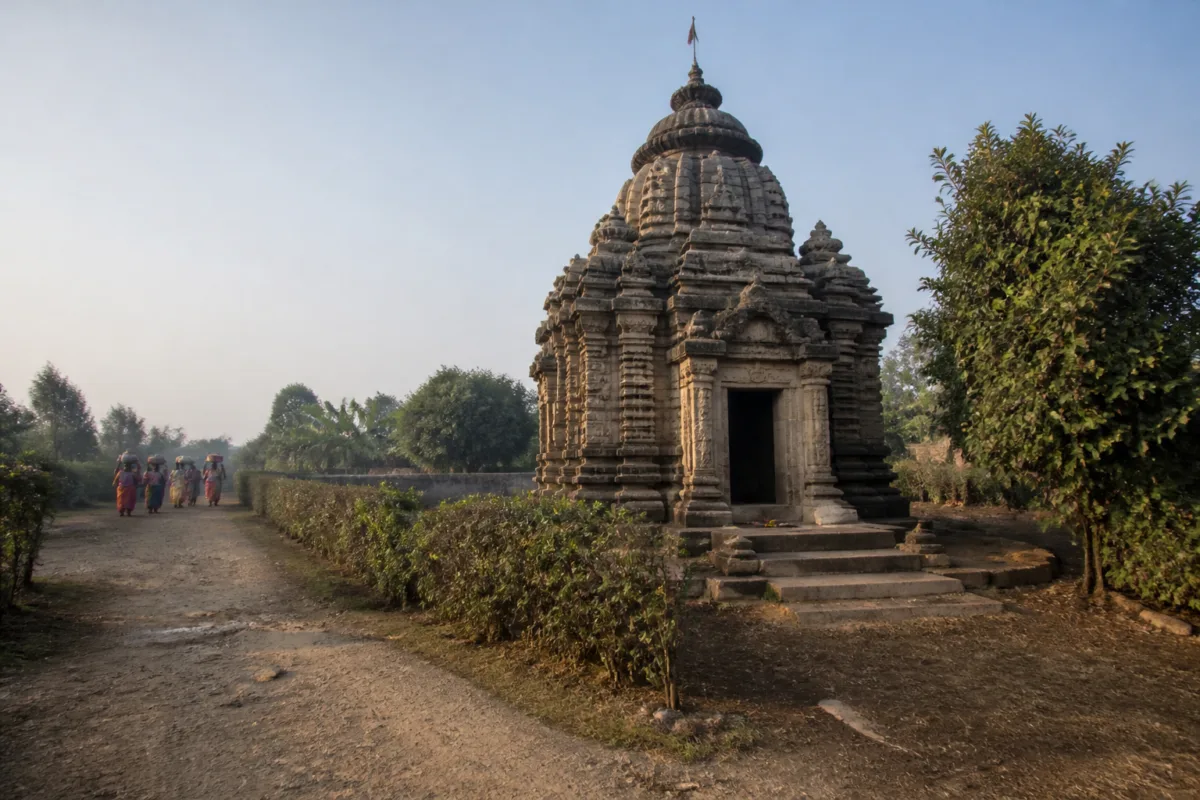
The neglect of Bihar’s Kandaha Sun Temple during the Chhath season exposes a problem that extends beyond one heritage site: religious importance alone cannot keep a monument accessible, conserved or visible when roads, visitor facilities and institutional coordination remain inadequate. Located in Kandaha village in Mahishi block of Saharsa district, the temple is one of north Bihar’s heritage structures and the only protected site under the state archaeology department in the area, according to residents quoted in the report.
The contrast is especially visible during Chhath, when thousands of devotees in the region gather to offer prayers to the setting and rising sun. The temple’s connection to Sun worship should make it a natural point of religious and cultural interest during the festival. Instead, poor approach roads and weak connectivity have limited visitor access, while inadequate upkeep has left the structure largely overlooked.
That gap between cultural significance and public usability is central to the Kandaha case. A protected monument is not preserved only through the survival of its walls. Its public value also depends on whether people can reach it safely, understand its significance and experience it without the site being damaged. In Kandaha, the available account indicates that these basic conditions have not yet been established.
The temple’s importance is linked to both its religious setting and its architectural record. Its Sanskrit inscriptions are described as valuable sources for understanding the site’s antiquity, while its architecture has been characterised by a local resident as among the finest in north Bihar. These features give the temple significance beyond its use as a place of worship. They make it a potential heritage destination and a source of historical knowledge, provided conservation and interpretation are handled appropriately.
Yet the site’s physical isolation appears to be working against that potential. Amit Anand, a Mahishi resident, said the approach road and connectivity were in poor condition and that the temple had not received adequate attention from the art and culture department. His account also underlines the local perception that the temple is important but insufficiently supported. The report does not provide details of the road’s length, ownership, condition assessment or funding allocation, but the access problem is presented as a direct reason visitors find it difficult to reach the monument.
This distinction matters because responsibility for a heritage site is divided across different parts of the public system. The Directorate of Archaeology and Directorate of Museums, Bihar, is responsible for the archaeological and museum functions associated with the state’s heritage administration. The art and culture department provides the wider administrative framework. Road access and construction-related works, however, may involve other agencies. The Kandaha proposal therefore requires more than a conservation decision inside the temple premises; it requires coordination between heritage officials, construction authorities and district administration.
Krishna Kumar, director of the Directorate of Archaeology and Directorate of Museums, Bihar, said the art and culture department secretary had recently reviewed the site. The plans include a boundary wall, lighting and basic visitor facilities. A request has been sent to Bihar State Building Construction Corporation Limited, or BSBCCL, to appoint consultants and prepare a detailed project report.
The sequence is significant. The proposed works have not yet been described as completed. The immediate administrative milestone is the appointment of consultants and preparation of the detailed project report. That document is expected to establish the scope of work, although the supplied report does not state its expected completion date, estimated cost or implementation schedule. Until those details are settled, the proposal remains at the planning stage rather than becoming a functioning visitor upgrade.
Sneha Jha, the district art and culture officer in Saharsa, said letters had been sent to BSBCCL. She also stressed that conservation of a protected archaeological site requires specialised expertise. This is an important institutional constraint. A boundary wall or lighting installation may appear straightforward, but interventions around an archaeological structure can affect the monument’s setting, drainage, movement of visitors and long-term maintenance. The district official’s emphasis on specialised expertise indicates that the department is treating the site as more than an ordinary public construction project.
At the same time, the proposal shows the difference between announcing facilities and creating a sustainable heritage system. A boundary wall can define the site, but it does not resolve access. Lighting can improve visibility, but it also creates maintenance and electrical safety responsibilities. Basic visitor facilities may encourage arrivals, but they need regular cleaning, supervision and funding. The source material confirms that these elements are being considered, but it does not establish who will operate them, how often they will be maintained or whether a recurring budget has been identified.
The Kandaha temple’s numbers are limited but revealing. The report identifies it as the only protected site under the state archaeology department in the area, while the Chhath season brings thousands of devotees to the surrounding region. This creates a clear mismatch between the scale of cultural activity and the condition of the heritage asset associated with that tradition. The site does not need to attract every festival visitor to be valuable, but its limited accessibility means that the state is not currently converting existing cultural interest into meaningful public engagement with the monument.
The absence of further data is itself relevant. The available account does not specify the temple’s age, the number of Sanskrit inscriptions, the annual number of visitors, the extent of structural deterioration, the condition of the road or the amount previously spent on maintenance. It also does not say whether a conservation assessment has been completed. These gaps prevent a precise assessment of the site’s physical risk or its tourism potential. They also make the forthcoming detailed project report important, because it should provide the evidence needed to move from general concern to defined works and responsibilities.
The temple’s location in a region where Sun worship is deeply rooted gives the state an existing cultural foundation for conservation and interpretation. However, religious prominence in the surrounding landscape does not automatically create a heritage-management plan. The site still requires decisions on its protected boundaries, conservation methods, visitor movement, signage, road access and institutional ownership of ongoing maintenance. None of these functions can be secured by festival attention alone.
The minister’s response points to official intent. Art and culture minister Pramod Kumar said the government would make efforts to maintain the temple and provide necessary support for devotees during religious festivities. That statement places maintenance and festival support within the government’s stated priorities, but the report does not identify a sanctioned project, budget or deadline. The next measurable steps are therefore administrative: consultant appointment, preparation of the detailed project report and clarification of the works that can be undertaken by the relevant agencies.
Kandaha illustrates a wider urban and regional planning question: heritage protection is often treated as a property-bound task, even though the public experiences heritage through a network of roads, services, institutions and local economies. A monument that cannot be reached or maintained remains legally protected but socially marginal. Conversely, improving access without specialised conservation can put pressure on a fragile structure. The challenge is to connect these two responsibilities without allowing one to substitute for the other.
For Saharsa, the issue is not simply whether the temple receives a boundary wall or new lights. It is whether the state can create a credible chain from recognition to conservation, access and long-term operation. The available evidence confirms that officials have reviewed the site and that a project report is being pursued. It does not yet confirm the project’s cost, design, timeline or delivery. Those details will determine whether Kandaha becomes a functioning heritage destination or remains an important monument that visitors struggle to reach.

