


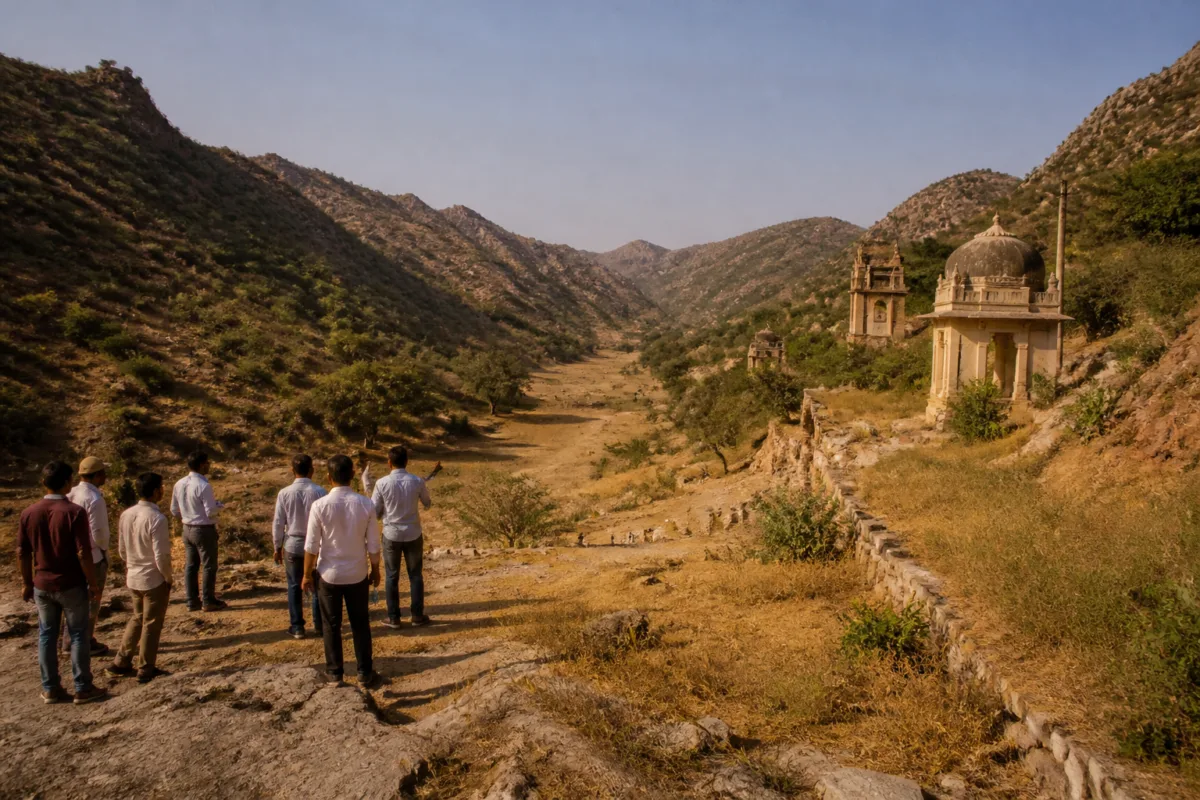
The dispute over where Rajasthan should build a proposed Maharana Pratap statue and museum at Haldighati is becoming a wider test of how the state plans, protects and interprets historic landscapes. Civil society groups in Rajsamand are asking the government to place the statue at the original Haldighati pass and the museum at Rakt Talai, while indications suggest that the statue may be located in Udaipur and the museum at another site in Rajsamand.
The disagreement matters because the proposed tourism development is not a small standalone memorial project. The state is pursuing a Rs 275.68-crore detailed project report for a tourism circuit, alongside an MoU worth around Rs 168 crore, according to the report. Decisions on location will therefore determine not only what visitors see, but also which parts of the battlefield are formally recognised, connected to public infrastructure and incorporated into the region’s tourism economy.
The Haldighati Tourism Committee and Haldighati Press Club submitted a memorandum on Friday and also filed a complaint on the Rajasthan Sampark portal. Their demand is specific: the original Haldighati pass should be selected for the statue, while Rakt Talai should host the museum. The organisations have also asked the government to protect the original battlefield and its historical monuments, particularly in Khamnor.
This makes the controversy different from a routine disagreement over the design or location of a public monument. The groups are arguing that the physical geography of the battle should guide the tourism project. Citing historical accounts, including the account of Mughal court historian Abul Fazl, they said the Battle of Haldighati began on June 18, 1576, at the narrow pass between Khamnor and Balicha and continued through Rakt Talai towards the Banas river and Molela. They identify Khamnor as the main battlefield and Rakt Talai as the location of the fiercest fighting.
The distinction between a battlefield site and a new destination has direct implications for planning. A statue placed away from the original pass could become a prominent visitor attraction while leaving the historic landscape less visible or less protected. Conversely, concentrating visitor infrastructure at the original locations could increase pressure on sites that civil society groups say have already suffered from neglect. The supplied report does not establish what final site assessment the government has accepted, but it shows that location is at the centre of the dispute.
The groups’ complaint also points to a second problem: the uncertain identity and condition of structures associated with the battlefield. They alleged that memorials connected with Hakim Khan near the entrance to the pass had disappeared. They further claimed that a platform built by the Parashar family around 100 to 125 years ago as a religious memorial to Bhole Baba’s Sagasji at Rakt Talai was later identified as Hakim Khan’s mazar. The organisations have sought an inquiry to establish the original identity of these structures.
These allegations place documentation at the heart of the project. Before a tourism circuit is finalised, the state will need to determine which structures, routes and landscape features are historically documented, which are later memorial additions, and which require conservation. The civil society groups have also sought an assessment of a previously proposed site in the hills of the Haldighati pass for the statue. Their position is that construction decisions should follow a site-level examination rather than be separated from the battlefield’s historical geography.
The institutional chain involved in the dispute is unusually broad. The organisations said they had approached the royal family in Udaipur, the government in Jaipur, the Union culture ministry and the state government, but claimed that repeated representations had not resulted in restoration or protection of the monuments. Kamal Kishore Paliwal of the Haldighati Tourism Committee said the groups had approached these authorities because, in their view, the monuments remained inadequately protected.
The state’s tourism plan also has an earlier commitment attached to it. The memorandum recalled that then Union minister Arjun Ram Meghwal announced a Rs 5-crore museum at Rakt Talai at a public meeting on January 1, 2023. The announcement was to be funded 80% by the Centre and 20% by the state, according to the groups. They have urged the government to honour that commitment and prioritise the Khamnor-Rakt Talai area under the tourism circuit and the third phase of the Mewar Complex scheme.
That funding structure is important because it illustrates how heritage infrastructure can move between different administrative programmes. A museum may be announced through one funding arrangement, while a larger tourism circuit is planned through another. Unless the relationship between those commitments is made clear, a new project can duplicate earlier proposals or shift attention away from sites that were previously identified for investment. The report does not state whether the Rs 5-crore museum proposal has been cancelled, retained or formally incorporated into the current tourism plan.
The figures available in the report indicate the scale of the planning challenge. The proposed tourism circuit has a DPR value of Rs 275.68 crore. The MoU under consideration is worth around Rs 168 crore, while the earlier museum announcement involved Rs 5 crore with an 80:20 Centre-state funding split. These are different figures and commitments, and the supplied material does not establish whether they represent separate components, successive stages or overlapping proposals. That distinction should be resolved before implementation begins.
The timing adds an administrative layer to the dispute. The complaint has been filed ahead of a proposed high court hearing in December, while the state continues to pursue the DPR and the MoU. This means that the location and conservation questions may be examined alongside the government’s efforts to move the tourism project forward. The immediate issue is not only whether a statue or museum will be built, but whether the planning process will formally account for the battlefield’s historic extent and the condition of associated monuments.
For visitors, the choice of site will shape the experience of Haldighati. A museum in a location disconnected from Rakt Talai could present the battle as a general historical narrative without making the landscape itself part of the interpretation. A project centred on Khamnor, the pass and Rakt Talai could connect the visitor route to the places identified in the historical accounts cited by the civil society organisations. However, the report does not provide a final visitor plan, conservation plan, land-use framework or mobility assessment, so the practical consequences of either approach remain unresolved.
The larger urban question is how public authorities should convert a historic landscape into a tourism asset without reducing it to a single monument. The dispute shows that heritage development involves more than constructing a statue, museum or access facility. It requires decisions about evidence, land, conservation, institutional responsibility, funding and the relationship between a site’s physical geography and its public narrative.
The case also demonstrates why a detailed project report is consequential. A DPR is not merely a financial estimate; it is the document through which a project’s components, locations and implementation logic are assembled. In this case, the choice between the original pass, Rakt Talai, Udaipur and another location in Rajsamand will determine how the state distributes attention and investment across the heritage landscape. The supplied report does not disclose the DPR’s final recommendations, leaving that document central to the next stage of scrutiny.
What is established is that civil society groups have formally asked Rajasthan to locate the statue at the original Haldighati pass, develop the museum at Rakt Talai, protect monuments in Khamnor and investigate disputed structures. It is also established that the state is pursuing a large tourism circuit and an MoU, while an earlier museum announcement remains part of the groups’ demands. What remains unclear is the government’s final site decision, the status of the earlier funding commitment and the conservation framework for the battlefield. Those questions are likely to remain central ahead of the proposed December high court hearing and the next steps on the DPR and MoU.

