


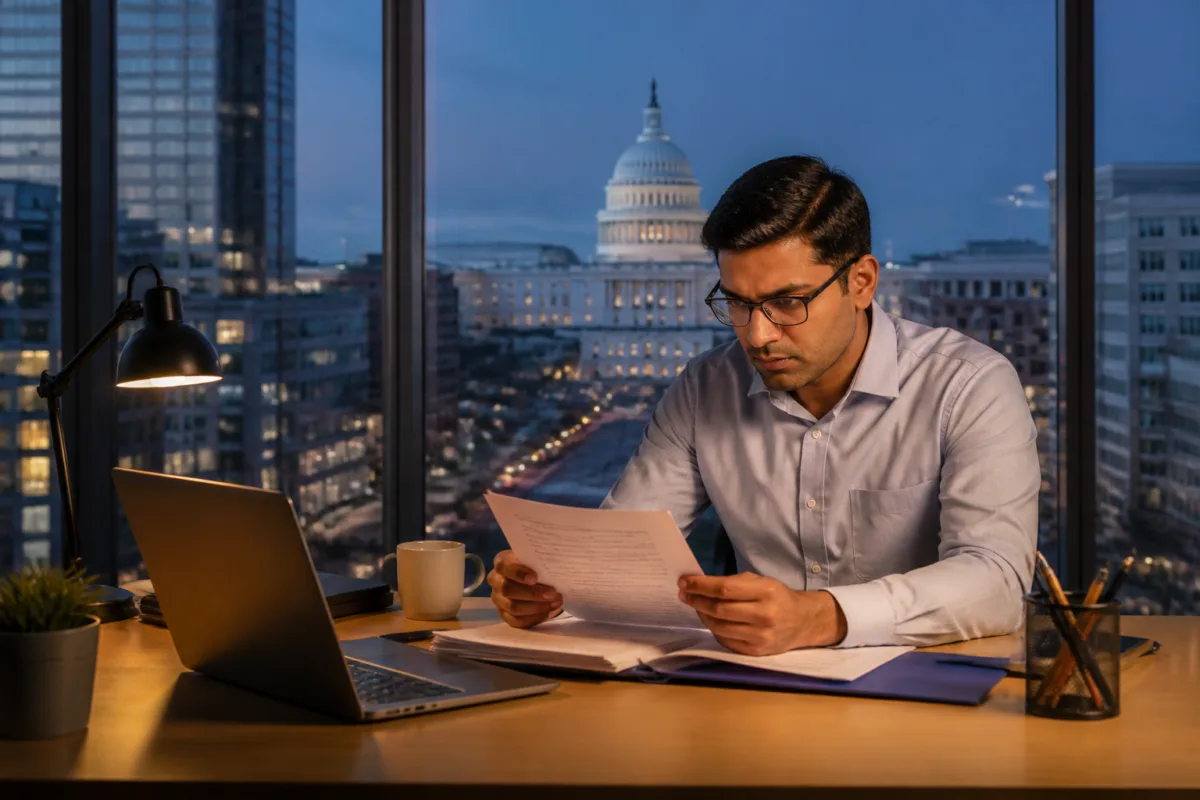
The projected Democratic takeover of both chambers of the US Congress has changed the political balance around the H-1B visa fee and tariffs on Indian goods, but it has not removed the main obstacle to reversing either policy: President Donald Trump’s executive authority and veto power. The result gives Democrats control of key committees, subpoena powers and influence over funding, yet the available numbers indicate that they do not have the supermajority required to override a presidential veto.
That distinction is central to understanding what the election result means for Indian professionals, employers and institutions that rely on cross-border mobility. The immediate change is not the cancellation of the $100,000 fee on new H-1B petitions or the reversal of tariffs of up to 50 per cent on Indian goods. It is the creation of a stronger congressional platform from which those measures can be investigated, challenged and potentially narrowed.
According to the report, Democrats had won at least 242 House seats to the Republicans’ 151 by Wednesday evening, with 42 races still uncalled. NBC’s model estimated that Democrats would finish with about 259 seats. In the Senate, Democrats were projected to hold 54 seats against 44 for Republicans, with races in Mississippi and Alaska yet to be called. The projected margins are enough to control committees, but not enough to secure the two-thirds majorities required in both chambers to override a presidential veto.
The H-1B programme is particularly significant for India because Indian nationals accounted for about 70 per cent of approved H-1B petitions in fiscal 2025, according to a US Citizenship and Immigration Services report to Congress. China was the second-largest beneficiary, at about 12 per cent. The concentration of approvals means that changes to fees, eligibility and enforcement can have consequences across the professional networks linking Indian cities with US employers.
For Indian technology workers, the fee is only one part of the policy environment. Employers must also assess whether new petitions remain financially viable, while workers and families face uncertainty over job mobility and long-term residence. The supplied report does not establish how many petitions have been withdrawn or how many employers have passed the cost on to workers. It does, however, show that the policy has become a significant congressional issue because of its implications for labour supply and public services.
Members of the New Democrat Coalition have already written to Homeland Security Secretary Kristi Noem seeking exemptions for healthcare workers from the H-1B fee imposed under President Trump’s September 19, 2025 proclamation, titled “Restriction on Entry of Certain Nonimmigrant Workers”. Their letter said the proclamation posed “a serious threat to the healthcare workforce in our districts”. The proposal is important because it illustrates the route Democrats may pursue: targeted exemptions or administrative pressure rather than an immediate legislative repeal.
The difference between an exemption and a repeal matters institutionally. An exemption could protect selected categories of workers while leaving the executive action in place for other applicants. A repeal would require legislation or another executive decision. The report says executive actions affecting H-1B workers and Indian students could proceed regardless of the election result, and that public comment windows for rules proposed by the administration were due to close in early November.
The new congressional majority will nevertheless have substantial oversight capacity. The House Judiciary Committee lists immigration policy and non-border enforcement among its areas of jurisdiction. Its immigration subcommittee covers immigration and naturalisation, border security and drug interdiction. The House Homeland Security Committee’s Border Security and Enforcement Subcommittee oversees Customs and Border Protection, Immigration and Customs Enforcement and USCIS.
That oversight can translate into hearings, requests for documents and subpoenas. It can also shape appropriations for the Department of Homeland Security. But committee control does not automatically give Congress the power to cancel a presidential proclamation. The report specifically notes that Democrats could use oversight and funding authority without having a direct mechanism to invalidate the fee.
The election also removed some prominent restrictions on H-1B migration from Congress. Ohio Senator Jon Husted, described in the report as one of the Senate’s leading H-1B restrictionists, lost to Democrat Sherrod Brown. Husted had sponsored a bill that would have raised the wage threshold for H-1B exemptions to about $140,000. In Texas, former state attorney general Ken Paxton, who had opened investigations into H-1B use at nearly 30 North Texas businesses, lost the Senate race to Democrat James Talarico.
These results may alter the tone of congressional debate, but they do not by themselves settle the policy question. The report does not establish that every Democratic member supports a broad expansion of H-1B admissions, nor does it show that all Republicans support the current fee. The clearest evidence is narrower: Democrats are positioned to scrutinise the administration’s actions, while some incoming or returning members have already proposed exemptions or repeal measures.
The tariff issue follows a similar pattern. Representatives Deborah Ross, Marc Veasey and Raja Krishnamoorthi introduced H.J.Res.134 in December 2025 to end the national emergency that President Trump used to impose tariffs of up to 50 per cent on Indian goods. The resolution was referred to the House Foreign Affairs Committee and had not received a vote at the time of the report. Krishnamoorthi called the tariff strategy “a counterproductive approach” that weakened a critical partnership.
Control of the House Ways and Means Committee is relevant because the committee identifies tariffs, reciprocal trade agreements and the bonded debt of the United States among its jurisdictions. Yet the same constitutional constraint applies. A bill or resolution overturning the tariff emergency would require the President’s signature, or two-thirds majorities in both chambers to override a veto. The projected Democratic margins fall short of that threshold.
For India-linked urban economies, the two measures operate through different channels. H-1B restrictions affect the movement of skilled workers and the employers that recruit them. Tariffs affect goods, trade relationships and business costs. The supplied material does not provide city-level estimates for Hyderabad, Bengaluru, Delhi or other Indian urban centres, so it cannot establish the local employment or housing impact of the policies. It does establish that the H-1B system connects a large share of Indian beneficiaries to US labour demand, making policy changes relevant to professional households and the institutions that support them.
The presence of six Indian American House members in the expected new Congress, subject to Amish Shah holding his lead in Arizona’s First District, may give India-related concerns greater representation within the majority. Those members include Pramila Jayapal, a former H-1B visa holder, and Ro Khanna, co-chair of the India Caucus. Representation can strengthen the political visibility of the issue, but it does not remove the executive branch’s authority over the proclamations and proposed rules described in the report.
The most immediate question is therefore not whether Democrats can simply roll back the H-1B fee or tariffs. The evidence indicates that they cannot do so alone under the projected numbers. The more realistic areas of congressional influence are hearings, investigations, appropriations, targeted exemptions and legislative pressure. Whether those tools produce a policy change will depend on the administration’s response, the progress of the proposed resolution and the treatment of pending rules affecting H-1B workers and Indian students.
The election result confirms a shift in oversight, not a completed reversal of policy. For Indian workers and employers, the next meaningful milestones are the new Congress’s convening in January, committee action on immigration and tariffs, the fate of H.J.Res.134 and the administration’s decisions on the proposed rules and the September 2025 H-1B proclamation. Until those steps occur, the fee and tariffs remain in place as described in the supplied report.

