Gurugram Encroachment Drive Reclaims Public Urban Space
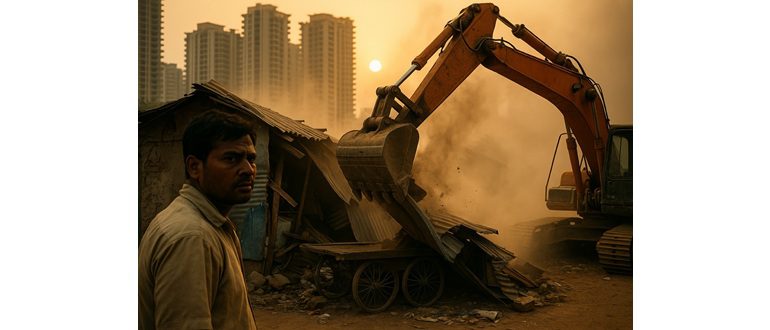
A large-scale enforcement drive in Gurugram has cleared more than 7,600 encroachments across key residential colonies in just five days, marking one of the city’s most extensive attempts to reclaim public land. The operation, spanning areas such as DLF phases and Palam Vihar, signals a renewed push to restore road access and address long-standing violations that have gradually eroded shared urban spaces.
Authorities targeted illegal extensions built along internal roads and right-of-way zones—spaces originally designated for mobility, emergency access, and public use. These included ramps, boundary walls, guard rooms, kiosks, and landscaped areas that had encroached onto roads and footpaths over time. In several neighbourhoods, these additions had narrowed streets significantly, affecting traffic flow and limiting access for emergency vehicles. The scale of the crackdown reflects the extent to which incremental encroachments have become normalised in planned colonies. In some of Gurugram’s most established residential areas, thousands of such violations had accumulated over years, often with minimal enforcement. Urban planners note that these seemingly minor extensions, when aggregated, can severely compromise infrastructure efficiency, pedestrian safety, and overall urban liveability. The current action is also linked to a broader regulatory shift following judicial intervention on building norms, particularly around stilt-floor constructions and misuse of residential plots. Authorities have been directed to ensure that public right-of-way areas remain unobstructed, prompting a time-bound crackdown across multiple colonies.
While the drive has improved road usability—reclaiming significant stretches of internal roads—it has also triggered mixed reactions among residents. Some have raised concerns over notice periods, implementation methods, and damage to existing utilities or green elements during demolition. Others, however, have supported the move, citing long-standing issues with congestion and unregulated construction in residential zones. From an urban development perspective, the episode underscores a deeper governance challenge. Gurugram’s rapid expansion has often outpaced regulatory enforcement, allowing informal modifications to proliferate even within planned layouts. The result is a gradual distortion of original urban design, where private interests override collective infrastructure needs. Experts argue that enforcement drives, while necessary, cannot be a substitute for continuous monitoring and community engagement. Without sustained oversight, reclaimed spaces risk being re-encroached over time. There is also a need to align enforcement with broader urban planning reforms, including clearer guidelines on permissible modifications, stronger coordination between agencies, and digitised tracking of violations.
The environmental dimension is equally significant. Encroachments on green belts and open spaces reduce urban permeability and exacerbate heat island effects, particularly in dense neighbourhoods. Reclaiming these areas could improve microclimates and support more climate-responsive urban design—if maintained effectively. As Gurugram continues to grow as a major economic hub, the crackdown highlights a critical inflection point: whether the city can transition from reactive enforcement to proactive planning. Ensuring that public spaces remain protected—and that infrastructure keeps pace with development—will be central to building a more resilient, equitable urban future.