


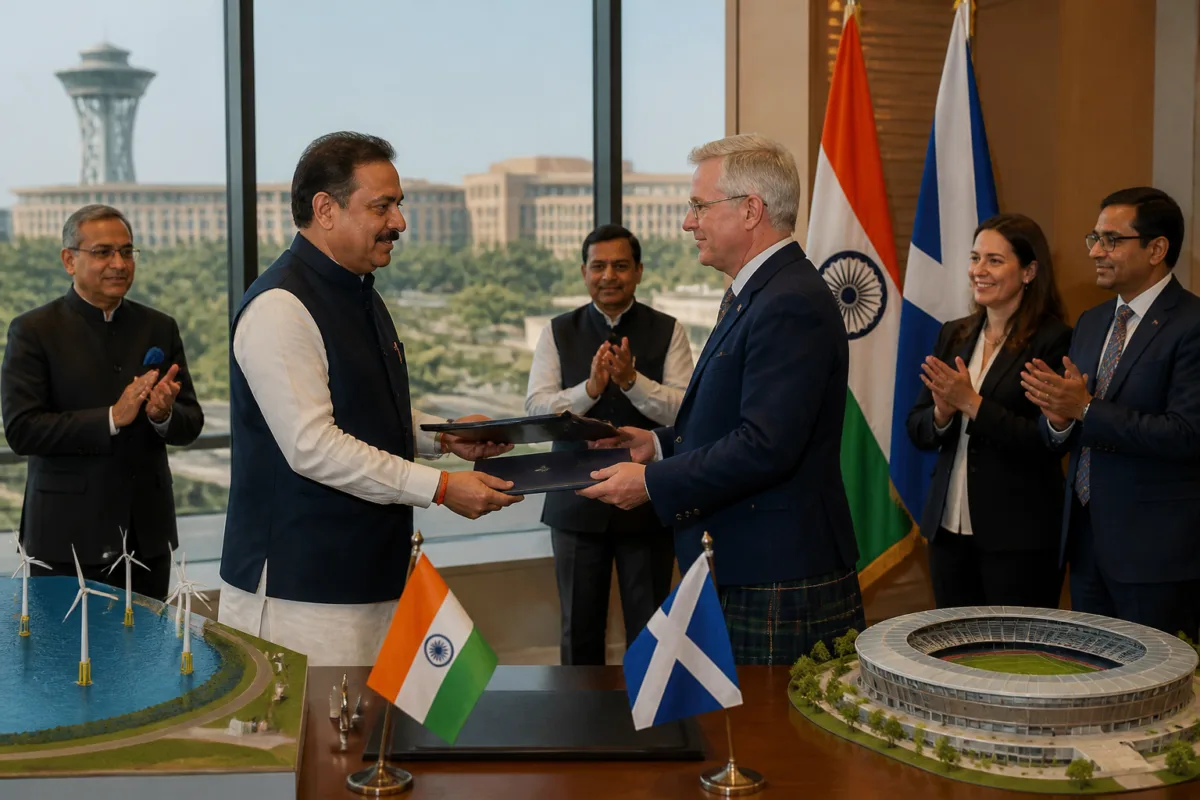
Gujarat and Scotland have signed a memorandum of understanding to expand cooperation in renewable and offshore energy, sports infrastructure, education, research, trade and cultural exchange, creating a formal framework for collaboration between the state and the Scottish administration.
The agreement was exchanged in Gandhinagar in the presence of Gujarat Chief Minister Bhupendra Patel and Scotland’s First Minister John Swinney. It seeks to promote sustainable and inclusive economic development, innovation, entrepreneurship and the sharing of knowledge and best practices.
Patel proposed that a Gujarat delegation visit Scotland to study its capabilities in offshore energy. He said Gujarat’s extensive coastline gives the state significant potential in the sector and described the state as one of India’s leading centres for renewable energy. Scotland has offered to share its offshore energy expertise with Gujarat under the partnership.
The proposed delegation visit could give Gujarat officials an opportunity to examine how offshore energy capabilities, institutional knowledge and technical practices are developed and managed in Scotland. The MoU, however, does not specify a project pipeline, investment commitment, generation target or implementation timeline for offshore energy cooperation.
The agreement also has a major sports infrastructure component. Gujarat is preparing to host the 2030 Commonwealth Games, while Glasgow hosted the 2026 edition. The partnership is expected to support knowledge-sharing on sports infrastructure, event management and other requirements involved in organising international sporting events.
That cooperation could cover institutional experience from Glasgow’s hosting of the 2026 Games, while Gujarat prepares for the operational and infrastructure demands associated with the proposed 2030 event. The source statement does not provide details of venues, construction plans, budgets or procurement arrangements for the Games.
Beyond energy and sports, the MoU provides for stronger links between universities, colleges and research institutions. These links are expected to include exchanges involving students, researchers and faculty, along with cooperation in skills development, professional partnerships and innovation.
Swinney said the agreement would create opportunities for collaboration in culture, sports, renewable energy and life sciences. The two sides also plan to strengthen cooperation in heritage, creative industries and cultural exchange, alongside trade and investment ties.
For Gujarat’s urban and infrastructure planning, the immediate significance of the agreement lies in the areas where international cooperation may intersect with future public systems: renewable energy capability, sports facilities and the skills needed to plan and manage large-scale events. The next stated step is the proposed Gujarat delegation visit to Scotland to study offshore energy expertise, while further details of projects and implementation are yet to be announced.

