


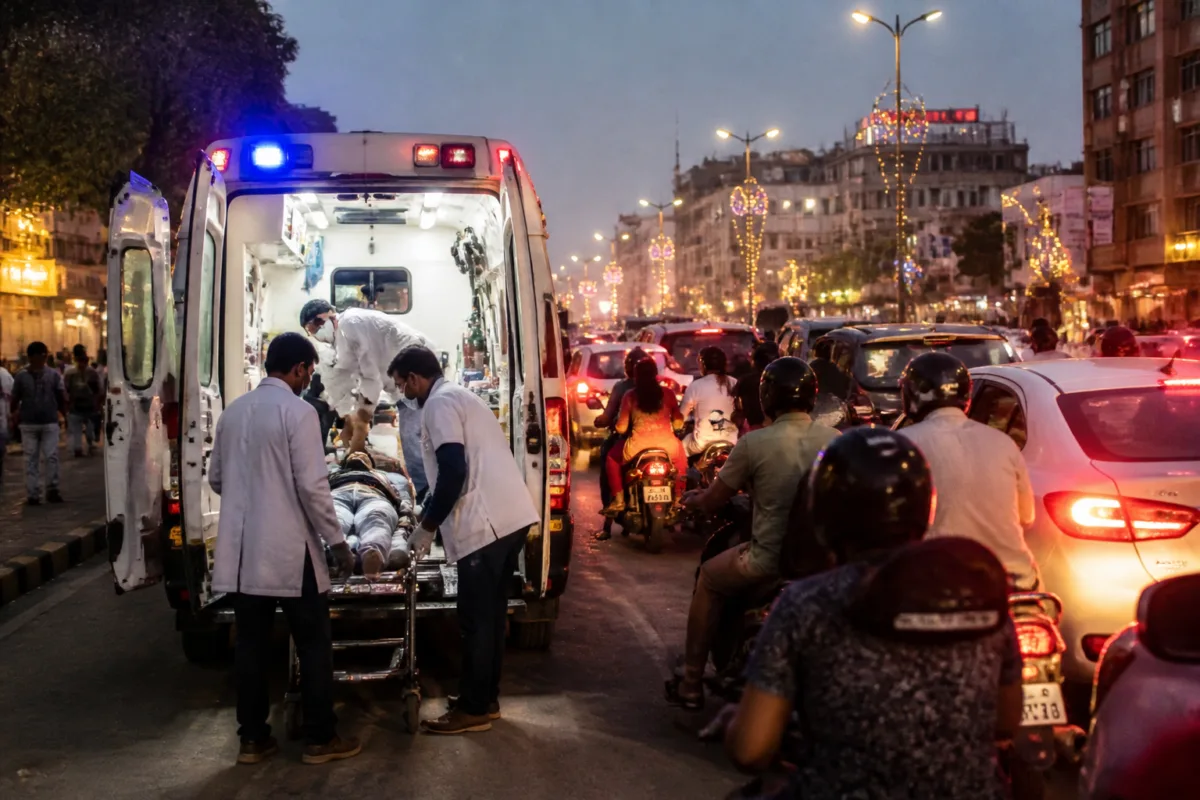
Gujarat emergency calls rose sharply during Diwali, New Year and Bhai Bij, according to data released by EMRI 108, revealing how festive mobility and celebrations place additional pressure on the state’s emergency-response infrastructure. The increase was driven mainly by road accidents, non-vehicular trauma and burn injuries, with several districts recording rises of at least 25% over normal daily levels.
EMRI 108 handled 5,934 emergencies on Diwali, 6,595 on New Year and 5,984 on Bhai Bij. The service’s normal daily average was 5,248 emergencies. This means demand was higher by about 13% on Diwali, 26% on New Year and 14% on Bhai Bij, based on the figures in the EMRI release. New Year recorded the highest total and the largest overall increase among the three occasions.
The numbers matter because emergency services are designed to absorb sudden spikes as well as routine demand. A rise in total calls does not only mean more ambulances are dispatched. It can also increase pressure on call centres, ambulance availability, hospital casualty departments and the coordination required between emergency medical teams, police and receiving hospitals. The supplied data does not establish whether any particular facility faced a shortage or delay, but it does show that demand was concentrated around predictable periods of heightened travel and celebration.
Road accidents were the clearest driver of the increase. EMRI recorded 1,212 road accident-related emergencies on Diwali, compared with a normal average of 646, a rise of 87.62%. The figure climbed to 1,541 on New Year, up 138.54% from the normal average, and stood at 1,032 on Bhai Bij, an increase of 59.75%.
The New Year figure is particularly significant within the dataset. Road accident emergencies accounted for a much larger increase than the overall rise in calls, indicating that the festive surge was not evenly distributed across all emergency categories. The data points to road trauma as a specific operational pressure rather than simply a general increase in calls for medical assistance.
Non-vehicular trauma also increased substantially. EMRI handled 1,043 such emergencies on Diwali, compared with a normal average of 595, a rise of 75.3%. The figure was 938 on New Year, up 57.7%, and 724 on Bhai Bij, an increase of 21.7%. Together, the road accident and non-vehicular trauma figures show that injury-related emergencies formed a major part of the additional load during the festive period.
Burn injuries followed a different pattern. EMRI recorded 62 burn-related emergencies on Diwali, compared with a normal average of 11. That was the sharpest proportional increase among the categories reported. Burn emergencies fell to 26 on New Year and 21 on Bhai Bij, but remained above the normal average. Ahmedabad recorded the highest number on Diwali, with 13 cases, followed by Surat with 12 and Rajkot and Kutch with five each. Ahmedabad also recorded the highest number on New Year, with 10 cases. On Bhai Bij, EMRI handled five burn-related emergencies in Ahmedabad, three in Surat and two in Rajkot.
The distribution across cities and districts suggests that festive emergency demand is not confined to one metropolitan centre. Among major cities, Surat recorded the highest increase on Diwali at 10.9%, followed by Rajkot at 6.8%. On New Year, Vadodara led with a 25.7% increase, followed by Rajkot at 21.7% and Ahmedabad at 13.5%. On Bhai Bij, Rajkot recorded the highest rise at 14.6%, followed by Vadodara at 9.6% and Ahmedabad at 7.9%.
The city-level pattern is important because the largest number of emergency calls and the highest percentage increase are not necessarily the same thing. Ahmedabad recorded the highest number of burn emergencies on Diwali and New Year, while Vadodara recorded the largest increase among the listed major cities on New Year. This distinction matters for planning: a large city may carry the highest absolute caseload, while a smaller or differently configured urban area may experience the greatest relative stress.
The EMRI data also identified Bharuch, Bhavnagar, Dahod, Devbhumi Dwarka, Mehsana, Mahisagar, Panchmahal, Sabarkantha, Dang and Valsad as districts where emergency calls rose by at least 25%. The supplied report does not provide the individual call totals or the size of the normal baseline for each of these districts. It therefore cannot establish which district faced the greatest absolute pressure. It does, however, indicate that the festive demand pattern extended across multiple parts of Gujarat rather than being limited to Ahmedabad, Surat, Vadodara or Rajkot.
This geographic spread raises an administrative question about how emergency resources are positioned during high-risk periods. A state-wide emergency service must respond to changing demand across cities, districts, highways and smaller settlements. The figures show that additional demand appeared in both major urban centres and districts beyond the largest cities. The release does not state whether ambulances were temporarily redeployed, whether additional personnel were scheduled or whether hospital coordination protocols were changed during the festivals. Those operational details would be necessary to assess how effectively the system absorbed the increase.
The figures also separate three different kinds of festive risk. Diwali produced the most pronounced rise in burn emergencies and a major increase in both road accidents and non-vehicular trauma. New Year produced the highest total number of emergencies and the largest increase in road accident-related calls. Bhai Bij recorded a smaller overall rise, but road accident and trauma cases remained above normal levels. Treating all festivals as one category would therefore conceal differences in the type of emergency generated by each occasion.
That distinction can inform the way public agencies prepare for predictable demand. The evidence supplied by EMRI supports a case for analysing festival-specific patterns rather than relying only on an annual average. Diwali-related planning would need to account for burn injuries as well as road trauma, while New Year planning would need to account for the much larger rise in road accident emergencies recorded in the data. The source does not provide an official prevention plan or claim that such a system has been adopted, so the operational implications remain an area for further examination rather than an established policy change.
The data also shows why emergency-response capacity cannot be assessed only through total call volumes. On Diwali, the overall number of emergencies was 5,934, but road accident calls rose by 87.62% and non-vehicular trauma by 75.3%. On New Year, total demand rose by about 26%, while road accident-related emergencies increased by 138.54%. A relatively moderate increase in total calls can therefore contain a much sharper rise in the categories that require ambulances, trauma care and rapid hospital access.
There are limits to what the supplied figures can establish. They do not include response times, ambulance utilisation, hospital admission numbers, fatalities, injury severity, call locations, traffic conditions or the duration of each demand spike. They also do not provide a comparison with other non-festive holidays or identify the causes behind individual accidents. The figures are therefore best read as a measure of emergency demand, not as a complete assessment of road safety or emergency-service performance.
Even with those limitations, the pattern is clear. Gujarat’s emergency system experienced higher demand during three major festive occasions, and the increase was driven disproportionately by injuries. New Year created the largest overall and road-accident-related surge, Diwali produced the sharpest burn-related increase, and Bhai Bij continued to generate above-normal road trauma and emergency calls. The next useful layer of public information would be response-time and outcome data showing how the 108 network and hospitals performed under this seasonal pressure.

