


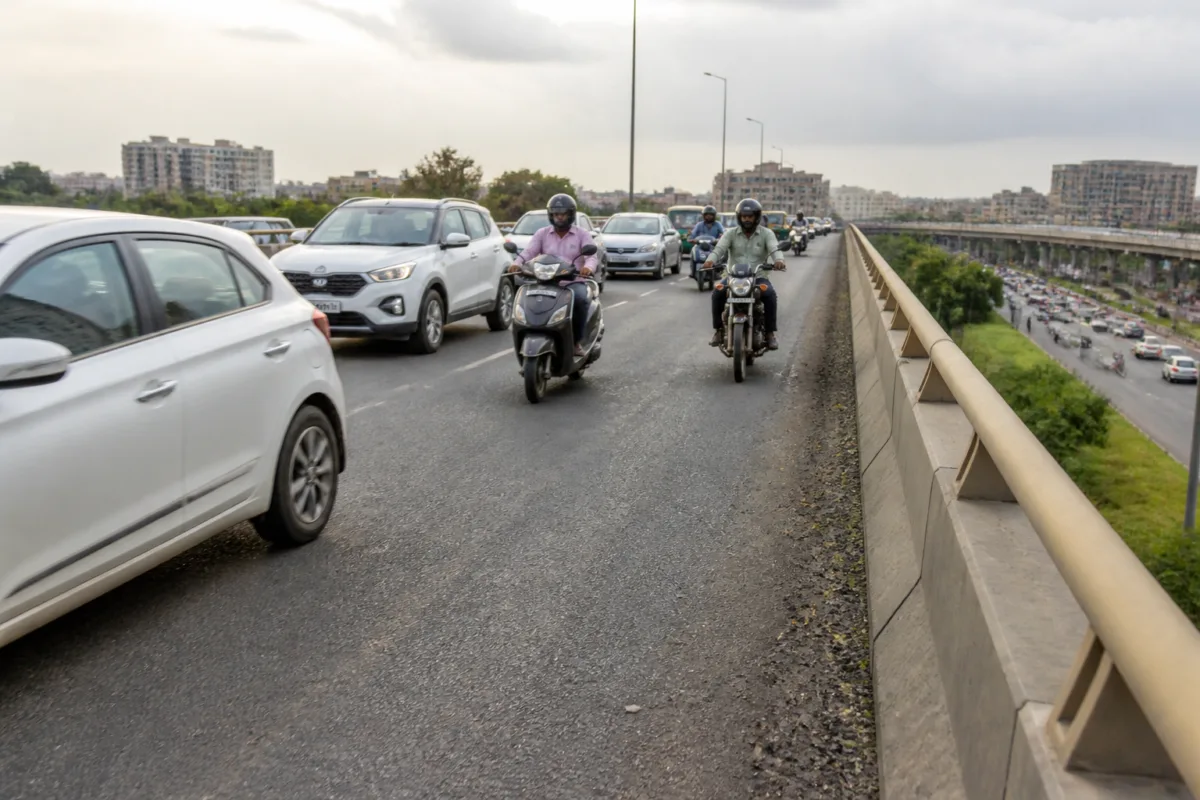
Ahmedabad’s Sarkhej-Iskcon bridge, built at a reported cost of more than Rs 450 crore and used by over 3 lakh vehicles a day, has come under scrutiny after a viral video raised questions about the quality and finish of its road surface. The allegations have drawn attention to how newly opened elevated infrastructure is inspected and handed over for daily traffic.
The 4.5-km Sarkhej-Iskcon elevated overbridge runs between the Sarkhej-Sanand junction and Iskcon Junction on the S.G. Highway. The bridge was inaugurated by Union Home and Cooperation Minister Amit Shah, according to a report by Divya Bhaskar. Its opening was intended to improve traffic movement for vehicles travelling towards Ahmedabad and Gandhinagar, including commuters arriving from the Saurashtra region.
The reported video shows a vehicle travelling along the bridge while the road surface appears uneven. Drivers cited in the report alleged that the polishing work on the surface had not been completed properly, causing vehicles to move over what they experienced as an undulating road. The report also said that vehicles did not appear to travel at a consistent level on some stretches of the bridge.
Drivers further alleged that the road work was not satisfactory despite the project’s high cost and that the uneven surface made driving difficult. Small pieces of aggregate were also reportedly visible at several locations on the bridge. Such loose material can be particularly relevant for two-wheeler users, who may face a greater risk of losing balance while travelling over an uneven or debris-covered surface.
The reported complaints contrast with the bridge’s stated traffic function. Since its opening, the structure has been carrying more than 3 lakh vehicles daily, according to the report, while reducing the need for motorists to stop at the YMCA, Prahladnagar and Karnavati Club junctions. Vehicles can also travel from Sarkhej towards Gandhinagar without stopping at multiple traffic signals, helping reduce congestion on the S.G. Highway.
The available report, however, does not include an official response from the road-owning agency, the contractor, an independent engineer or a safety authority on the condition of the surface. It also does not establish whether the visible unevenness is a temporary finishing issue, a maintenance defect or a broader construction-quality problem. The road-quality allegations therefore require verification through an engineering inspection and an on-record response from the responsible authorities.
The immediate public-interest question is whether the bridge has been formally inspected after opening and what defect-liability or maintenance provisions apply if shortcomings are confirmed. Any official assessment would need to clarify the affected stretches, the nature of the surface irregularities, the safety implications for two-wheelers and the timeline for corrective work. No such findings were included in the supplied report.

