


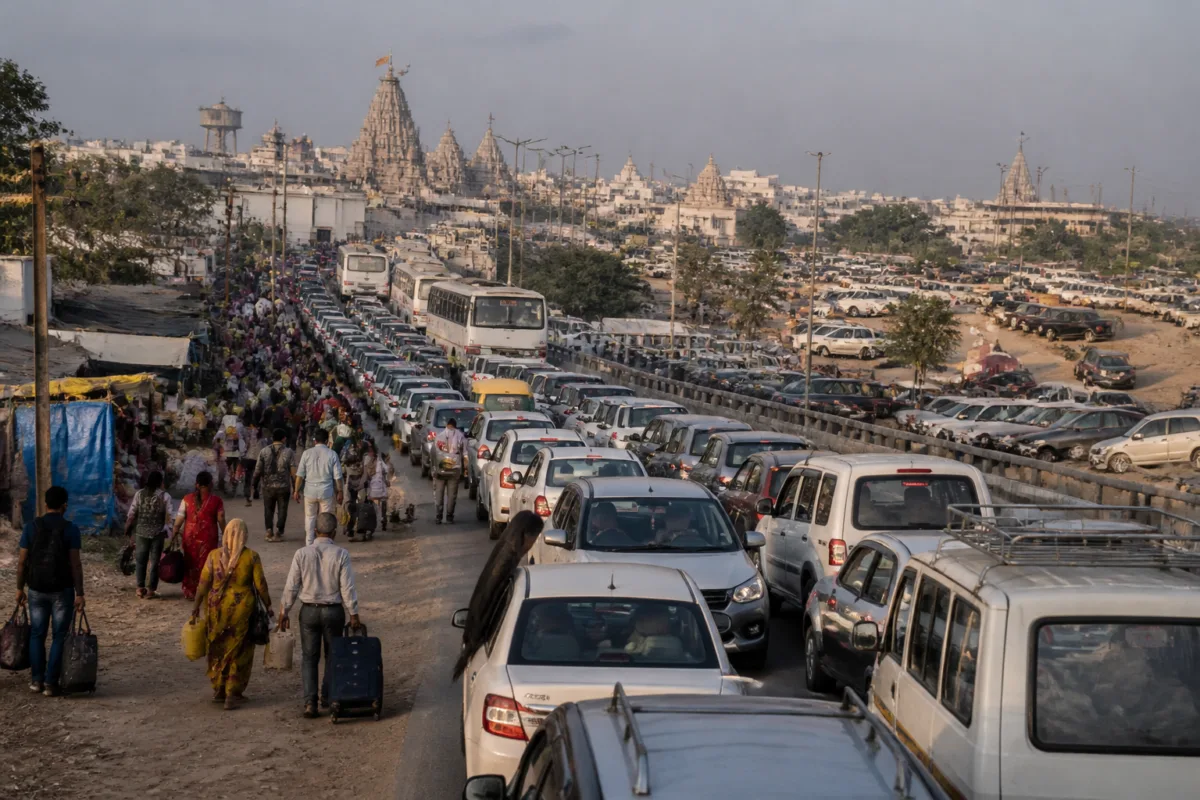
The Diwali travel surge across Gujarat and Rajasthan did more than fill hotels and slow highways. It exposed how quickly pilgrimage towns, hill destinations, wildlife gateways and newly promoted visitor hubs can exceed the capacity of the roads, parking areas, fuel stations, accommodation stock and shuttle systems on which they depend.
The Times of India reported that destinations including Somnath, Dwarka, Udaipur, Mount Abu, the Statue of Unity area, Gir and Saputara faced a combination of overflowing hotels, sharply higher room rates, long traffic queues and limited parking. In some places, visitors spent the night in vehicles, on terraces or beside roads. The disruption was not confined to one town or one type of destination: it stretched across pilgrimage circuits, leisure destinations, protected-area tourism and major approach highways.
That spread is important. A single congested road can be treated as a traffic-management problem. Simultaneous pressure across several destinations points to a wider capacity-planning challenge. Tourist demand is concentrated into a small number of festival and holiday periods, while much of the supporting infrastructure is designed for ordinary days. The result is a system that appears adequate for average demand but becomes highly fragile during predictable peaks.
Somnath provided the clearest indication of the scale of the surge. The temple town normally receives around 30,000 visitors a day, according to the report, but saw at least 1 lakh visitors each on Tuesday, Wednesday and Thursday. The rush continued on Friday. The increase therefore represented more than a short-lived rise in footfall: the town was dealing with more than three times its reported normal daily visitor volume over several consecutive days.
Accommodation was one of the first points at which the pressure became visible. Somnath Trust facilities were reported to be overbooked, while private hotels charged up to three times their usual rates. One visitor from Delhi said a room that had cost Rs 1,500 during a previous visit was quoted at Rs 7,000 during the rush. The report also cited an Ahmedabad travel expert who said rooms in Rajasthan that generally cost Rs 3,000 a night were being sold for nearly Rs 7,000 after last-minute bookings surged.
These figures show how a demand shock is transmitted through a destination economy. When room supply cannot expand quickly, prices become the immediate rationing mechanism. Visitors who can pay more secure accommodation, while others search for informal alternatives. In Somnath, a tea-stall operator said he worked beyond midnight because people unable to find rooms stayed on the roads and remained awake with tea and snacks. In Dwarka, some residents and dharamshalas opened terraces to visitors. One resident reportedly rented a terrace to five tourists a day at Rs 500 per person, supplying mattresses, pillows and drinking water.
The terrace arrangements illustrate both community response and infrastructure failure. Informal hospitality can provide temporary relief, but it cannot substitute for a planned system of safe, regulated and serviced accommodation. The supplied report does not establish how many visitors were accommodated in such conditions or whether local authorities had a formal mechanism for managing them. It does, however, show that the shortage moved visitors beyond the conventional hotel and guest-house network.
Mobility pressure followed the accommodation shortage. Traffic backed up for nearly 2 km near the entrance to Dwarka. Police blocked U-turns to regulate vehicle movement, but congestion persisted. On the Khedbrahma-Ambaji-Abu Road stretch, pilgrims and holidaymakers converged on the route towards Mount Abu. The Ahmedabad-Himmatnagar-Shamlaji highway also saw congestion as travellers headed towards Udaipur and pilgrims travelled towards Nathdwara and Kankroli.
These corridors perform multiple functions at the same time. They carry local traffic, intercity holiday travel, pilgrimage movement and commercial vehicles. During a festival surge, the same road network must absorb visitors arriving at different times, vehicles searching for parking, buses circulating through town centres and motorists stopping for fuel or accommodation. The report does not provide traffic counts or road-capacity figures, so it cannot establish which individual bottleneck contributed most to the delays. It does show that congestion extended beyond destination centres and affected the approaches connecting several towns.
Fuel availability became a second mobility constraint in Dwarka. CNG queues on roads leading to the town stretched up to 1 km, with motorists reportedly waiting more than 90 minutes to refuel. Only a few stations were operating near the town, according to the report. This creates a compounding problem: a destination already struggling with road congestion also experiences vehicles queuing at fuel stations, reducing effective road capacity and increasing uncertainty for travellers trying to leave or continue their journeys.
Parking shortages were reported in Saputara and the Dang region, while Ektanagar experienced increased pressure on approach roads, parking lots and shuttle services during Bharat Parv 2026 and Ekta Prakash Parv. The combination matters because parking is often treated as a destination-level facility rather than as part of a wider mobility plan. When visitor numbers rise suddenly, cars circulate in search of spaces, pedestrians compete with vehicles near attractions and shuttle operations face greater demand. Without adequate peripheral parking and reliable last-mile connections, the road entering the destination becomes the parking system by default.
Wildlife tourism exposed another form of capacity pressure. Gir experienced heavy tourist movement, affecting safari bookings and access roads. A group of 30 visitors from Ahmedabad could not secure a jungle safari and instead visited the Devalia Interpretation Zone after an acquaintance arranged entry. Another visitor said the three-hour safari itself was conducted smoothly, but the drive from Sinh Sadan to Devalia took more than 45 minutes instead of the usual 20 because of traffic. The group reached 45 minutes late for its 10 am to 11 am slot, although the guide and driver ensured that the full tour was provided.
The Gir example separates attraction capacity from access capacity. A safari booking system may function once visitors enter the designated experience, while the roads connecting separate facilities remain congested. This distinction is relevant for destinations where visitor management depends on timed slots, protected-area rules and controlled entry. The visitor experience can still be disrupted even when the principal attraction is operating as scheduled.
The same pattern appears across the destinations described in the report. Somnath and Dwarka faced high pilgrimage footfall; Mount Abu, Saputara and Udaipur faced holiday traffic; Gir faced pressure on safari access; and Ektanagar faced demand linked to organised events. Each destination has a different administrative and operational setting, but the immediate stresses were similar: too many vehicles, insufficient parking, limited rooms and demand concentrated into a narrow period.
The institutional picture is therefore spread across several actors. Police managed traffic in Dwarka by blocking U-turns. Hotels, trusts, guest houses, dharamshalas and residents supplied accommodation. Fuel stations served the travelling population. Safari operators, guides and drivers managed visitor slots in Gir. Event-related visitor flows added pressure around Ektanagar. The report does not identify a single coordinating authority responsible for the full visitor journey, from highway approach to parking, accommodation, fuel and attraction entry.
That fragmented responsibility is a central urban question. A visitor may experience one continuous trip, but the infrastructure supporting it is divided among road agencies, municipal bodies, tourism authorities, private businesses, religious trusts, police departments and attraction managers. When demand rises sharply, each component can become a bottleneck for the others. Extra hotel rooms do not solve a parking shortage, and traffic controls do not solve the absence of accommodation. A functioning destination requires these systems to work together.
The numbers in the report also show why average-day planning can be misleading. Somnath’s reported daily footfall rose from around 30,000 to at least 1 lakh for three consecutive days. Room prices in cited examples rose from Rs 1,500 to Rs 7,000 and from Rs 3,000 to nearly Rs 7,000. Dwarka saw a 2-km traffic backup, fuel queues of up to 1 km and waits exceeding 90 minutes. The Gir route between Sinh Sadan and Devalia took more than twice the usual travel time in one reported instance, rising from about 20 minutes to over 45 minutes.
These are not measures of the entire system, and the report does not provide comparable data for every destination. They are nevertheless useful indicators of stress. They show that the problem was not simply that visitors encountered inconvenience. The surge altered prices, operating hours, travel times and the way accommodation was provided. It also placed additional demand on small businesses, with one Somnath tea seller reporting that he stayed open through the night.
The larger lesson is not that festival travel should be discouraged. It is that destinations need to be assessed against peak demand as well as normal demand. The evidence supplied here does not establish whether visitor forecasts, temporary parking plans, additional fuel arrangements or coordinated accommodation measures were prepared in advance. Nor does it establish whether the congestion was more severe than in earlier Diwali periods. Those gaps matter because they determine whether the episode was an exceptional disruption or a recurring seasonal pattern.
What the report does establish is that several destinations experienced predictable holiday demand without enough visible spare capacity in accommodation, parking, fuel access and approach-road movement. The immediate responses came from police, businesses, residents, drivers and attraction staff. The unresolved issue is whether these temporary responses can be converted into a coordinated destination-management system before the next major peak. Until then, Gujarat’s most popular visitor centres will continue to function efficiently on ordinary days while remaining vulnerable when the state’s travel calendar concentrates demand in one short window.

