


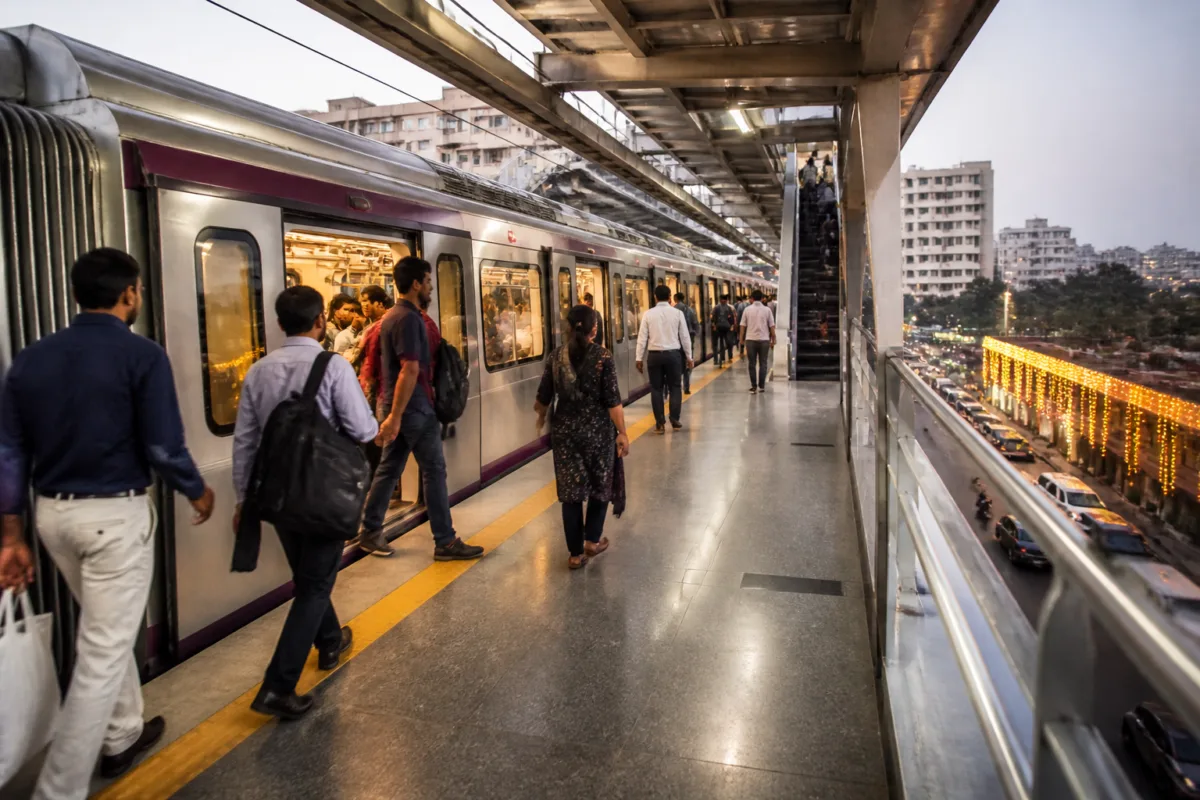
Pune Metro recorded 12,13,868 passenger journeys and revenue of Rs 1.86 crore during the seven-day Diwali holiday period from November 5 to 11, according to figures reported by Punekar News. The numbers show that the system was used heavily for shopping, visiting relatives and tourism, but the sharp variation between individual days also reveals how strongly Pune’s metro demand is shaped by the timing and purpose of urban travel.
The two operational corridors generated total revenue of Rs 1,86,30,951 during the period. The Purple Line, which runs between Vanaz and Ramwadi, carried 6,56,105 passengers and earned Rs 1,05,31,513. The Aqua Line, connecting Pimpri Chinchwad and Swargate, recorded 5,57,763 passengers and revenue of Rs 80,99,440.
Together, the two corridors averaged more than 1.73 lakh passenger journeys and over Rs 26.61 lakh in revenue per day across the seven-day period. These figures are significant because they capture the metro not simply as a weekday commuting service, but as part of the wider movement system used during one of the busiest periods in the urban calendar.
The data also shows that the two lines did not perform identically. The Purple Line carried nearly 98,342 more passenger journeys than the Aqua Line during the period and earned approximately Rs 24.32 lakh more in revenue. Its share of the combined ridership was about 54 per cent, while the Aqua Line accounted for roughly 46 per cent.
That difference does not, by itself, establish why one corridor attracted more passengers. The supplied figures do not provide station-wise footfall, trip purpose, service frequency, fare-category information or interchange data. They do, however, show that the two corridors were both important contributors to the festive-period total, with neither line operating as a marginal part of the system.
The strongest evidence of concentrated demand came on November 5, the day of Vasu Baras. Pune Metro recorded its highest daily footfall of the period on that day, with 2,58,368 passenger journeys and revenue of Rs 40,40,402. The following day, Dhanteras, produced the second-highest result: 2,12,832 passengers and revenue of Rs 33,69,577.
The combined ridership on these two days was 4,71,200 passenger journeys, accounting for nearly 39 per cent of the full seven-day total. Revenue during the same two-day period was Rs 74,09,979, or almost 40 per cent of the reported total. This concentration suggests that festive mobility was not evenly distributed across the holiday period. Travel intensified around particular shopping and celebration dates rather than remaining constant throughout the week.
The pattern changed sharply on November 7, when ridership fell to 1,85,143. On November 8, only 22,283 passengers used the metro, the lowest daily figure in the reported period, while revenue stood at Rs 11,01,036. The fall from the November 5 peak to November 8 was more than 91 per cent in passenger journeys.
The supplied report does not identify the operational or behavioural reason for this drop. It records the change without attributing it to a particular service disruption, holiday practice, station closure, weather event or other cause. That distinction matters: the numbers demonstrate uneven demand, but they do not establish what caused the lowest-footfall day.
Ridership recovered over the final three days. Passenger journeys rose to 1,49,951 on November 9, 1,55,586 on November 10 and 1,59,705 on November 11. The recovery remained below the first two days’ levels, but it placed usage at more than seven times the November 8 figure by the end of the period.
This sequence gives Pune Metro a useful short-term picture of festive mobility. Demand began at a very high level, declined across the middle of the period, reached a pronounced low and then recovered. For a transport system, such variation is operationally relevant because passenger volumes affect station crowding, train loading, ticketing demand and the deployment of frontline staff. The report, however, does not provide details of additional services, altered schedules, crowd-management measures or peak-hour conditions.
The figures also need to be read correctly. The report counts passenger journeys, not necessarily unique individuals. A person travelling multiple times during the seven-day period may contribute more than one journey to the total. The data therefore measures use of the metro service rather than the number of distinct residents who chose it.
Similarly, revenue cannot be treated as a direct measure of profitability. The reported Rs 1.86 crore represents revenue generated during the period, but the supplied material does not include operating expenditure, staffing costs, electricity costs, maintenance expenses, capital costs or the fare mix. It is therefore possible to say that festive travel produced substantial fare revenue, but not that the period was profitable or that it changed the metro’s financial position.
The results nonetheless point to the expanding role of rapid transit in Pune’s urban activity. The stated purposes of travel—shopping, visiting relatives and tourism—are different from the regular work and education trips commonly associated with metro systems. This indicates that the network’s usefulness during a holiday period extends beyond daily commuting, at least during the dates covered by the report.
That broader role is especially relevant for a city-region comprising Pune and Pimpri Chinchwad. The Aqua Line links the Pimpri Chinchwad side of the urban area with Swargate, while the Purple Line connects Vanaz and Ramwadi. The two corridors serve different stretches of the metropolitan landscape, and their combined festive-period performance provides a system-level view of demand across both sides of the network.
At the same time, a seven-day festive period cannot establish a long-term ridership trend. Diwali travel is affected by specific dates, household schedules, shopping activity and holiday behaviour. The supplied report contains no comparison with ordinary weeks, the previous Diwali period, monthly averages or ridership before and after the holiday. Without those comparisons, it is not possible to determine whether the 12.13 lakh journeys represent a sustained change in metro usage or a temporary festival-related peak.
The most defensible conclusion is narrower but still important. Pune Metro demonstrated that its two corridors could collectively carry more than 12 lakh passenger journeys in seven days during a period of intensified urban movement. The system also experienced pronounced daily fluctuations, with demand concentrated around Vasu Baras and Dhanteras, falling sharply on November 8 and then recovering during the final three days.
For planners and operators, the next layer of understanding would depend on information not included in the report: station-level counts, time-of-day patterns, interchange volumes, trip purposes, train frequency and comparable non-festival data. Those measures would help distinguish whether the surge reflected broader acceptance of the metro, specific retail and tourism destinations, or a temporary shift in travel behaviour during the holiday period.
The evidence currently confirms a strong festive-period performance, a higher aggregate contribution from the Purple Line and a substantial but uneven revenue contribution from both corridors. It does not establish a permanent ridership trend, profitability or the precise reasons for the day-to-day variation. Pune Metro’s subsequent regular-period ridership and future holiday data will determine whether this seven-day result remains an isolated peak or becomes part of a wider pattern in the city’s public transport usage.

