


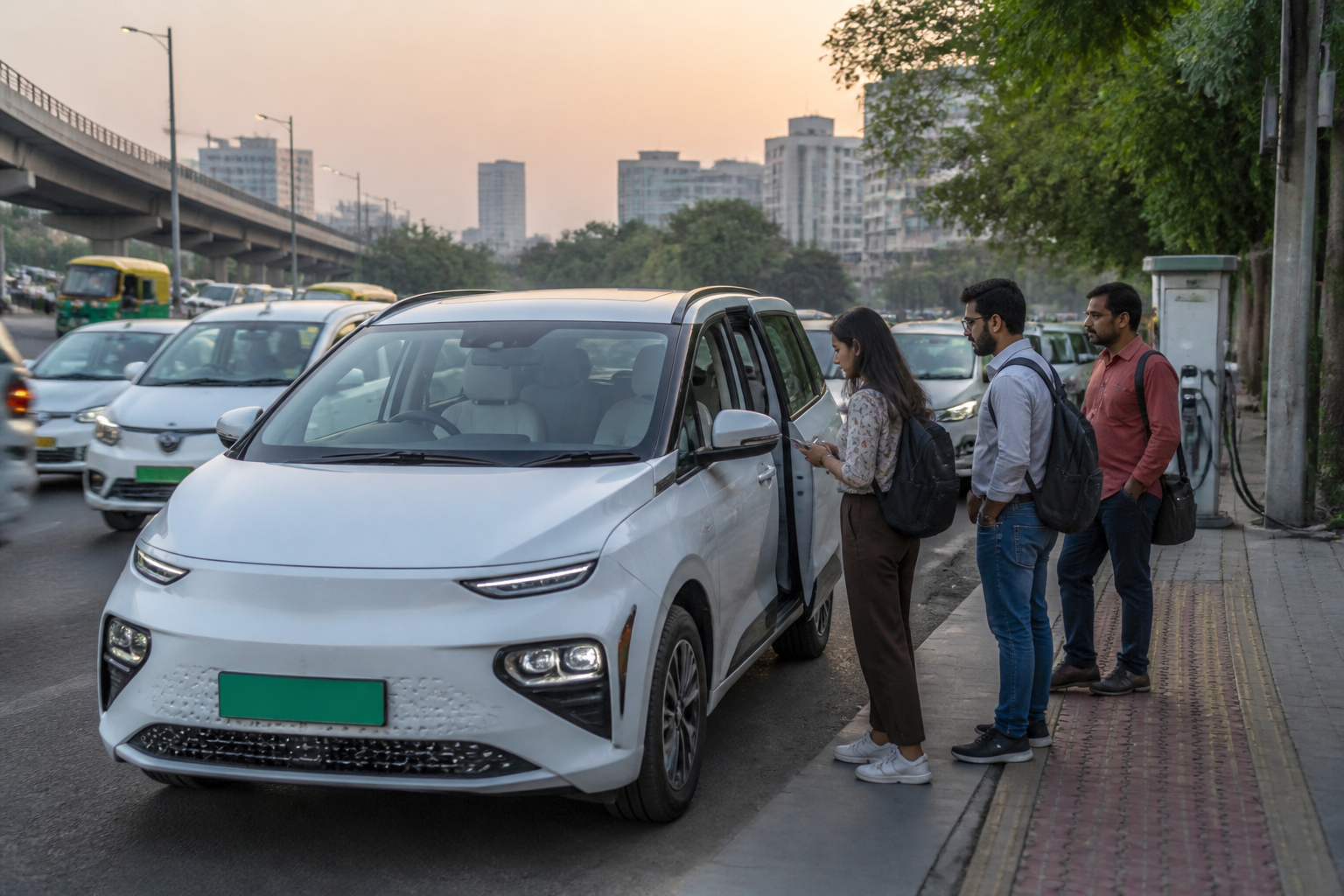
Green SM India’s entry into Delhi-NCR is not simply another cab launch. It is a test of whether a company-controlled electric fleet can deliver a more dependable urban taxi service without carrying the financial and operational pressures that contributed to the collapse of an earlier electric mobility rival, Blu Smart.
The Vietnamese electric mobility company launched Green SM Limo in Delhi-NCR on June 5 with about 1,000 electric vehicles and plans to eventually scale to 10,000 vehicles in the region, according to the supplied report. Its first Indian vehicle is the VinFast Limo Green, a seven-seat electric MPV designed for commercial passenger transport. The company is targeting a premium segment rather than immediately competing with the mass-market model associated with Uber and Ola.
That positioning matters because India’s app-based cab market has been shaped by a different operating logic. Ola and Uber expanded by connecting passengers with independent vehicle owners and drivers, rather than owning and managing every car on their platforms. Their advantage came from building a marketplace with enough drivers, customers, technology and capital to create density across major cities. Green SM is entering with a model that places more responsibility on the operator itself: acquiring vehicles, managing drivers, maintaining cars, arranging charging and ensuring that the fleet is used efficiently.
The company’s strategy therefore combines two apparently different eras of urban taxi services. It resembles the radio-taxi businesses that preceded app aggregators because it emphasises a controlled fleet, professional drivers and greater control over the passenger experience. At the same time, it uses app-based electric mobility and is entering a market in which customers already expect digital booking, predictable fares and rapid availability.
The history of India’s cab market shows why the operating model is as important as the vehicle. Meru initially built its business around air-conditioned, metered cabs, trained drivers and bookings handled through a call centre. Mega Cabs operated within the same broad model. After Ola arrived in 2011 and Uber followed in 2013, the centre of gravity moved towards digital aggregation. Meru shifted from owning cars towards aggregation by 2012, while Mega Cabs lost market share after the newer platforms entered major cities.
The change was not only technological. It altered who carried the cost and risk of urban transport services. Under the aggregator model, platforms could expand without owning the entire supply of vehicles. Under a fleet-owned model, the company has greater control over quality but must absorb more of the cost of vehicles, drivers, charging, maintenance and unused capacity.
Green SM’s decision to enter with a controlled electric fleet is particularly significant because electric taxis need operational systems that are more demanding than simply adding another vehicle to an existing marketplace. The company must maintain vehicle availability, ensure access to charging, manage charging time and keep cars on the road for enough hours to justify their purchase and operating costs. A vehicle that is clean and comfortable but spends too much time charging or waiting for passengers can weaken the economics of the service.
The supplied report identifies Blu Smart as the most important recent precedent. Blu Smart operated a dedicated electric taxi fleet in Delhi and had built more than 8,000 electric taxis before suspending operations in April 2025. Reuters reported that it had become a notable rival to Ola and Uber, with about 9% of the Delhi market. Its shutdown followed regulatory action involving Gensol Engineering and co-founder Anmol Singh Jaggi, after which Blu Smart appointed Grant Thornton for a forensic audit.
Blu Smart’s experience demonstrated both the appeal and the vulnerability of the fleet-owned electric taxi model. Customers had become accustomed to clean cars, predictable fares, professional drivers and fewer cancellations. Those are precisely the service characteristics that a company-controlled fleet can support more easily than a marketplace dependent on independent vehicle owners. But the same control also creates a large fixed-cost burden. The company must keep the fleet productive even when demand varies, while continuing to pay for vehicles, people, energy and maintenance.
Green SM is attempting to address that challenge through its relationship with the VinFast ecosystem. Green SM was established in 2023 by Pham Nhat Vuong, founder and chairman of Vietnam’s Vingroup and the driving force behind VinFast, an electric-vehicle manufacturer. Although Green SM and VinFast are separate companies, the report says Green SM’s Indian vehicles are procured through VinFast-authorised dealers and that the companies coordinate on maintenance, after-sales support and technical matters.
The company is also working with VinFast, V-Green, a Vingroup-linked charging infrastructure company, and local partners on charging infrastructure. This creates a more integrated structure than the one available to a standalone taxi operator. Vehicle supply, servicing, technical support and charging can be planned within a connected corporate ecosystem rather than assembled entirely through unrelated vendors.
For VinFast, the taxi operation also provides an immediate institutional customer and a visible fleet of vehicles on Indian roads. A commercial fleet can place a new model in front of thousands of potential private customers, while also generating operating experience in local traffic, weather and road conditions. Green SM has rejected the suggestion that it is primarily a sales channel for VinFast, but the relationship remains central to understanding the company’s market entry.
The strategy also reveals a larger issue in India’s urban mobility transition. The shift to electric vehicles is often discussed as a question of consumer adoption, but urban taxi fleets may be equally important. High-use commercial vehicles can put more kilometres on the road than private cars and can expose passengers to electric mobility repeatedly. However, the transition depends on more than vehicle availability. It requires charging capacity, reliable maintenance, trained drivers, commercially viable utilisation and enough demand to sustain the fleet.
Delhi-NCR offers a substantial test market because the region already has a large app-based cab ecosystem and a customer base familiar with digital booking. The challenge for Green SM is not to introduce the idea of booking a taxi through an app. It is to persuade passengers to choose a premium electric service while ensuring that the cars remain available across the region. A premium proposition may allow better service quality and higher fares, but it also narrows the pool of customers compared with a mass-market platform.
The scale announced by Green SM makes this question more consequential. Starting with about 1,000 vehicles and planning for as many as 10,000 means that the company’s performance will depend on how quickly it can build demand, charging access and operational density together. Expanding the number of vehicles without sufficient bookings could increase idle capacity. Expanding demand without enough cars or charging support could undermine the reliability that defines the service.
The report places this decision within a ride-hailing market estimated by Grand View Research to have generated $2.5 billion in revenue in India in 2025, with e-hailing accounting for the largest segment. That figure indicates the scale of the opportunity, but it does not by itself resolve the central question: whether an electric fleet operator can compete sustainably against platforms that do not carry the same ownership burden.
That is why Green SM India should be watched not only as a new cab brand but as an urban operating experiment. It is testing whether vertical integration can produce a better passenger experience and whether the benefits of controlling vehicles outweigh the costs of owning and managing them. It is also testing whether an automaker-linked mobility company can coordinate the infrastructure required for electric taxis more effectively than an independent operator.
The evidence supplied so far confirms the company’s launch, its initial fleet, its expansion ambition, its premium positioning and its links with VinFast and V-Green. It also establishes the precedent set by Blu Smart and the risks associated with fleet ownership. What remains unestablished is whether Green SM can achieve sufficient utilisation, pricing power and operational reliability at scale. Those measures, rather than the launch fleet alone, will determine whether Delhi-NCR gets a durable new mobility option or another short-lived experiment in electric cab operations.
