


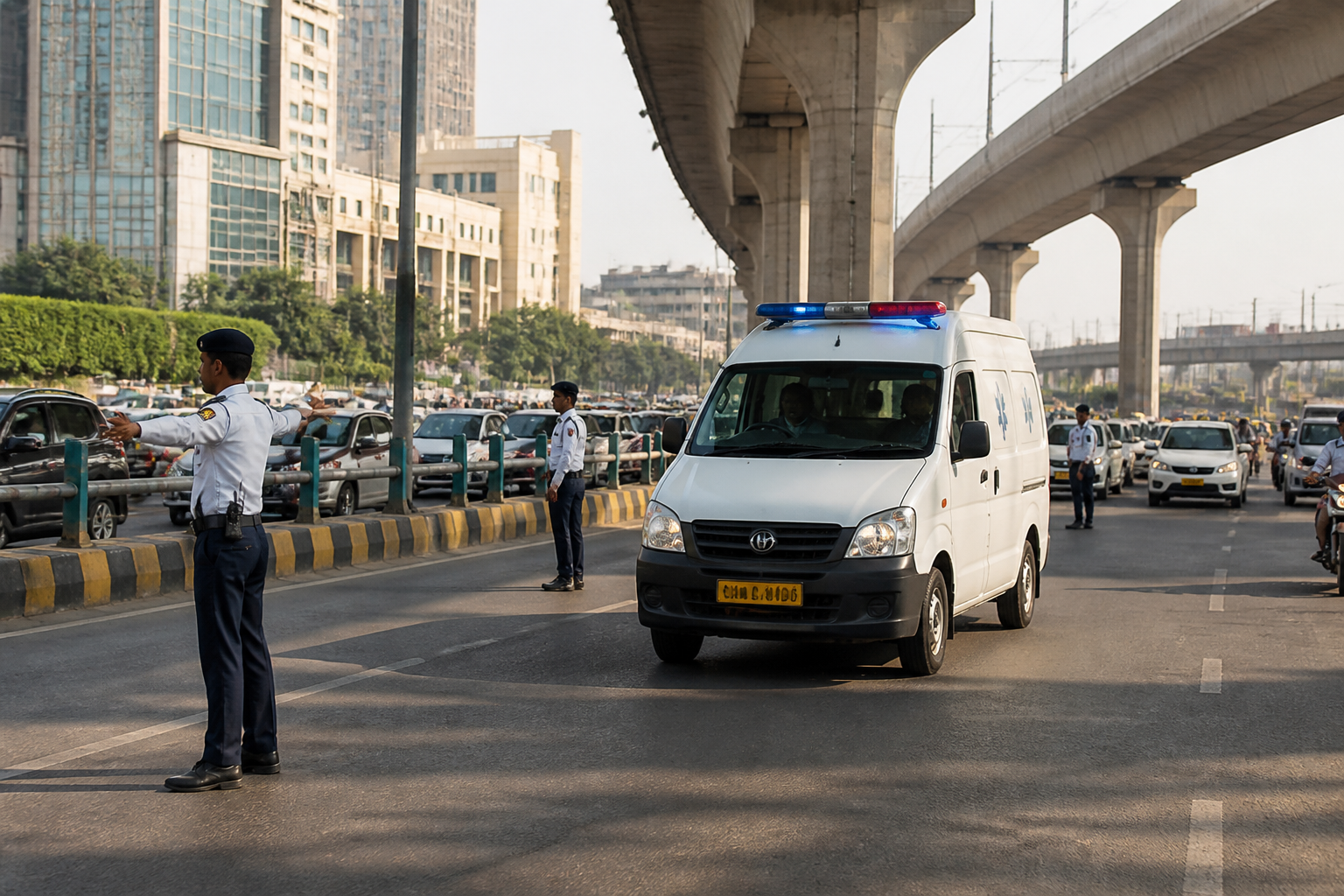
A donor heart travelled nearly 20 kilometres from Hindon Airport in Ghaziabad to Fortis Hospital in Noida Sector 62 in 16 minutes after traffic police created a green corridor on September 9. The journey was an emergency success, but its larger significance lies in what it reveals about the National Capital Region’s ability to temporarily turn a fragmented road network into a coordinated medical logistics system.
The heart was donated by a woman in Chandigarh and flown to Hindon Airport by air ambulance. From there, an ambulance carried it by road to the Noida hospital, where it was successfully transplanted into a 62-year-old patient, officials said. Noida DCP (Traffic) Abhay Kumar Mishra said a corridor spanning approximately 20 kilometres was established between Ghaziabad and Sector 62. The ambulance left Hindon Airport at 2 pm and reached the hospital in 16 minutes.
A green corridor is not a separate road or a permanent infrastructure project. It is a temporary traffic-management arrangement in which police regulate movement along a designated route so that an ambulance carrying an organ or a critically ill patient faces as few interruptions as possible. Its effectiveness depends on a chain of decisions made across jurisdictions: identifying the route, positioning personnel, managing junctions, communicating with the ambulance team and ensuring that the receiving hospital is ready.
That makes the corridor an urban governance mechanism as much as a traffic intervention. The road remains the same, but the way it is administered changes for a limited period. Signals, intersections and police units that ordinarily operate within separate local systems are brought together around a single medical deadline.
Green corridors and the NCR’s fragmented road network
The National Capital Region is a continuous urban area administered by multiple authorities and police jurisdictions. An ambulance travelling from Ghaziabad to Noida does not move through one uniformly managed city. It crosses an urban landscape in which traffic regulation, road conditions and operational communication may involve different agencies.
The September 9 journey required coordination between Ghaziabad and Noida. The source report does not identify every agency involved in the route or provide a detailed account of the command structure, but the episode demonstrates the practical problem that inter-city emergencies create: the medical transfer cannot wait for administrative boundaries to disappear, so institutions must coordinate across them in real time.
The road distance itself is only one part of the challenge. Under ordinary conditions, an ambulance’s travel time can be affected by signals, congestion, turning movements, roadside activity and the unpredictability of arterial traffic. A corridor attempts to reduce those interruptions for a specific journey. It does not remove the underlying congestion; it temporarily gives priority to a vehicle whose cargo has a limited period of viability.
This distinction matters. A 16-minute journey should not be read as evidence that the entire route normally performs at that speed. It is evidence of what coordinated traffic control can achieve when a route is selected and protected for an exceptional medical purpose.
From exceptional response to recurring capability
The September incident was not presented as an isolated event. The report lists several other green corridors created in the NCR in recent years, involving organs, premature infants and critically ill patients.
In August 2025, Noida traffic police created a six-kilometre corridor from the DND Flyway to Child PGI in Sector 30 for the transfer of premature twins. Officials said the ambulance completed the journey in about four minutes. The twins, a boy and a girl, had been born at 26 weeks at a private hospital in Delhi’s Najafgarh and weighed around 700 grams each. According to Child PGI officials, they were in intensive care and experiencing severe respiratory and digestive complications.
On June 2, 2025, authorities in Noida, Ghaziabad and Delhi coordinated a 17-kilometre corridor from Yashoda Hospital to Fortis Escorts Hospital. A live donor heart was transported in 19 minutes. On January 8, 2025, Noida and Faridabad police coordinated a 46.4-kilometre route between Amrita Hospital in Faridabad and Yatharth Hospital in Greater Noida for the transportation of a kidney. The distance was covered in 24 minutes and 40 seconds.
Earlier, on October 1, 2021, traffic police created a 14-kilometre corridor between the Delhi-Noida Chilla border and Jaypee Hospital in Sector 128 for an ambulance carrying a harvested organ. The journey took 14 minutes, according to the report. A separate corridor was also deployed that day between Sector 14-A and Jaypee Hospital for another organ-transplant-related emergency.
Taken together, these examples suggest that green corridors have become a recurring operational capability in the region. They still depend on exceptional circumstances and rapid mobilisation, but repeated use creates institutional familiarity. Police teams, hospitals and ambulance operators are no longer confronting an entirely new type of emergency each time a corridor is requested.
The available evidence does not establish how many such corridors are created annually, how often requests are denied or delayed, or whether every corridor meets its intended travel time. It does, however, show a pattern of repeated coordination across Delhi, Noida, Ghaziabad and Faridabad, with routes adapted to the location of the sending facility, the receiving hospital and the condition of the patient or organ.
The medical clock is also a transport problem
Organ transplantation makes the relationship between mobility and healthcare especially clear. A donated organ has a limited period of viability outside the donor’s body. The time spent moving it between airports, ambulances and hospitals therefore becomes part of the medical process, not merely a logistical detail.
The September 9 transfer involved two transport modes. The heart first travelled by air ambulance from Chandigarh to Hindon Airport and then continued by road to Sector 62. The road leg was only one link in the chain, but a delay at that stage could have affected the value of the arrangements made earlier.
This is why green corridors are different from ordinary emergency driving. The objective is not simply to help one ambulance move faster. It is to align the movement of an organ or patient with the readiness of medical teams, the route selected by traffic authorities and the deadlines imposed by medical viability. The corridor is successful only when these parts remain synchronised.
The same principle applies outside transplantation. The transfer of the premature twins from the DND Flyway to Child PGI involved a short six-kilometre route, but the case was time-critical because the children were extremely premature and in intensive care. The distance was modest compared with the 46.4-kilometre kidney transfer between Faridabad and Greater Noida, yet both required traffic control to reduce avoidable delay.
These cases show that distance alone is a poor measure of emergency mobility. A longer route may be completed quickly if it is clearly planned and regulated, while a shorter route can become difficult if intersections, congestion or institutional communication are not managed. The relevant measure is not just kilometres travelled, but the reliability of the entire transfer.
The institutional work behind a fast journey
The visible part of a green corridor is the ambulance moving through relatively clear roads. The less visible work involves advance coordination. The source report identifies route planning, real-time communication and prompt access to specialised medical care as conditions that affect effectiveness.
Traffic police must regulate junctions and minimise interruptions. Ambulance teams must follow the planned route and maintain communication. Hospitals must be prepared to receive the organ or patient when the vehicle arrives. Where a journey crosses city boundaries, agencies must also ensure that responsibility is transferred without creating a gap in control.
This makes green corridors a useful test of administrative interoperability. A city can have roads, traffic signals, hospitals and emergency vehicles without having a dependable emergency logistics system. The system emerges only when these assets work together under pressure.
The NCR examples also underline the importance of hospital geography. The corridors connect airports, private hospitals, public or specialised medical institutions and facilities located in different cities. Medical capacity is distributed across the region, while the road network is shared by everyday commuters, freight, public transport and emergency services. Time-critical care therefore depends partly on how well the region connects its institutions, not only on the quality of any single hospital.
The supplied report does not provide a formal standard operating procedure, funding arrangement or performance audit for these corridors. It also does not state whether the region has a single coordinating authority for such transfers. Those gaps limit what can be concluded about the system’s scale or consistency. The documented cases nevertheless point to a recurring need for cross-jurisdictional procedures rather than one-off improvisation.
What the numbers reveal—and what they do not
The reported journeys range from four minutes for the six-kilometre transfer of the premature twins to 24 minutes and 40 seconds for the 46.4-kilometre kidney transfer between Faridabad and Greater Noida. Other examples include the 16-minute, approximately 20-kilometre heart journey from Hindon Airport to Sector 62; the 19-minute, 17-kilometre live donor heart transfer; and the 14-minute, 14-kilometre corridor from the Chilla border to Jaypee Hospital.
These figures illustrate the scale of time reduction that authorities sought in each case, but they are not directly comparable performance indicators. The routes differ in length, location, traffic conditions, time of day and medical purpose. The report does not provide the normal travel time for any of the journeys, so it is not possible to calculate the exact delay avoided.
The figures also do not establish how many emergency transfers occur without green corridors or how many requests require coordination across more than two jurisdictions. Nor do they show whether the arrangements produce similar results at different times of day or during severe congestion. A corridor’s success may depend on factors that vary from one incident to another.
What the numbers do establish is that the NCR has repeatedly used temporary traffic regulation to support time-critical medical movement. The distances show that such coordination is relevant both to short intra-city transfers and to longer journeys between cities. The minutes show the operational aim: to make the road leg predictable enough for medical teams to plan around it.
The bigger urban question
The central lesson is not that emergency vehicles can always cross the NCR in a few minutes. It is that urban mobility is partly a question of institutional coordination. Roads are physical infrastructure, but their emergency value depends on the rules, personnel and communication systems that govern their use.
For residents, the green corridor is an exceptional intervention. It cannot replace accessible hospitals, reliable ambulance services or better everyday traffic management. It does show, however, that agencies can create a protected movement system when the need is clearly identified and responsibility is coordinated.
The repeated cases listed in the report raise a further administrative question: whether the NCR’s experience can be converted into a more standardised regional protocol for organ and critical-care transfers. The supplied evidence does not answer that question. It does show why the issue matters. Medical logistics increasingly operate across city boundaries, while governance remains divided among local administrations and police units.
The September 9 heart transfer therefore stands as both a successful emergency response and a window into a larger urban system. Its 16-minute road journey was made possible not by a new road, but by the temporary alignment of existing infrastructure, traffic control and hospital readiness. The next measure of that system will be how consistently such coordination can be organised when another time-critical transfer moves through the NCR.

