


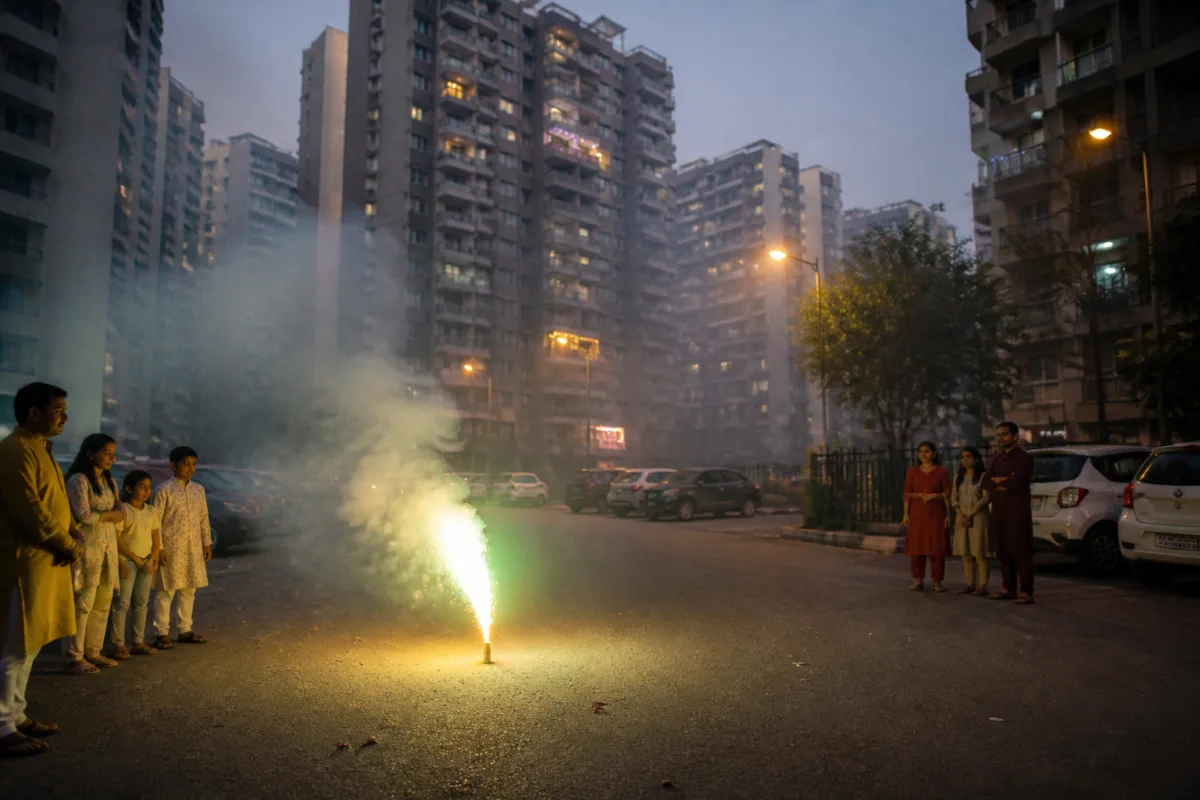
The Supreme Court’s limited permission for green crackers in Delhi-NCR on 7 and 8 November has reopened a recurring urban question: can a regulated version of firecrackers reduce the pollution and health risks associated with Diwali without eliminating them? The evidence cited in the source report points to a narrow answer. Green crackers are designed to emit less particulate matter and fewer gases than conventional crackers, but they still release pollutants, including extremely small particles that can penetrate deep into the respiratory system.
The permission is limited by both date and time. Green crackers may be used in Delhi-NCR from 6 am to 7 am and from 8 pm to 10 pm on the two specified days. This makes the issue more than a question of product design. It is also a question of enforcement, identification, public behaviour and the ability of urban institutions to manage pollution during a period when multiple sources of emissions can overlap.
The distinction between green and conventional crackers is therefore important, but it does not support the idea that one category is harmless. The source report describes green crackers as products intended to reduce particulate matter emissions by at least 30 per cent and gaseous emissions by at least 10 per cent. Their noise is also designed to remain below 125 decibels at a distance of four metres. These are reduction targets, not a promise of zero emissions or zero health risk.
That difference is central to understanding the policy. In a city that already faces severe air-quality stress, a product that emits less pollution may be preferable to a conventional alternative. But a reduction in emissions from each cracker does not automatically translate into clean air across the city. The outcome also depends on how many crackers are used, whether they are genuine green crackers, whether the permitted time windows are followed and what other pollution sources are active at the same time.
The reported chemical composition shows how green crackers are intended to work. Conventional crackers are described as containing about 34 per cent aluminium, 57 per cent potassium nitrate and 9 per cent sulphur. The green-cracker composition cited in the report is about 29 per cent aluminium, 28 per cent potassium nitrate, 38 per cent of a special CSIR-NEERI material and 5 per cent sulphur. The special material includes iron oxide, or Fe₂O₃.
The change is also reflected in the chemicals that green crackers are not supposed to use. The report identifies barium nitrate, lithium, mercury, arsenic and cadmium among substances excluded from their manufacture. These substances can pose environmental and health concerns, making chemical substitution a significant part of the green-cracker framework. But the absence of some hazardous chemicals does not mean that combustion produces no harmful material.
This is where the health question becomes more complicated. The report cites a Delhi Technological University study that found green crackers can generate substantial quantities of ultrafine particles when burned. PM2.5 particles are 2.5 micrometres or smaller and can travel deep into the lungs when inhaled. Ultrafine particles are even smaller. Their size allows them to penetrate deeply into the body, which means that lower overall particulate emissions do not remove the possibility of exposure-related harm.
The distinction matters because air-pollution policy often relies on measurable reductions. A 30 per cent reduction in particulate emissions, for example, can be meaningful when compared with a conventional product. But the measure does not describe the total exposure experienced by residents. It does not, by itself, show the number of crackers used, the concentration of pollutants in a particular neighbourhood, the duration of exposure or the health status of people breathing the air.
For Delhi-NCR, that exposure takes place within a dense urban system. Residents live close to one another, and emissions released in one locality can affect people beyond the immediate site of use. The source report does not establish how pollution from the permitted period will be distributed across the region, but the city’s compact form makes enforcement and monitoring more difficult than a simple product comparison might suggest. A rule that works on paper still depends on what happens at street level.
Product identification is one of the most important parts of that street-level system. Genuine green crackers are reported to carry green logos from the Council of Scientific and Industrial Research’s National Environmental Engineering Research Institute, or CSIR-NEERI, and the Petroleum and Explosives Safety Organisation, or PESO. They are also supposed to carry a QR code that allows product information to be checked.
This means that the word “green” on packaging is not sufficient proof of compliance. Consumers, enforcement agencies and sellers need a way to distinguish approved products from conventional crackers marketed with environmental claims. The logo and QR-code system is intended to provide that link between technical standards and retail verification. Its usefulness, however, depends on whether buyers can access and understand the information, whether sellers stock compliant products and whether enforcement teams check products in practice.
The regulatory structure is consequently spread across several layers. The Supreme Court sets the legal boundary described in the report by permitting use only on specified dates and during specified hours. CSIR-NEERI is associated with the technical design and identification of green crackers, while PESO is linked to safety and product approval. Local administration and enforcement agencies must translate the framework into action across markets, neighbourhoods and public spaces.
This division of responsibility creates a familiar governance challenge. A court order can establish permitted hours, and technical institutions can define product characteristics, but compliance depends on implementation at thousands of points across an urban region. The system has to address sales, transport, storage, use and disposal. The supplied report does not provide enforcement figures for the current permission, so it is not possible to assess how effectively the rules will be implemented on the specified dates.
Previous pollution readings cited in the report show why the issue remains contested. After the Supreme Court imposed a ban on firecracker sales in Delhi in 2017, the city’s air quality index around Diwali was still reported to be between 302 and 403. The figures do not establish that firecrackers alone caused those readings, but they demonstrate that restrictions did not produce clean-air conditions during the festival period.
The report also cites readings from 2025, when green crackers were permitted only during designated hours. The AQI was recorded at 296 on 19 October, 345 on 20 October and 351 on 21 October. The same account says that the permitted-time rules were widely violated. These figures are presented as evidence that limited permission and green-cracker standards cannot be treated as a complete solution to Delhi’s pollution problem.
The data also highlights the difference between a policy’s formal design and its real-world effect. On paper, the framework combines lower-emission products with restricted hours. In practice, the outcome depends on compliance with both conditions. If conventional crackers are used, or if crackers are burned outside the permitted window, the policy loses part of its intended value. If genuine green crackers are used within the permitted period, emissions may still occur and ultrafine-particle exposure may remain.
That does not make the green-cracker framework meaningless. The reported reductions in particulate and gaseous emissions, the exclusion of certain chemicals and the use of product verification mechanisms represent an attempt to regulate an activity rather than treat all firecrackers as identical. The framework recognises that product composition can change the level and type of emissions. But it also confirms that “green” is a comparative label, not an absolute environmental guarantee.
The larger urban question is whether Delhi-NCR can manage seasonal pollution through narrow permissions when compliance is difficult to observe and health risks are not captured by a single emission-reduction percentage. The evidence supplied here confirms three points: green crackers are designed to emit less than conventional crackers; they are not pollution-free; and their use can still produce ultrafine particles that carry health concerns.
What remains uncertain is equally important. The supplied material does not establish the scale of current enforcement, the quantity of genuine green crackers in circulation, the total volume of crackers used during the permitted period or the precise contribution of green crackers to city-wide AQI readings. Those questions will determine whether the policy functions as a meaningful emissions-control measure or remains primarily a product-label and time-window system. The next important developments are the implementation of the permitted hours on 7 and 8 November and the enforcement record that follows.

